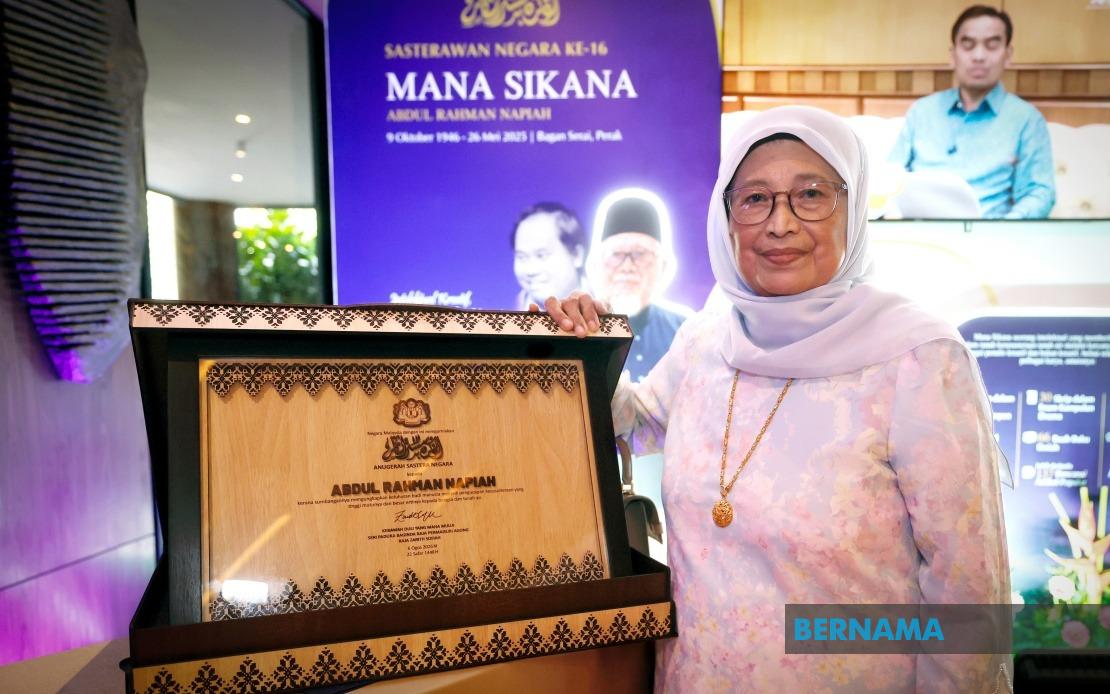
The conferment of Malaysia's 16th National Laureate upon Dr Abdul Rahman Napiah, the acclaimed author and academic better known by his pen name Mana Sikana, represents a significant moment of recognition for one of the nation's most prolific literary figures. The honour, presented by Her Majesty Raja Zarith Sofia, Queen of Malaysia, was received on his behalf by his widow, Salmah Ali, at a ceremony in Kuala Lumpur today. For a writer whose influence spanned generations and extended across the region, the award arrives as an affirmation of contributions that shaped Malaysia's literary landscape across multiple decades.
Salmah Ali, now 82, described the moment with mixed emotions—pride in seeing her husband's legacy acknowledged, tempered by profound sadness at his absence. She revealed that Mana Sikana had been informed of the possibility of receiving this distinction before his death last May, at the age of 80, from heart complications. The recognition he had long hoped for thus becomes a tribute to a man who spent his final active moments in service to literature itself, presenting a working paper at Dewan Bahasa dan Pustaka before his fatal illness struck. For his widow, accepting the award underscored the recognition he had consistently deserved throughout his career.
Mana Sikana's literary journey began early and never ceased. From his school years onwards, he accumulated prestigious awards and accolades, each marking his progression as a writer of significance. Yet his influence extended far beyond the publication of novels and stories. As Salmah explained, his creative energy manifested across multiple platforms—he produced television and radio dramas for both Malaysian and Singaporean broadcasters while simultaneously maintaining rigorous academic standards as a university lecturer. This dual commitment to popular creative expression and scholarly rigour distinguished his career from many of his contemporaries.
Born in Bagan Serai, Perak, on October 9, 1946, Mana Sikana initially trained as a teacher before transitioning into higher education, where he ultimately attained the rank of professor. His academic credentials spanned several institutions of considerable standing, including Universiti Kebangsaan Malaysia, Universiti Pendidikan Sultan Idris, and even Nanyang Technological University in Singapore, where he served as a visiting lecturer. This regional presence reflected the calibre of his scholarship and the reach of his intellectual influence within Southeast Asian academic circles.
Education Minister Fadhlina Sidek delivered remarks emphasising that Mana Sikana's selection acknowledged his instrumental role in strengthening national literature through multiple intellectual disciplines. His contributions encompassed not merely creative writing itself, but also literary theory, critical analysis, and academic discourse—the intellectual foundations upon which literary traditions are constructed and sustained. In this sense, his recognition speaks to the importance Malaysia places on nurturing not simply artists, but thinkers who can articulate the deeper significance of cultural production.
The scope of Mana Sikana's domestic influence within his family further illustrated his commitment to literary values. Salmah noted that throughout his life, he shared his profound knowledge of writing and literature with their four children and twelve grandchildren, ensuring that his intellectual legacy extended beyond published works into the family sphere. This intergenerational transmission of literary consciousness represents a form of cultural continuity that formal awards ultimately attempt to honour and encourage.
For Malaysian readers and observers of Southeast Asian cultural development, the late recognition of Mana Sikana carries broader significance. The National Laureate designation represents the apex of literary recognition within Malaysia's institutional framework, yet the award arriving posthumously raises questions about the timeliness of such acknowledgements. His career spanned the critical decades when Malaysian literature in the Malay language was establishing itself as a serious intellectual enterprise—the 1970s through to the early 2000s represented formative periods for the nation's literary culture, and Mana Sikana's work during these years helped define what Malaysian literature could achieve.
The award ceremony itself, attended by the nation's Queen and the Minister responsible for educational and cultural development, underscores the state's investment in literary heritage. The presence of such dignified witnesses transforms a singular honour into a public affirmation of values—that the written word, literary criticism, and sustained intellectual engagement merit recognition at the highest institutional levels. For aspiring writers and academics in Malaysia and the broader region, such ceremonies articulate cultural priorities.
Salmah's emotional acceptance of the award on her husband's behalf captured the bittersweetness inherent in posthumous recognition. She expressed gratitude that his contributions had finally received formal acknowledgement, yet the physical absence of the man himself inevitably diminished the occasion for her personally. The award thus becomes both a vindication of his life's work and a poignant reminder of loss—a complexity that characterises how societies remember and honour their creative figures.
As Malaysia continues to develop its literary institutions and cultural frameworks, the recognition of figures like Mana Sikana serves multiple functions. It documents for future generations the names and achievements of those who shaped the nation's intellectual life. It validates the choices made by those writers who pursued rigorous, demanding literary work over decades without immediate commercial reward. And it affirms, through state ceremony and institutional recognition, that literature and literary scholarship constitute essential rather than peripheral dimensions of national cultural life and identity.

