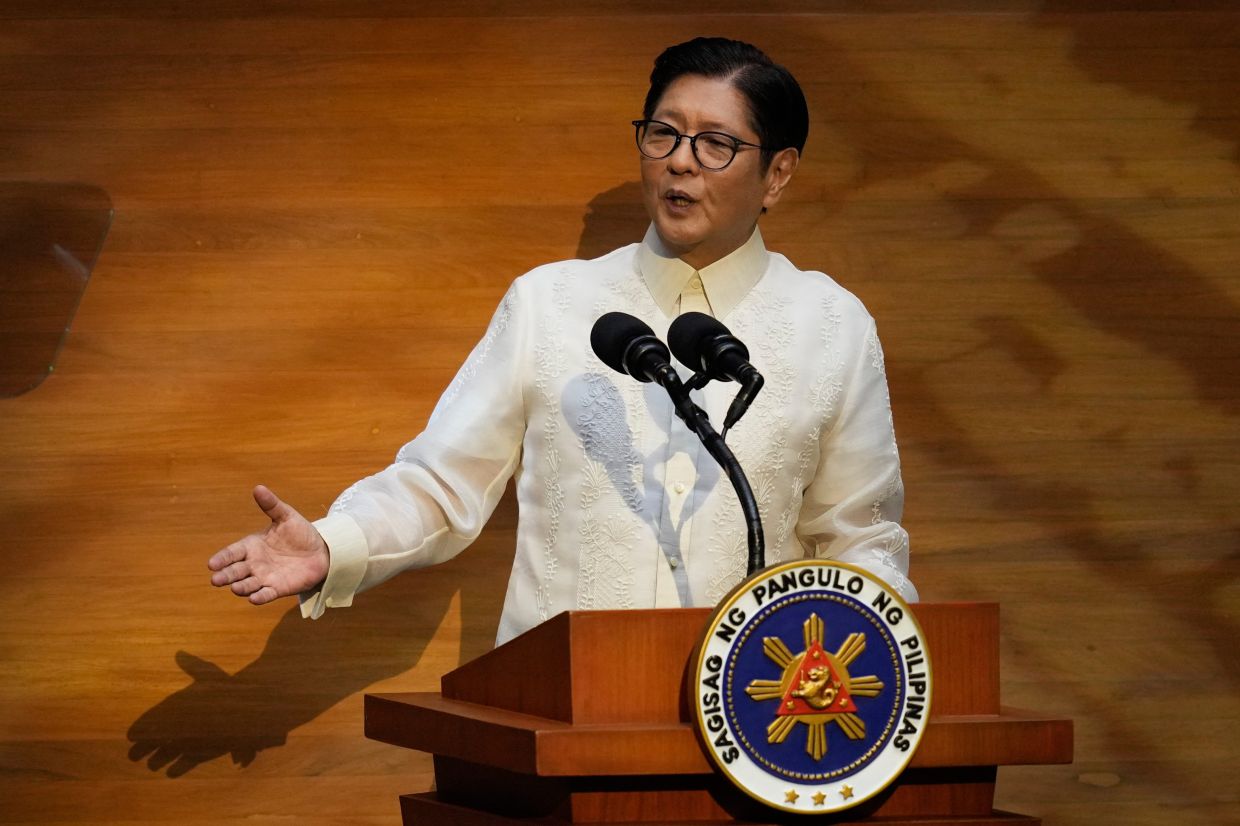
Philippine President Ferdinand Marcos Jr. delivered a thinly veiled but forceful rebuke of China during his state of the nation speech on Monday, pledging that his administration would steadfastly defend the 2016 arbitration ruling that struck down Beijing's sweeping maritime claims in the disputed South China Sea. Without naming China directly, Marcos asserted that Filipinos "do not yield" to outside pressure and insisted that his government would employ "every peaceful and legal means available" to uphold the landmark decision. The remarks drew loud applause from many lawmakers and signalled Manila's determination to maintain its diplomatic and legal stance despite mounting pressure from its larger neighbour.
Marcos refrained from explicitly identifying China in his speech, instead offering a broader defence of Filipino dignity and national character. "Of late, our very humanity has been called into question," he said, before insisting that "Filipinos are a noble … and a great race. We are not greedy. We are not racists. We are not liars." This carefully worded statement appeared directed at Beijing following a recent international controversy in which China Daily, a state-owned Chinese media outlet, published AI-generated images depicting Filipinos as monkeys. The animated content was distributed in response to Manila's stance on the arbitration award, prompting the Philippine government to condemn the material as "racist and dehumanizing" and demand its removal.
The timing of Marcos's remarks followed his decision to summon Chinese Ambassador Jing Quan to his Manila office the previous week over the offensive imagery. The incident has added another layer of tension to already fraught bilateral relations, extending disputes beyond territorial disagreements into questions of national honour and racial dignity. Beijing's response through Foreign Ministry spokesperson Lin Jian proved characteristically dismissive, with the official stating that the video "does not represent the official position" while offering no apology. Instead, Lin Jian reiterated China's longstanding rejection of the arbitration process itself, describing the 2016 ruling as "a political farce disguised as a legal proceeding" and declaring the decision "illegal, null and void and has no binding force."
Marcos's reaffirmation of the arbitration award carries significant weight for Southeast Asia's maritime stability. The Philippines initiated the arbitration process in 2013 following a tense naval standoff between Chinese and Philippine vessels near Scarborough Shoal, a strategically important feature in contested waters. Despite China's refusal to participate in the proceedings and its subsequent rejection of the outcome, the tribunal's decision was grounded in the 1982 United Nations Convention on the Law of the Sea, lending it international legal authority. The president characterised the ruling as a "definitive benchmark for the interpretation and application" of the convention, underscoring Manila's view that the award provides a stable framework for resolving maritime disputes in the region.
The South China Sea remains one of the world's most volatile geopolitical flashpoints, with territorial confrontations involving Chinese, Philippine, and Vietnamese forces becoming increasingly frequent in recent years. The waterway's strategic importance as a global trade route and its potential resource wealth have made it a focal point for competing regional interests. Beyond the three major claimants, Malaysia, Brunei, and Taiwan also have stakes in various disputed features. For Southeast Asian nations, Philippine President Marcos's firm stance on the arbitration award signals a willingness to resist what many in the region view as coercive pressure from a much larger neighbour, potentially emboldening other countries to defend their own maritime interests more assertively.
Domestically, Marcos used his address to confront a festering corruption scandal that has threatened to undermine his administration's credibility. Although he avoided naming his cousin and former political ally Martin Romualdez, the president announced that a special anti-graft prosecutor would soon file charges against the former House of Representatives Speaker over his alleged involvement in a sprawling corruption scheme. Marcos acknowledged the personal difficulty of taking action against a close family member, stating plainly: "This is painful to me, but we have to do the right thing. I'm not a president for my family. I'm not a president for my friend." The statement underscored the political cost of pursuing accountability while maintaining family relationships.
Romualdez, who stepped down as House Speaker last year but continues to serve as a congressman, has been implicated in a corruption scandal centring on kickbacks from flood control projects. Investigations by government and congressional bodies have linked him and several other legislative members to the scheme, though charges had not previously been filed against him despite action against other suspects. An incumbent senator, a former senator, a former public works secretary from the previous administration, and various government engineers and construction company executives have already been charged and detained. The decision to prosecute Romualdez signals that the president's anti-corruption campaign will not grant immunity to those connected to his own family and political network.
The financial scale of the corruption detected through government investigations has been substantial. Authorities have recovered or frozen nearly 25 billion pesos—approximately 410 million US dollars—in cash and properties belonging to suspects involved in the schemes. Some of these recovered assets have already been returned to the national treasury, effectively compensating the state for misappropriated public funds. The magnitude of these figures underscores the systematic nature of the corruption and the government's determination to recoup public resources. By highlighting these recoveries in his state of the nation address, Marcos sought to demonstrate that his administration is taking concrete action to restore public trust and combat the entrenched networks of graft that have historically plagued Philippine governance.
For Malaysian observers, these developments hold particular relevance. Southeast Asia's shared interest in maritime stability depends partly on whether individual nations can maintain credible, principled positions on international law and governance. The Philippines' commitment to the arbitration award, coupled with a domestic anti-corruption push, suggests an administration attempting to establish legitimacy and consistency in its policies. Malaysia's own maritime claims in the South China Sea, along with its economic interests in regional stability, make the trajectory of Filipino-Chinese relations a matter of strategic concern. If Philippine resistance to Beijing's maritime assertiveness weakens—whether through external pressure or internal instability—the implications for the broader region could be significant.
The convergence of foreign policy assertiveness and domestic accountability in Marcos's address reflects a recognition that national credibility depends on both dimensions. An administration that defends national sovereignty abroad while tolerating corruption at home sends contradictory signals about its commitment to the rule of law. Conversely, one that pursues domestic accountability while maintaining firm international principles demonstrates a more coherent approach to governance. Whether Marcos can sustain this balance while managing the political costs of prosecuting family members remains an open question, but his state of the nation speech indicated an attempt to do precisely that.

