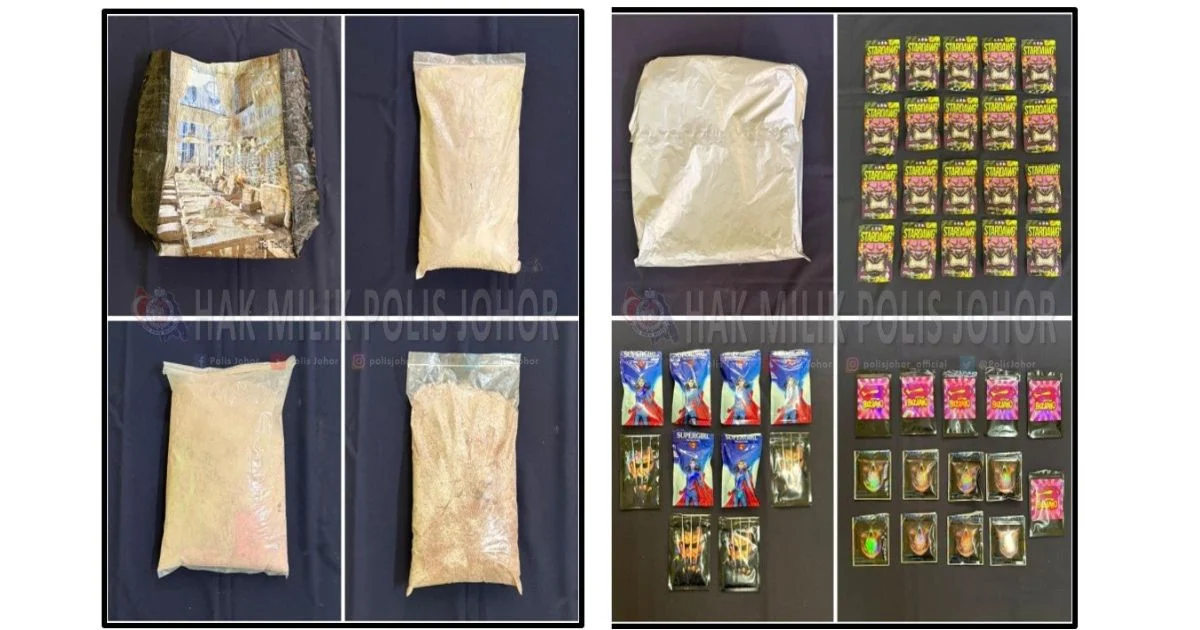
A major narcotics operation in Johor has been disrupted following the arrest of a husband-and-wife team and the confiscation of an estimated RM3.59 million worth of illegal drugs in Kulai. The coordinated police action represents a significant enforcement success in the ongoing battle against organised drug trafficking in the southern state, with authorities moving swiftly to dismantle the network after gathering sufficient intelligence.
The operation marks another chapter in Johor's intensifying crackdown on drug syndicates, which have increasingly been using the state as a transit point for smuggling operations into Peninsular Malaysia. Kulai, positioned strategically between Johor Baru and Pontian, has long been identified as a vulnerable corridor for narcotics distribution. The couple's alleged involvement underscores how criminal networks exploit family units to compartmentalise operations and reduce detection risk, with intimate relationships providing natural cover for suspicious financial and logistical movements.
The precise circumstances of the arrests and the composition of the seized drugs remain subjects of ongoing investigation. Police typically distinguish between various narcotic categories when calculating street value, with synthetic drugs commanding premium valuations compared to plant-based substances. The RM3.59 million figure suggests a substantial cache that would have supplied a considerable geographical area and customer base, reflecting the scale at which this particular syndicate operated.
This development arrives as Malaysian law enforcement agencies continue to grapple with a complex drug landscape complicated by evolving smuggling methods and supply chain innovations. The Interior Ministry and Royal Malaysia Police have repeatedly emphasised that transnational trafficking networks are becoming more sophisticated, employing encrypted communications, cryptocurrency transactions, and decentralised distribution models that challenge traditional investigation techniques. Dismantling operations at the street level requires not merely apprehending individual offenders but systematically disrupting the supply chains feeding demand.
For Malaysian residents, the implications extend beyond the immediate criminal case. The resources deployed in Kulai represent law enforcement capacity that could address other regional priorities, illustrating the ongoing drain that narcotics enforcement imposes on already stretched police services. The psychological and social costs of drug availability in communities—including addiction, family breakdown, and escalating property crime—remain substantial concerns across Johor's diverse population centres.
The arrest method and investigation timeline typically provide insight into how police intelligence networks operate. Syndicates of this scale usually generate detectable patterns through surveillance, informant networks, or financial monitoring that alert authorities to their presence. The transition from intelligence gathering to enforcement action involves careful coordination among narcotics units, tactical teams, and coordination with federal agencies where interstate trafficking is suspected.
Kulai's geography makes it particularly significant within Johor's drug enforcement landscape. The district sits at a junction of major highway routes and serves as a residential and industrial hub attracting transient populations, conditions that organised crime typically exploits. Previous operations in the area have revealed similar family-based syndicates, suggesting that kinship networks remain preferred structures for distributing narcotics despite their vulnerabilities to police investigation.
The married couple's alleged role raises questions about the division of labour within the syndicate. Partner-based operations often involve one individual managing street-level distribution while the other handles logistics, financial operations, or supply chain liaison with upstream distributors. Understanding this hierarchical structure assists investigators in identifying other network members and dismantling connections to larger trafficking organisations.
Beyond the immediate enforcement success, this case contributes to an emerging data pattern regarding drug syndicate composition in Johor. Authorities monitoring trends have noted the involvement of older demographic groups and established couples in trafficking, suggesting that syndicates are deliberately recruiting or utilising individuals less likely to trigger intensive police scrutiny. This tactical evolution complicates prevention efforts and requires law enforcement to expand their profiling methodologies beyond traditional risk indicators.
The seizure value itself warrants contextualisation. Street-level retail prices for narcotics vary significantly depending on drug type, market location, and wholesale-versus-retail positioning. A RM3.59 million valuation could represent anywhere from several kilograms to hundreds of kilograms depending on the substance mix and market segment. This distinction matters for estimating the scale of potential street-level distribution and the number of affected consumers.
Police investigations following arrests of this nature typically expand through forensic analysis of communications, financial records, and supply chain documentation recovered during premises searches. These secondary investigations often reveal connections to upstream suppliers and downstream distribution networks, potentially triggering subsequent enforcement operations in other states.
For Johor's business community and residents, enhanced police presence and increased interdiction operations carry both positive and negative implications. While removing narcotics from circulation protects public health and safety, intensified enforcement sometimes generates disruption for legitimate commercial activity. Finding equilibrium between effective drug suppression and minimal collateral impact remains an ongoing operational challenge.
This Kulai operation reflects broader southeast Asian trends in drug enforcement, where family-based and couple-operated syndicates increasingly feature in major seizures. Regional cooperation frameworks and intelligence sharing arrangements facilitate information exchange regarding cross-border trafficking networks, though coordination challenges persist. The RM3.59 million seizure demonstrates that targeted enforcement remains effective when supported by adequate intelligence and resources.

