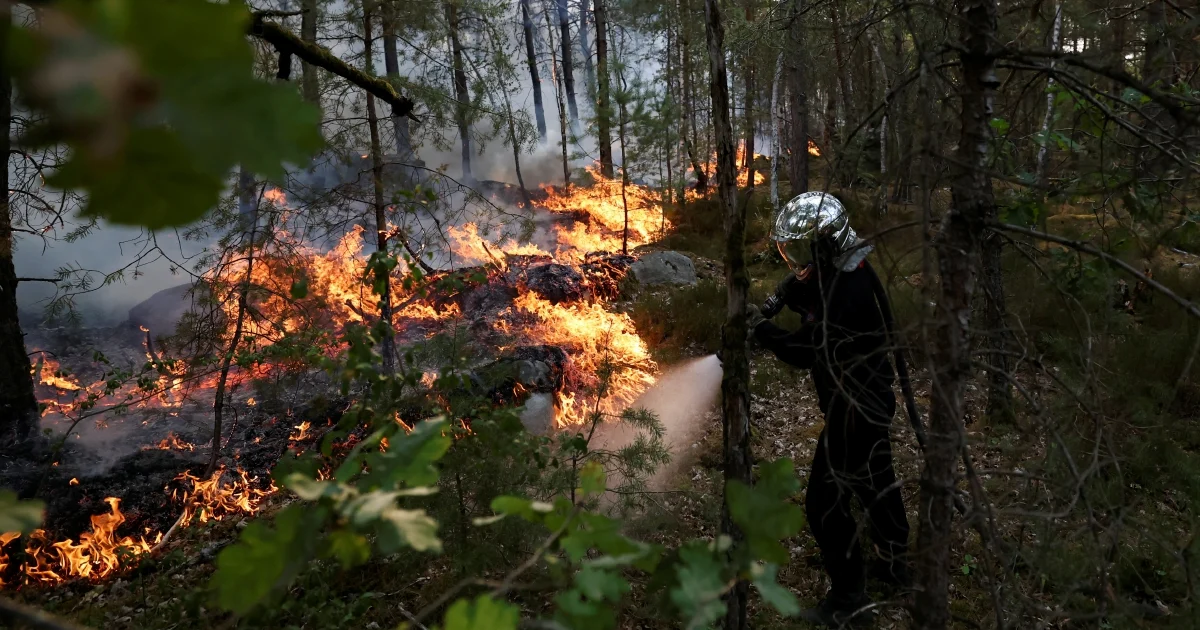
France mobilised significant firefighting resources on Monday to tackle two major wildfires that tore through a historic forest region south of Paris, ultimately destroying more than 1,300 hectares of woodland in the Arbonne-la-Foret area. The scale of the destruction underscores the vulnerability of Europe's forests to both environmental pressures and deliberate human action, concerns that have intensified across the continent in recent years as climate conditions shift and wildfire seasons extend.
Authorities moved swiftly to contain the blazes, which erupted in a region known for its ecological and historical significance. The simultaneous outbreak of two fires raised immediate suspicions about their origins, prompting police to launch investigations that yielded arrests within hours. French law enforcement detained two individuals on suspicion of arson, reflecting a troubling pattern where deliberate fire-setting contributes to seasonal forest losses alongside natural climate factors.
The incident highlights growing tensions between environmental protection and public safety in densely populated regions bordering major metropolitan areas. The proximity of Arbonne-la-Foret to Paris means that smoke, air quality deterioration, and potential threats to surrounding communities required rapid response protocols. French authorities have invested heavily in forest management and firefighting infrastructure, yet the speed and scale of these fires demonstrate how quickly situations can spiral beyond initial control mechanisms.
For Southeast Asian observers, the French wildfire crisis offers a cautionary parallel to regional forest challenges. While Malaysia and neighbouring countries face different climate dynamics and vegetation types than temperate European forests, the underlying vulnerabilities are comparable. Deliberate and unintended fires have repeatedly ravaged peatlands and tropical forests throughout Southeast Asia, with consequences for air quality, biodiversity, and transboundary environmental health. The arson arrests in France underscore how enforcement actions remain critical tools in fire prevention strategies.
Climate change is reshaping wildfire patterns globally, extending the duration and intensity of fire seasons. In Europe, scientists have documented how rising temperatures interact with drier vegetation cycles to create conditions where fires spread with unprecedented speed. Southeast Asia experiences similar climate pressures, where El Niño episodes historically trigger severe droughts that exponentially increase fire risk. The lessons from European forest management thus carry direct relevance for tropical and subtropical fire prevention efforts.
The destruction of 1,300 hectares represents not only immediate ecological loss but also long-term consequences for forest ecosystems. Recovery timelines for mature forests span decades, and reforestation efforts require sustained investment and careful species selection. Carbon sequestration capacity diminishes sharply when old-growth forests burn, contributing to broader climate concerns. This reality applies equally to Malaysia's remaining natural forests and peatland reserves, where fire-driven degradation represents a permanent reduction in carbon storage capacity until full restoration occurs.
French emergency services' ability to mobilise resources swiftly reflects infrastructure advantages that wealthier nations possess. More developed countries typically maintain dedicated aerial assets, trained rapid-response teams, and sophisticated early warning systems. Many Southeast Asian nations, despite facing proportionally greater wildfire threats due to land use patterns and climate variability, operate with more constrained resources. This capacity gap means that fires in the region often burn for extended periods, consuming far larger areas before containment becomes possible.
The arrest of two arson suspects demonstrates that human accountability remains feasible when investigations receive proper attention. In Southeast Asia, establishing prosecutorial pathways for deliberately set fires has proven more challenging due to jurisdictional complexities, limited forensic resources, and entrenched agricultural practices where fire-clearing remains common despite formal prohibitions. The French precedent suggests that rigorous investigation combined with swift legal action creates deterrent effects that complement prevention campaigns.
Forest fires pose cascading economic impacts extending far beyond the immediate burn area. Air quality deterioration affects public health and economic productivity across regional boundaries. Tourism sectors suffer when smoke obscures natural attractions and outdoor activities become hazardous. Agricultural productivity declines when ash fall contaminates soil and water supplies. France's tourism-dependent economy suffered measurable losses from the smoke and visibility reductions caused by these fires, a pattern that Southeast Asian economies understand acutely given the region's experience with transboundary haze from Indonesian peatland fires.
Investigators will examine whether the two arrested individuals acted independently or as part of broader criminal networks engaged in land clearing or insurance fraud schemes. Such economic motivations frequently drive arson in developing regions where land acquisition pressures intensify and regulatory enforcement remains inconsistent. Understanding these root causes proves essential for designing preventive policies that address not merely the symptom of fires but their underlying drivers.
The Arbonne-la-Foret incident will likely prompt France to reassess forest management protocols and fire prevention infrastructure investments. European Union environmental standards and coordination mechanisms enable cross-border sharing of best practices and resources during emergencies. Southeast Asia, lacking comparable regional institutional frameworks, faces greater challenges in coordinating responses to transboundary fire phenomena. Enhanced regional cooperation frameworks could significantly improve collective capacity to prevent and respond to major fire events.

