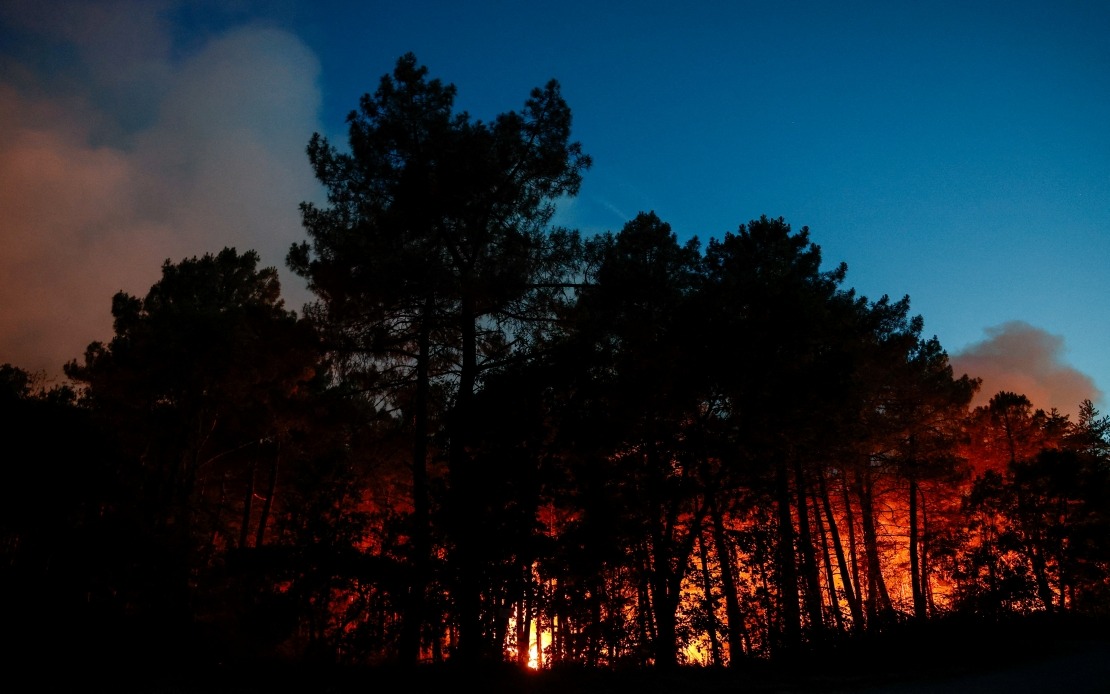
Firefighting crews in the Île-de-France region are mounting an intensive operation to contain a sprawling wildfire that erupted in the Fontainebleau forest on Sunday evening. As of Monday, approximately 400 firefighters have been deployed to battle the blaze, which has already consumed roughly 800 hectares of woodland in one of Western Europe's largest continuous forested areas. The scale of the emergency underscores growing wildfire risks across France as extreme heat conditions persist throughout the summer season.
The fire's origin points to a troubling development that has alarmed French security officials. Laurent Nuñez, the country's Interior Minister, visited the affected zone and indicated that evidence suggests the fire may have been deliberately ignited. His assessment was based on the discovery of multiple separate fire outbreaks all emerging within a narrow geographic band of approximately 1,000 metres, a distribution pattern inconsistent with natural wildfire spread. The gendarmerie has formally opened an investigation into the suspected arson, marking a significant escalation from a natural disaster to a potential criminal matter.
The timing and intensity of the blaze have forced rapid emergency evacuation efforts. More than 1,000 residents and holidaymakers were relocated from communities near the forest's edge, with residents of Le Vaudoué describing an advancing wall of flames reaching the outskirts of their village. The evacuation reflected the speed with which the fire spread, overwhelming initial containment attempts and threatening populated areas bordering the woodland.
To combat the expanding inferno, authorities have deployed specialized aerial resources. Two water-bombing aircraft have been activated to drop retardant and water directly onto the burning forest, drawing water supplies from the nearby Seine river. This multi-pronged response—combining ground crews, aerial assets, and water resources—represents a coordinated effort to prevent the fire from expanding further into populated zones and consuming additional protected forest habitat.
The Fontainebleau forest holds significant cultural and ecological importance for France and Europe more broadly. Home to the historic Château de Fontainebleau, a former royal residence of major architectural and artistic significance, the woodland ecosystem supports diverse flora and fauna adapted to its specific environmental conditions. The loss of 800 hectares represents a substantial portion of this irreplaceable natural and cultural heritage, with recovery requiring decades even after the immediate fire threat is contained.
The incident occurs within a broader context of heat-driven wildfire pressure across France. The country is experiencing its third major heatwave of the year, creating dangerously dry conditions that transform forests into tinderboxes susceptible to rapid fire spread. National meteorological services placed 37 administrative departments under the highest level red heat alert at the beginning of the week, indicating exceptionally hazardous temperature and moisture conditions across vast swathes of the country. These systemic conditions have made France unusually vulnerable to large-scale wildfires.
French government officials have characterized the Fontainebleau situation as exceptional, particularly given the rarity of such large fires in northern France. Maud Bregeon, the government's chief spokeswoman, emphasized that all available firefighting resources were being mobilized to prevent escalation. Her remarks highlighted how this incident challenges prevailing assumptions about wildfire risk in regions north of the Mediterranean and Alpine zones, where such major blazes have historically been less frequent.
The distinction between accidental and deliberately set fires carries profound implications for emergency response strategy and criminal investigation. If arson is confirmed, it would suggest that the wildfire resulted not from natural ignition sources or careless human behavior, but from intentional actions designed to cause destruction. Such a finding would prompt investigators to examine potential motives ranging from protest to criminal activity, expanding the investigation far beyond standard forest fire causation analysis. The discovery of multiple ignition points strengthens the arson hypothesis and may eventually involve counterterrorism or organized crime specialists alongside fire investigators.
The incident also raises regional concerns across Europe about wildfire vulnerability during periods of extreme heat. Southern European nations including Spain, Italy, and Greece have experienced devastating megafires in recent years, but northern France has generally escaped such catastrophic events. This event suggests that climate patterns may be pushing wildfire risk zones northward, challenging firefighting infrastructure and evacuation systems in regions that historically invested less in such capabilities. For Malaysian policymakers monitoring global climate trends and disaster management lessons, the Fontainebleau fire demonstrates how even developed nations face escalating wildfire challenges when extreme heat becomes the norm rather than anomaly.

