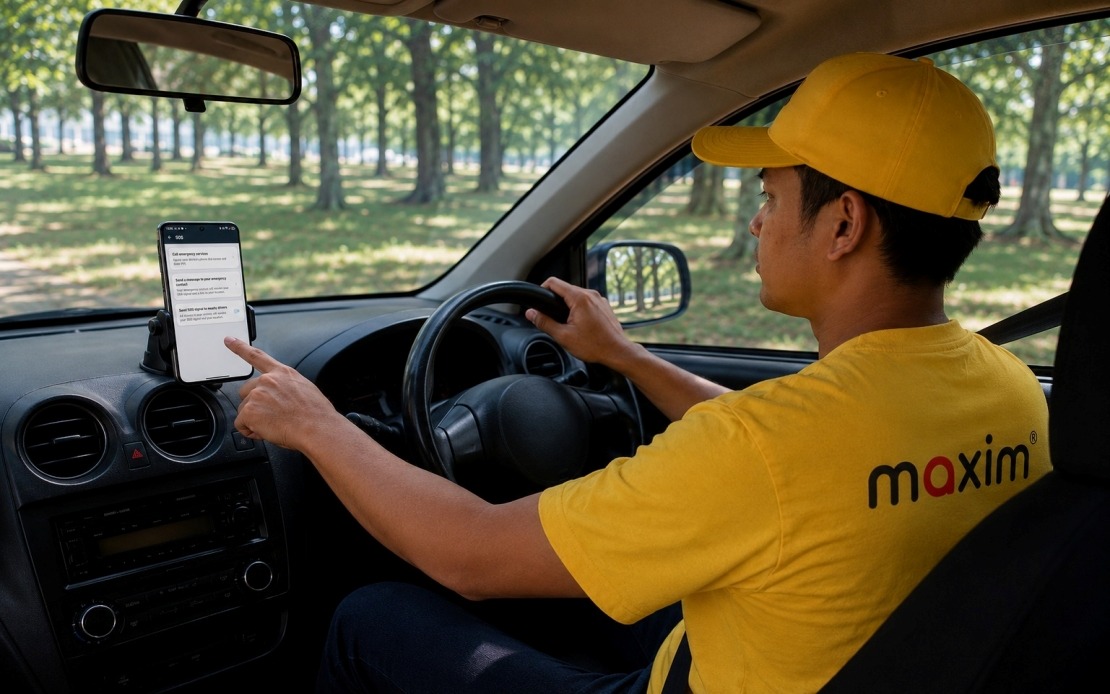
Maxim Malaysia has fortified its commitment to user safety by introducing a comprehensive overhaul of its in-app emergency response capabilities, marking a significant development in the regional ride-hailing sector's approach to passenger and driver protection. The platform announced on July 13 that its upgraded SOS system now delivers faster access to emergency assistance while providing users with granular control over who receives alerts during critical situations.
The refreshed system addresses a fundamental challenge in emergency response: reducing the time gap between when an incident occurs and when appropriate help is mobilised. By standardising the SOS function across both passenger and driver interfaces, Maxim Malaysia has created a unified framework that allows users to simultaneously access professional emergency services and personal support networks. The SOS button now permits alerts to be directed to up to three designated emergency contacts, with recipients immediately receiving a text message containing the user's precise GPS coordinates and a live trip-tracking hyperlink that functions reliably even when mobile data connectivity is compromised.
A particularly innovative component of the upgrade is the Driver Alert System, which extends safety responsibilities across the platform's driver community. When a partner driver activates the emergency function, notifications detailing the nature of the emergency and its exact location are transmitted to other Maxim drivers operating within a three-kilometre radius. This peer-support mechanism leverages the distributed presence of driver-partners to provide immediate on-scene assistance while professional emergency responders are being contacted, potentially reducing response times in congested urban areas where ambulance or police units may face delays.
Mohd Hazwan Musli, Maxim Malaysia's director, articulated the strategic thinking behind these enhancements, emphasising that different emergency scenarios demand different response priorities. A passenger experiencing vehicle trouble may prioritise contacting a trusted family member first, while a driver facing a medical event might benefit most from immediate professional intervention or assistance from nearby colleagues. The system's flexibility acknowledges that a one-size-fits-all alert mechanism may not adequately serve the diverse emergency needs within a user base spanning commuters, delivery riders, and daily users across Malaysia's varied geography.
The speed of access embedded within the redesigned interface represents a critical safety consideration. Emergency responders and human factors experts consistently identify rapid notification as a cornerstone of effective crisis response, and Maxim's commitment to achieving alert transmission within seconds potentially translates to tangible differences in outcomes. This is particularly salient in Malaysia's urban-rural divide, where response times from formal emergency services can vary dramatically depending on proximity to hospitals and police stations.
Data security and privacy protections form an essential infrastructure supporting the system's trustworthiness. All communications through the SOS function, Driver Alert System, and the related Trip Sharing feature employ encryption protocols aligned with contemporary security standards. Access to transmitted location data and emergency information is restricted to authorised security personnel and relevant government authorities operating under established legal procedures, addressing concerns about surveillance or data misuse that could otherwise deter users from activating emergency features.
The Trip Sharing capability extends passive safety measures by enabling passengers to proactively distribute real-time travel information to designated contacts upon boarding. This function provides family members or friends with continuous visibility into a user's journey without requiring manual updates, creating an accountability trail that deters certain categories of risk and ensures that others know a person's whereabouts if communication becomes impossible.
For the broader Malaysian ride-hailing market, this announcement signals an intensifying competitive focus on safety differentiation. As ride-hailing platforms mature and regulatory scrutiny around passenger protection increases, safety features increasingly function as brand assets that influence user choice and platform adoption. Maxim's enhancements suggest that platforms recognise safety not merely as a compliance requirement but as a competitive battleground where superior emergency response capabilities can drive market positioning.
The implications extend beyond immediate user protection to encompass systemic resilience. By creating a networked emergency response capacity that integrates informal peer assistance with formal emergency services, Maxim is architecting a hybrid safety model that may prove particularly valuable in Malaysian contexts where traffic congestion and distributed settlement patterns can hinder rapid professional response. This approach acknowledges operational realities on Malaysian roads while leveraging the concentration of drivers during peak hours to create emergent safety capacity.
Further, the standardisation of SOS functionality across user types reflects an evolving recognition that driver-partners themselves warrant substantive safety provisions. As ride-hailing driver communities have grown and driver welfare concerns have mounted globally, platforms implementing robust driver-focused emergency features address both humanitarian and operational imperatives by enabling driver-partners to maintain confidence in workplace safety.
Implementation and user adoption will determine whether these technical enhancements translate into measurable safety improvements. Success depends on drivers and passengers understanding and trusting the system, maintaining current emergency contact lists, and accessing the features intuitively during high-stress situations. Maxim's rollout strategy and training approach will likely influence whether the platform realises the full protective potential of its upgraded architecture.
The timing of this announcement reflects broader industry momentum around safety innovation in Southeast Asia's ride-hailing sector. As regulators, users, and advocacy groups increasingly demand tangible safety commitments, platforms that demonstrate genuine technical investment in emergency response capabilities position themselves favourably within rapidly evolving policy environments across Malaysia and the wider region.

