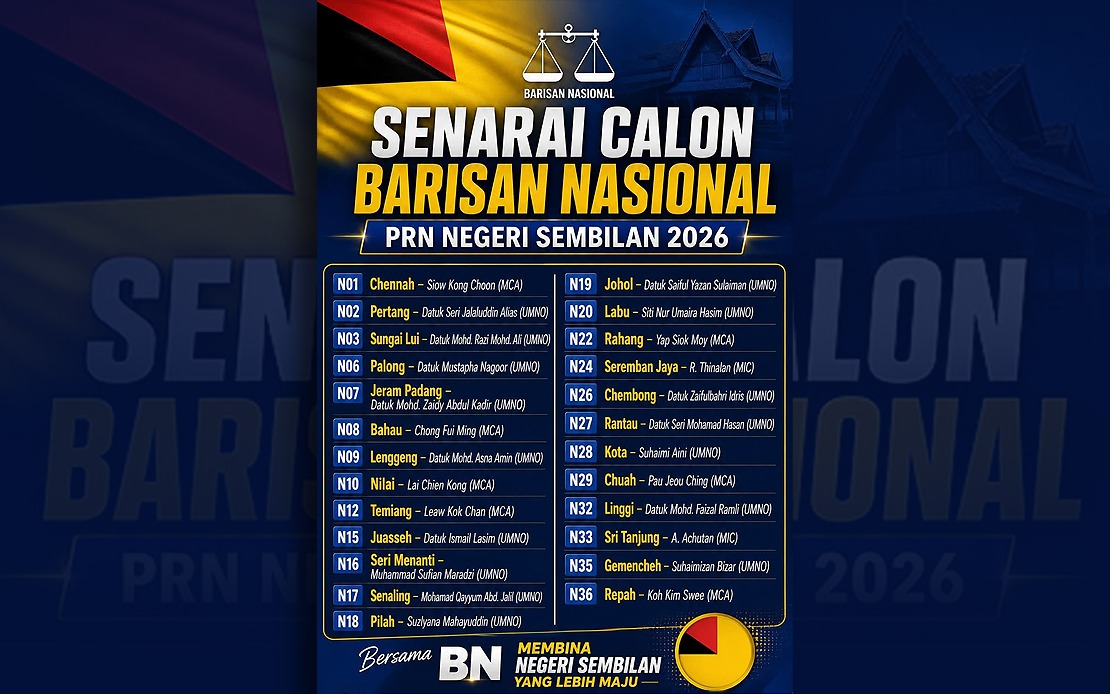
Barisan Nasional's seat distribution for the 16th Negeri Sembilan state election reflects a carefully calibrated strategy designed to maximise the coalition's chances of reclaiming ground lost in the previous election. BN chairman Datuk Seri Dr Ahmad Zahid Hamidi disclosed on July 15 that the Chinese-majority party MCA would field candidates in seven State Legislative Assembly seats, while the Indian-focused MIC would contest four, as the coalition prepares to challenge opposition dominance in the state.
Ahmad Zahid, who doubles as Deputy Prime Minister, explained that the allocation process went beyond routine seat-sharing mechanics. The formula considered a sophisticated assessment of each candidate's electoral viability within their designated constituency, a practice meant to position BN's strongest contenders in battleground areas. The announcement followed a comprehensive vetting exercise where prospective nominees individually signed undertakings and formally pledged allegiance to Ahmad Zahid in his capacity as BN chairman, a customary protocol executed during state elections, by-elections, and general elections to enforce party discipline and commitment.
The leadership's emphasis on candidate credibility and personal commitment signals BN's recognition that numerical seat allocation means little without competitive individuals capable of mobilising ground support. By publicly highlighting the undertaking process and the allegiance oath, Ahmad Zahid underscored the coalition's intention to present unified, disciplined candidates who would operate within party directives rather than pursue independent agendas that could fracture the coalition's messaging.
The meeting between Ahmad Zahid and prospective BN candidates at Wisma UMNO Negeri Sembilan served as both a practical coordination forum and a symbolic reaffirmation of BN's organisational coherence. Such gatherings allow senior leadership to align candidates on policy priorities, campaign strategy, and messaging while simultaneously allowing aspirants to demonstrate their commitment to collective party objectives. The setting itself—at the state UMNO headquarters—emphasised UMNO's continued primacy within BN's structure, even as coalition partners like MCA and MIC maintain specific portfolios.
Candidate announcement was scheduled for later that evening at Stadium Tuanku Abdul Rahman Paroi, a venue selection that suggests BN anticipated a substantial turnout for the formal unveiling. The timing and location reflected the party's intention to generate momentum ahead of the Election Commission's nomination day on July 18, granting the coalition a brief window to shape public narrative around its chosen representatives before the formal registration period commenced.
The electoral schedule compressed into a tight fortnight underscores the administrative efficiency Malaysia's Election Commission maintains. With nomination day set for July 18, early voting scheduled for July 28, and polling day fixed for August 1, candidates and political organisations face compressed timelines for campaign preparation. This compressed calendar advantages better-resourced coalitions capable of rapid mobilisation while potentially disadvantaging smaller parties or independent candidates lacking established infrastructure for swift campaign launches.
Negeri Sembilan's political trajectory over successive elections demonstrates the state's volatility as a bellwether for broader Malaysian political currents. In the 15th state election, Pakatan Harapan emerged as the dominant force with 17 seats, while BN secured 14 and Perikatan Nasional captured five seats. This result represented a significant reversal from BN's historical dominance in the state and reflected broader voter sentiment against the coalition during the post-2018 political upheaval. The opposition's commanding majority has governed Negeri Sembilan since the previous election, implementing policies and administrative decisions that have shaped voter perceptions of alternative governance.
BN's current allocation of eleven seats to MCA and MIC, combined with the implicit remainder designated for UMNO and other component parties, represents a modest but meaningful challenge to the incumbent opposition government. The coalition's strategy appears calibrated toward reclaiming sufficient seats to form government, particularly if opposition unity fractures or if specific constituencies demonstrate receptivity to BN's messaging on economic management, development priorities, or federal-state coordination.
MCA's seven-seat allocation acknowledges the party's traditional strongholds in urban and semi-urban constituencies with significant Chinese-majority populations, particularly in areas like Seremban and surrounding commercial centres. MIC's four seats reflect the party's concentrated influence among Tamil-speaking communities in specific pockets of the state, though the Indian population's broader distribution means many MIC candidates contest in mixed constituencies rather than demographically dominant seats. This particularised allocation reveals how BN coalition partners operate within specific demographic niches rather than genuinely competing for broad-based support across diverse voter groups.
The seat-sharing arrangement also illuminates ongoing tensions within Malaysian electoral politics regarding representation and coalition viability. While BN's formal designation as a coalition suggests equal partnership among members, the practical dominance of UMNO in seat numbers and campaign resources ensures that larger component parties function as junior partners dependent on the Malay-Muslim majority party's goodwill. This asymmetry affects parties' negotiating power and policy influence within coalition governments, a dynamic particularly relevant in Negeri Sembilan where any BN victory would require negotiation among component parties regarding ministerial portfolios and state development priorities.
For Malaysian voters and observers across Southeast Asia, the Negeri Sembilan election serves as an interim referendum on federal government performance and opposition effectiveness. The state's election occurs within a broader context of Malaysian political realignment, where traditional coalition structures face persistent challenges from internal factions and voter demand for alternative governance models. BN's recovery strategy, evidenced through its disciplined candidate selection and allocation formula, demonstrates the coalition's determination to reverse electoral setbacks through organisational efficiency rather than fundamental policy repositioning.
The weeks preceding August 1 will reveal whether BN's candidate-centred approach and seat allocation calculations translate into electoral recovery. Opposition parties will simultaneously deploy their own mobilisation strategies, potentially highlighting governance achievements or drawing attention to BN's historical record. The outcome will provide valuable indicators regarding voter sentiment in Peninsula Malaysia beyond major urban centres, offering insights applicable to potential future general elections and shaping calculations about coalition viability in Malaysia's increasingly fragmented political landscape.

