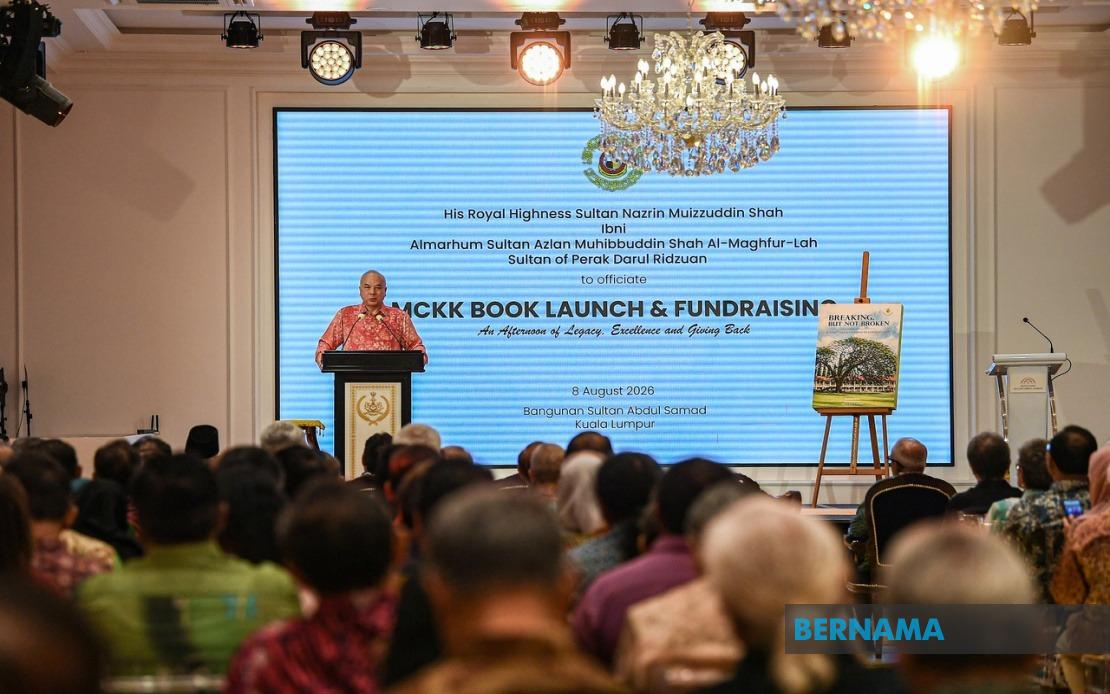
The Malay College Kuala Kangsar and other premier Malaysian boarding schools face a critical juncture, according to Perak's Sultan Nazrin Shah, who believes these institutions can reclaim their former prestige by fundamentally rethinking how they operate within an era dominated by artificial intelligence and rapid technological disruption. Speaking as Royal Patron of the MCKK Board of Governors, Sultan Nazrin argued that heritage schools need not fade into irrelevance if they embrace substantive transformation that honours their historical mission while squarely addressing contemporary realities.
The challenge confronting institutions like MCKK is substantial and multifaceted. These so-called "power schools" have traditionally served as incubators for Malaysia's elite, producing generations of leaders distinguished by eloquent communication, analytical rigour, and a demonstrated commitment to public service. Yet the Perak Ruler's remarks acknowledge a troubling reality: the calibre of graduates emerging from these prestigious establishments has demonstrably declined. Observers increasingly note deficiencies in language proficiency, critical reasoning capacity, and civic-minded orientation among recent cohorts—a stark departure from the institutional excellence these schools once reliably delivered.
Sultan Nazrin's diagnosis goes beyond nostalgia for a golden age. He emphasised that educational institutions must fundamentally reimagine their curricula and pedagogical approaches to prepare young Malaysians for an economic landscape being reshaped by artificial intelligence and digital innovation. This requires more than superficial adjustments to existing programmes. Rather, schools must undertake wholesale conceptual rethinking about what knowledge, skills, and dispositions matter most in an AI-augmented world where routine cognitive tasks are increasingly automated.
The Ruler articulated a dual imperative that deserves careful consideration. On one hand, Malaysian schools must equip students with practical competencies—technical literacy, adaptability, creative problem-solving—that enable them to thrive economically amid technological disruption. Yet simultaneously, educational institutions must nurture what Sultan Nazrin termed the "intangible" dimensions of human development: ethical sensibility, cultural understanding, emotional intelligence, and the values that ground a person's contribution to society beyond mere economic productivity. Neither dimension can be sacrificed for the other.
This holistic vision proves particularly urgent during periods of upheaval and uncertainty. As artificial intelligence and automation reshape employment markets faster than regulatory or educational systems can typically adapt, young people require more than technical training. They need the philosophical grounding, ethical frameworks, and adaptable thinking patterns that enable them to navigate ambiguity and maintain purpose when circumstances change dramatically. Heritage schools possess institutional memory and established cultures that could facilitate this broader development if they choose to build upon rather than merely preserve them.
Sultan Nazrin commended the authors of a recently launched book examining MCKK's trajectory—Ghazally Ismail, Ahmad Ibrahim, and Hisham Badrul Hashim—for their unflinching analysis of these institutions' contemporary challenges. Rather than retreating into self-congratulatory narratives about past glories, these scholars apparently confronted uncomfortable truths about why premier schools have struggled to maintain their former standing. Their assessment extends beyond MCKK itself to encompass the broader cohort of selective residential institutions facing similar pressures, each seeing their historical competitive advantages gradually eroded.
The financial dimension of MCKK's revitalisation efforts demonstrates institutional commitment to tangible improvement. The MCKK Foundation, established in 2008, has accumulated over RM36 million in donations and contributions from individuals and corporations including PETRONAS and Brunei's Sultan Hassanal Bolkiah. This represents genuine philanthropic confidence in the institution's future prospects. Of these funds, approximately RM19 million have funded new infrastructure projects including an International Baccalaureate complex and Auditorium Tun Abdul Razak, while another RM3.5 million addressed deferred maintenance across boarding facilities, athletic venues, and other campus necessities.
Beyond physical infrastructure investment, the Foundation has cultivated endowment funds exceeding RM16 million, positioning MCKK for sustainable long-term development independent of volatile annual fundraising cycles. The endowment's investment income—exceeding RM7 million to date—has supported scholarships for disadvantaged students, professional development for teaching staff, participation in international academic competitions, and preservation of the college's heritage architecture. This multi-pronged approach to resource deployment suggests recognition that contemporary educational excellence requires simultaneous attention to campus infrastructure, financial accessibility, faculty capability, and institutional heritage preservation.
For Malaysia's broader educational landscape, Sultan Nazrin's remarks carry significant implications. If premier boarding schools successfully navigate the transition from twentieth-century excellence models to twenty-first-century adaptive institutions, they could become vital proving grounds for pedagogical innovation that subsequently diffuses throughout the education system. Conversely, if these schools continue their trajectory of relative decline, Malaysia risks losing important institutional anchors for developing its most promising young people according to demanding standards. The stakes extend beyond any single institution's reputation or alumni outcomes.
The emphasis on adaptability while preserving core institutional values offers lessons applicable beyond elite boarding schools. Malaysian educational institutions generally—universities, secondary schools, vocational institutions—face similar pressures to evolve their offerings and approaches without abandoning foundational commitments to rigorous learning and character development. Sultan Nazrin's framework suggests that successful institutions will neither cling defensively to outdated practices nor abandon all established traditions in pursuit of modernity, but instead undertake deliberate, philosophically grounded transformation.
The question remains whether heritage schools like MCKK possess the organisational flexibility and leadership capacity to execute such transformation at the pace that contemporary change demands. Institutional inertia, alumni conservatism, and resource constraints all present obstacles. Yet Sultan Nazrin's public endorsement of this agenda, combined with concrete fundraising success and intellectual engagement with these challenges, suggests that revitalisation remains achievable for institutions willing to embrace fundamental self-examination and substantive change.

