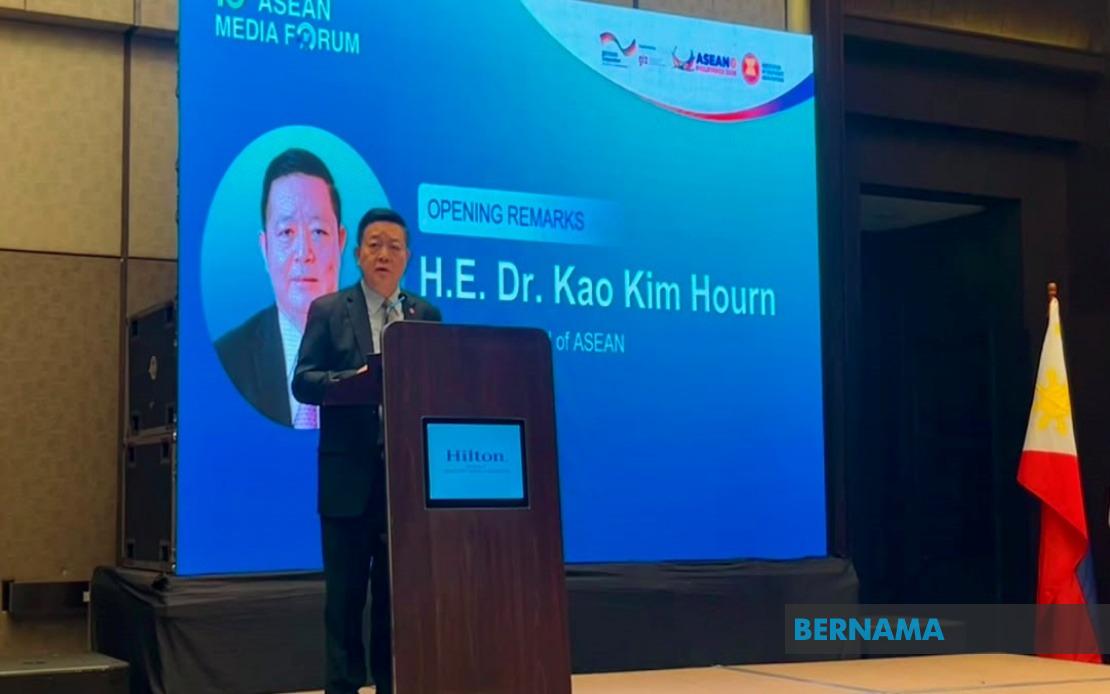
The media stands at the centre of ASEAN's ambitious plans to deepen regional integration and strengthen public consciousness of shared identity, according to ASEAN Secretary-General Dr Kao Kim Hourn, who addressed delegates at the 10th ASEAN Media Forum in Manila this week. His remarks underscored the profound responsibility that journalists and media organisations carry as the 10-nation bloc works towards its ASEAN Community Vision 2045, a framework that will shape the region's political, economic and social trajectory for the next two decades.
The technological landscape surrounding news production and consumption has fundamentally altered over the past decade, creating both unprecedented opportunities and considerable risks. The emergence of digital platforms, social media networks and generative artificial intelligence have revolutionised how information moves through society, enabling faster dissemination and broader reach than ever before. Yet this same technological transformation has dismantled traditional gatekeeping mechanisms that once helped filter out unreliable content. For Malaysian and Southeast Asian readers accustomed to navigating multiple information sources simultaneously, the distinction between trustworthy reporting and manufactured narratives has become increasingly blurred.
The proliferation of misinformation, disinformation and manipulated content across borders presents an especially pressing challenge for ASEAN nations seeking to maintain social cohesion. Unlike traditional falsehoods confined to single countries, digitally-spread falsehoods can instantly reach multiple nations with different cultural contexts, political sensitivities and institutional capacities. This borderless nature of information pollution threatens to undermine public confidence in institutions precisely when ASEAN requires strong domestic support for regional cooperation initiatives. For Malaysia, where social media use ranks among the world's highest, the stakes are particularly acute.
Dr Kao articulated a vision where journalists transcend their conventional role as observers of events and instead become educators who decode complex policy frameworks for ordinary citizens. He argued that as ASEAN implements its Community Vision 2045 across the political-security, economic and socio-cultural domains, media organisations must actively bridge the gap between high-level policy decisions made in government conference rooms and the tangible impacts these decisions have on Malaysian families, Thai farmers, Vietnamese workers and Indonesian entrepreneurs. This interpretive function requires both subject matter expertise and narrative skill that goes beyond simple news reporting.
Generative artificial intelligence presents a paradox that particularly concerns journalism professionals across the region. The technology offers genuine efficiencies: newsrooms can process larger volumes of information, translate content into multiple languages simultaneously and identify newsworthy patterns in vast datasets faster than human journalists could manage alone. These capabilities could theoretically democratise news production, allowing smaller outlets in developing economies to compete with well-resourced international bureaus. Simultaneously, however, the same technologies enable the creation of deepfakes, synthetic media and automated disinformation at industrial scale. The challenge for ASEAN's media ecosystem is determining how to harness productivity gains while preventing technology from becoming a tool for systematic deception.
Credibility has emerged as the media's most valuable asset yet its most vulnerable one, a tension that strikes at the heart of contemporary journalism. Public trust, once fractured through repeated exposure to false information or perceived bias, proves extraordinarily difficult to restore. Malaysian readers who have witnessed credibility erosion in certain media outlets understand intuitively how quickly institutional legitimacy can evaporate and how lengthy the rebuilding process becomes. For ASEAN as a region, the loss of media credibility would have cascading consequences: citizens might retreat into narrow information bubbles, political polarisation could intensify, and ASEAN's collective decision-making capacity could weaken precisely when regional challenges demand unity.
The Philippines, holding ASEAN's rotating chair for this year, positioned journalism as fundamental to all three pillars of the Community Vision 2045. Through the remarks of Undersecretary Leo M. Herrera-Lim, Manila emphasised that media are not passive chroniclers documenting ASEAN's development but active architects helping to shape the region's future. This framing reflects recognition that communication itself constitutes a strategic resource. An ASEAN that communicates strategically and deliberately about its decisions, achievements and challenges possesses greater capacity to maintain public support for integration initiatives that may involve short-term adjustments for long-term regional benefit.
The geopolitical context surrounding ASEAN makes credible journalism more consequential than ever. As the region navigates strategic competition between major powers, contested maritime claims, economic interdependencies and transnational challenges from climate change to pandemic preparedness, the need for accurate information and balanced analysis becomes vital. Responsible reporting prevents rumour and speculation from inflaming regional tensions, while it also ensures that ASEAN citizens understand the rationale behind their governments' foreign policy choices. For Malaysia specifically, which occupies a strategically important position in Southeast Asia, media literacy and access to reliable information directly affect public support for foreign policy decisions.
The ASEAN Media Forum itself has evolved considerably since its inaugural gathering in Manila in August 2017, when it was established to mark ASEAN's 50th anniversary. What began as a commemorative initiative has matured into a permanent institutional platform where journalists, editorial leaders and policymakers convene regularly to exchange perspectives, identify common challenges and strengthen professional networks. The forum's expansion reflects growing recognition that journalism transcends national boundaries and that media professionals across ASEAN share common professional standards, ethical obligations and practical challenges even while operating in diverse political contexts and institutional environments.
Organisation of the forum by the ASEAN Secretariat with support from Germany's development agency GIZ demonstrates international recognition of ASEAN's media development as a regional public good. This institutional backing and international partnership signals that Southeast Asian journalists are not working in isolation but are part of a global professional community with established norms and shared commitments to verification, accuracy and ethical standards. For Malaysian journalists and media outlets, participation in regional forums provides opportunities to learn from counterparts in other ASEAN nations, benchmark practices and contribute to raising professional standards across the entire region.
As ASEAN advances toward 2045, the role of media will only become more complex and demanding. Journalists will need to navigate not only rapid technological change and information warfare but also the inherent challenge of explaining integration processes to publics who may not immediately perceive personal benefit. The media's contribution will ultimately determine whether ASEAN's Community Vision remains an elite policy project or becomes rooted in genuine public understanding and support. In this sense, the quality of journalism practised in Malaysia, Thailand, Vietnam, Indonesia and other member nations directly influences the success or failure of ASEAN's collective ambitions.

