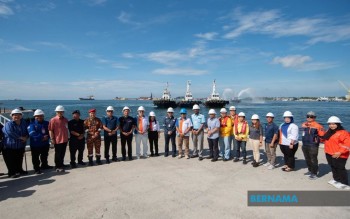
Megah Port Management Sdn Bhd (MPM) has formally inaugurated its marine services division at Labuan Port, marking a significant operational milestone anchored by the acquisition of four purpose-built tugboats valued at RM23 million. The fleet deployment represents a substantial capital commitment to establishing comprehensive maritime support infrastructure within the Federal Territory's principal port facility, which serves as a crucial transshipment and industrial hub for Malaysia's energy and downstream sectors.
Managing Director Datuk Seri Patrick Tiong framed the tugboat procurement as a strategic manifestation of MPM's operational mandate under the recently executed Operation, Facility and Management Continuation Agreement signed with the Labuan Port Authority (LPA). Beyond representing contractual obligation, the investment reflects a broader corporate positioning to enhance the safety profile and operational reliability that increasingly distinguishes competitive port facilities in Southeast Asia's crowded maritime marketplace. The tugboat acquisition, he emphasized, provides the tangible assets and technical capacity necessary for MPM to discharge its newly assumed responsibility as the primary provider of marine services across Labuan's operational domain.
The tugboat fleet serves multiple functional purposes critical to modern port management. The vessels will guide commercial shipping during ingress and egress procedures, provide essential assistance during berthing and unberthing manoeuvres, and maintain vessel control through restricted waters where navigational margins are constrained. The tugboats are equipped to manage challenging weather scenarios and adverse current conditions that periodically affect Labuan's operational efficiency, whilst simultaneously offering towage services that extend vessel control to distressed ships experiencing mechanical breakdown, propulsion loss, or maneuvering complications. This versatile capability portfolio transforms MPM's operational profile from a purely administrative port authority into an active maritime service provider capable of addressing the operational challenges that characterize modern petroleum product handling and chemical logistics terminals.
Emergency preparedness and maritime safety command particular strategic importance in Labuan's operational context. The tugboat fleet strengthens MPM's capacity to mount rapid response interventions during maritime incidents, providing initial firefighting support, repositioning vessels away from high-risk operational zones, and enabling coordinated action with Malaysian Maritime Enforcement Agency personnel and Marine Police Force assets deployed across the port's jurisdiction. This emergency-response capability matrix reduces exposure to catastrophic risk scenarios involving hazardous cargo operations, where rapid vessel movement and coordinated incident management directly determine outcomes for human safety, environmental protection, and business continuity across the port's dependent industrial ecosystem.
The geographic scope of marine services encompasses multiple specialized operational terminals within Labuan Port's jurisdiction, including the DG Terminal handling dangerous goods shipments, the Petronas Chemicals Methanol Labuan Terminal processing energy sector chemical exports, the Asian Supply Base Fuel Terminal supporting offshore petroleum operations, and the Shell Timur Terminal managing additional petroleum-related logistics. This terminal diversity reflects Labuan's strategic positioning as Malaysia's primary offshore energy support hub, where integrated port services directly enable the commercial viability of regional oil and gas production infrastructure. The tugboat services ensure that vessel movements across these specialized terminals proceed with coordinated efficiency, minimizing costly operational delays whilst maintaining the safety protocols that petrochemical and petroleum product handling demands.
Coordination with maritime enforcement authorities emerged as a central theme in Tiong's remarks regarding operational implementation. Close collaboration with Malaysian Maritime Enforcement Agency assets, Marine Police Force personnel, and other security agencies ensures that all vessel movements, towage operations, and associated maritime activities comply with Malaysia's evolving maritime regulatory framework and international safety conventions. This enforcement coordination transforms tugboat operations from routine port mechanics into integrated components of Malaysia's broader maritime security architecture, particularly important as Labuan's location on major regional shipping lanes and its role in energy sector logistics attracts heightened regulatory scrutiny from port state control authorities and flag state maritime administrations.
The formal launch featured an operational demonstration documenting the tugboat fleet's emergency response capability through a simulated firefighting scenario conducted within Labuan waters. This public demonstration served multiple stakeholder communication objectives, establishing visible evidence of MPM's technical capacity whilst building stakeholder confidence in the port's capacity to manage maritime incidents effectively. For maritime industry participants, insurance underwriters, and vessel operators conducting risk assessments of Labuan Port utilization, the demonstration provided tangible evidence that the facility now possesses modern emergency response infrastructure comparable to international best-practice standards.
Tiong's emphasis on continuous improvement and openness to regulatory guidance indicates a deliberate corporate positioning toward stakeholder engagement that extends beyond minimal contractual compliance. This posture acknowledges that port operators function within complex regulatory ecosystems involving multiple government agencies, industry associations, environmental groups, and international bodies establishing evolving standards for maritime operations. By positioning MPM as receptive to constructive feedback and committed to professional service delivery aligned with legal requirements, management signals an understanding that reputational capital and regulatory goodwill constitute increasingly important competitive factors distinguishing ports that successfully navigate Southeast Asia's shifting maritime governance landscape.
The marine services initiative carries particular significance for Malaysia's broader port infrastructure development strategy. As regional port competition intensifies, particularly with expansion initiatives underway at neighboring facilities in Singapore, Brunei, and Indonesian maritime centers, Labuan Port's capacity to offer integrated, modern marine services becomes critical to maintaining its role as a preferred transshipment and energy sector support hub. The RM23 million tugboat investment demonstrates that MPM recognizes this competitive dynamic and is prepared to deploy capital to establish service quality standards that justify port user selection decisions in an increasingly commoditized regional maritime marketplace.
The operational commencement of marine services also reflects broader infrastructure modernization priorities established within Malaysia's maritime sector policy framework. Enhanced port capabilities contribute to national objectives regarding maritime connectivity, energy sector logistics efficiency, and competitive positioning within ASEAN's evolving maritime landscape. For Malaysian shipping companies, energy sector operators, and other port users, improved marine services availability at Labuan reduces operational costs and scheduling uncertainty whilst strengthening Malaysia's position as a reliable, professionally-managed maritime logistics hub capable of competing effectively with established regional port centers.

