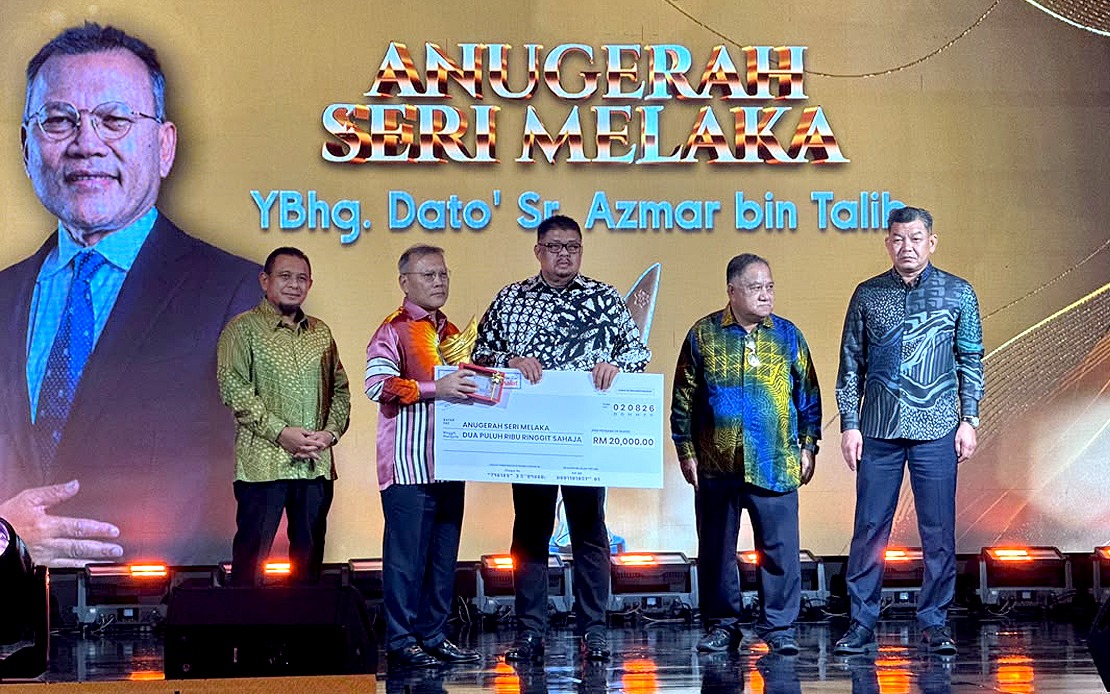
Melaka's Chief Minister Datuk Seri Ab Rauf Yusoh has made a direct appeal to the state's accomplished professionals and successful entrepreneurs to transition their personal achievements into a broader mentorship role within the community. Speaking at the Anugerah Seri Melaka (ASM) Gala Night held at the Melaka International Trade Centre in Ayer Keroh, Ab Rauf outlined a vision where individual success becomes a catalyst for regional advancement, transforming isolated accomplishments into shared resources for collective progress.
The initiative, known as Melaka Sayang Rakyat (MeSRa), represents the state government's commitment to documenting and publicising the achievements of notable Melaka-born individuals across diverse sectors. Rather than allowing success stories to remain as isolated personal victories, the programme aims to distill practical wisdom and establish networks that can benefit younger aspirants seeking to build their own careers. This approach reflects a growing recognition among regional leaders that talent retention and intergenerational knowledge transfer depend on creating visible pathways to success.
The Anugerah Seri Melaka awards programme itself demonstrates the breadth of excellence emerging from the state. Spanning four distinct categories—Public Service, Corporate, Sports, and Arts and Culture—the awards received more than 200 nominations, indicating substantial community participation and a deep reservoir of accomplished professionals willing to be recognised. Each nomination, according to Ab Rauf, embodies a personal journey constructed through sustained effort, considerable sacrifice, and demonstrated resilience, serving as testament to Melaka's capacity to cultivate individuals of genuine distinction.
Among the inaugural recipients was Datuk Azmar Talib, chief executive officer of TRX City Sdn Bhd, who claimed the prestigious overall award alongside the Corporate category honour. This recognition underscores the state government's intent to highlight private sector leadership and commercial achievement as legitimate markers of excellence worthy of celebration and emulation. The selection reflects an understanding that business acumen and entrepreneurial success, when anchored in ethical practice, contribute significantly to regional economic development.
National badminton player Aaron Chia received the Sports category award, representing Malaysia's continued excellence in competitive athletics. His recognition acknowledges that sporting achievement at international level brings prestige to the state and provides aspirational models for younger athletes. Similarly, performing arts director Lokman Abd Ghani's Arts and Culture award highlights Melaka's cultural contributions, suggesting that excellence extends beyond commercial or administrative domains into the creative and cultural realms.
The Public Service category winner, Datuk Zamri Misman, director-general of the Legal Affairs Division at the Prime Minister's Department, exemplifies professional achievement within the civil service framework. His selection signals the state government's recognition that public sector competence and strategic positioning within federal institutions constitute important forms of achievement that warrant acknowledgement. The inclusion of a public servant among primary award categories balances recognition across sectors and emphasises that governmental effectiveness depends on capable individuals throughout the administrative apparatus.
International medical science researcher Dr Saiful Anuar Singar received the Special Category award, reflecting Melaka's contributions to scientific advancement and research. This recognition positions the state not merely as a commercial or administrative hub but as a generator of intellectual capital and scientific knowledge. The inclusion of a researcher in the awards framework suggests that the state government views academic and scientific excellence as integral to a comprehensive development strategy.
The financial structure of the awards—with the overall recipient receiving RM20,000 and a trophy, while category winners receive RM10,000 and trophies—demonstrates meaningful though modest acknowledgement. More significant than the monetary component is the public recognition and formal documentation, which creates a searchable archive of successful individuals available for mentorship, consultation, and collaborative ventures. This systematic approach to identifying and celebrating achievement facilitates the networking opportunities Ab Rauf emphasised.
The Chief Minister's specific articulation of expectations—that successful individuals use their "experience, expertise and networks" to create opportunities for others—provides concrete guidance about what partnership entails. This framing moves beyond mere ceremonial recognition toward functional collaboration. By explicitly linking individual achievement to generational responsibility, Ab Rauf constructs a narrative where success carries implicit obligations to mentor, advise, and facilitate access for emerging professionals.
Melaka's initiative carries relevance for other Malaysian states grappling with brain drain and intergenerational economic mobility challenges. The programme suggests that systematic documentation and public celebration of achievers can help counteract the perception that success requires departure from one's home state. By making achievement visible and creating formal mechanisms for successful individuals to contribute to their home communities, Melaka potentially addresses a significant regional challenge affecting development across Southeast Asia.
The awards programme also reflects broader questions about how states can retain and mobilise human capital in an increasingly competitive regional environment. For younger professionals in Melaka contemplating migration to Kuala Lumpur or international destinations, the existence of visible, accomplished peers remaining engaged with their home state provides an alternative model. This psychological and social dimension—the visibility of success within one's own community—may prove as consequential as economic incentives for talent retention.
The scale of nomination response, exceeding 200 entries, suggests substantial untapped potential within Melaka's professional and entrepreneurial ecosystem. The state government's challenge now involves translating this awards recognition into sustained institutional mechanisms that facilitate the mentorship partnerships Ab Rauf envisions. Without follow-up structures—mentorship matching systems, collaborative platforms, or formal advisory roles—the awards risk becoming ceremonial rather than catalytic.
Moving forward, Melaka's success in implementing the MeSRa initiative's ambitious vision will depend on creating concrete mechanisms through which award recipients can meaningfully engage younger generations. The framework Ab Rauf has articulated positions the state government as a convener and facilitator, creating spaces where individual excellence becomes the foundation for collective advancement. Should the state effectively operationalise these aspirations, it may establish a replicable model for talent mobilisation and intergenerational knowledge transfer that extends beyond Melaka's borders.

