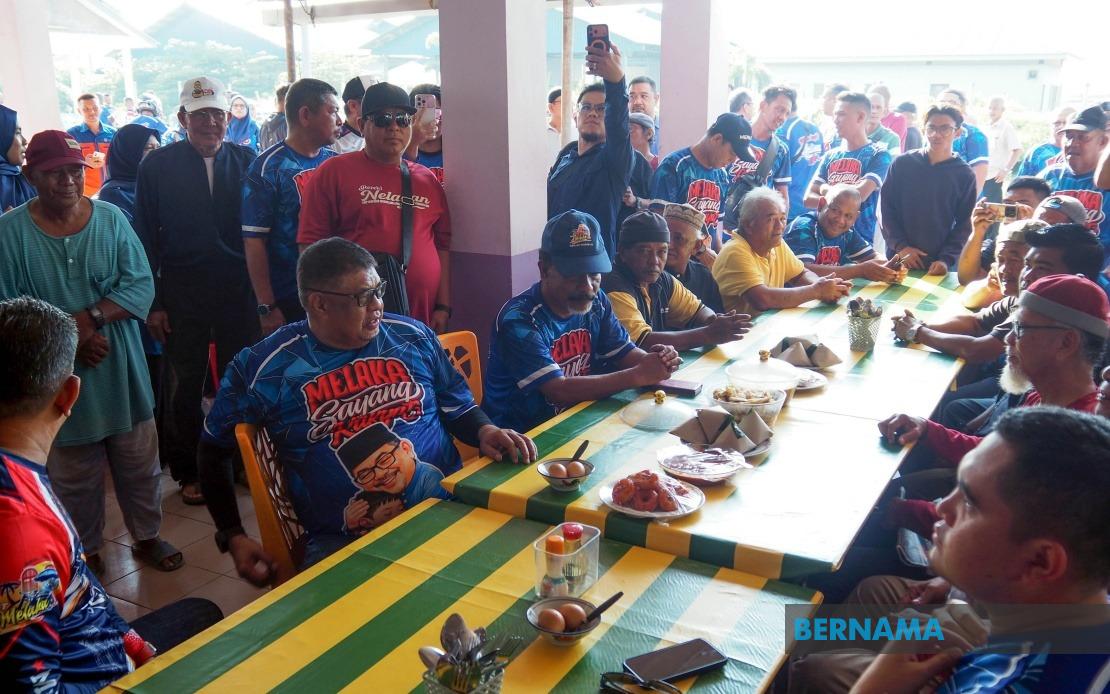
The Melaka state government has launched a multi-pronged intervention to strengthen economic security and modernise traditional fishing operations, providing comprehensive social protection and advanced technology to its registered fishing population. Chief Minister Datuk Seri Ab Rauf Yusoh unveiled these initiatives during the fifth instalment of his grassroots engagement tour, held at Kuala Sempang Jetty in the Merlimau state constituency, signalling a strategic pivot toward direct intervention in the maritime livelihoods sector.
The centrepiece of the announcement involves extending PERKESO social security coverage to all registered fishermen—a significant development that addresses long-standing vulnerability in an occupationally hazardous profession. Fishermen in Malaysia have historically operated outside conventional employment frameworks, leaving them exposed to workplace accidents, illness, and income disruption without institutional safety nets. This extension recognises the intersection between maritime labour and social policy, ensuring that workers exposed to weather hazards, equipment risks, and irregular income streams gain access to structured income replacement and healthcare benefits typically reserved for formal-sector employees.
Complementing this protective measure is the distribution of fish-finder technology, equipment that represents a substantial modernisation leap for small-scale fishing operations. Fish finders employ sonar technology to identify underwater concentrations of fish, transforming what has historically been an experience-based, trial-and-error pursuit into a data-informed activity. By displacing reliance on accumulated knowledge and educated guessing, the technology promises to compress search time, reduce fuel consumption, and improve catch reliability—factors that directly influence whether fishing households sustain or improve their income levels.
Yusoh's framing of the initiative emphasises government presence at the grassroots level rather than administrative distance from communities. His statement that officials do not wish to "remain seated comfortably in our offices" reflects a broader Malaysian political conversation about the legitimacy of proximity governance, where elected leaders engage directly with constituent groups to identify needs and design responses. This rhetorical commitment to ground-level visibility complements the material interventions, positioning the government as responsive to articulated community concerns rather than imposing top-down solutions.
The distribution component of the programme extended immediate cash relief to 107 registered fishermen, with each receiving RM200 under the 'Bantuan Jaring Nelayan' (Fishermen's Net Assistance) scheme, representing a total outlay of RM21,400. This direct cash transfer serves multiple functions: it acknowledges current income pressure within the fishing community, provides immediate liquidity during what may be a seasonal low period, and signals that state support encompasses both structural interventions and temporary relief. The government also distributed 360 kilogrammes of fish—valued at RM3,600—to the public, averaging 1.5 kilogrammes per recipient, which addresses food security alongside fishery support.
Amirul Shah Fuad Shah, a 35-year-old fisherman with more than two decades of experience in Kuala Merlimau, articulated the practical value of fish-finder adoption from an operational perspective. His assessment that the technology enables precise identification of fish concentrations, replacing probabilistic casting with targeted deployment, speaks to efficiency gains that compound over time. Amirul's note that private purchase of fish finders costs between RM1,000 and RM2,000 per unit underscores the capital barrier that subsidy removal from technology access. For small-scale fishermen operating with tight margins and irregular income, equipment acquisition represents a prohibitively expensive investment, meaning government provision fundamentally alters the technology adoption landscape.
Amirul's recognition of PERKESO coverage as conferring meaningful protection reflects awareness among working fishermen that occupational exposure—to drowning, decompression injuries, equipment trauma, and chronic conditions exacerbated by salt-water exposure—occurs without institutional safeguards in informal maritime work. PERKESO's extension promises income replacement during work-related incapacity and dependant benefits in catastrophic scenarios, converting individual risks into pooled, insurable contingencies. This addresses a gap in Malaysian social security that has long disadvantaged self-employed and informal-sector workers.
Kampung Sempang Fishermen's Association chairman Md Khalil Md Jadi, aged 67, positioned the initiatives within a longer arc of fishing community neglect, welcoming state recognition of demographic vulnerability within the sector. His observation that many fishermen are elderly and subsist entirely on maritime income identifies a group with constrained labour mobility and heightened exposure to age-related productivity decline. The introduction of technology that enhances catch efficiency becomes particularly consequential for workers approaching retirement thresholds without alternative income sources, potentially extending working lifespan and income adequacy.
Md Khalil's characterisation of fish-finder adoption as modernisation of the traditional fishing sector reflects an important tension in development policy. Technology transfer into established occupational practices can enhance productivity, but it also risks displacing workers who lack training or access, concentrating benefits among early adopters, or creating new dependencies on maintenance and technical expertise. The success of this intervention will depend substantially on implementation details: whether training accompanies device distribution, whether maintenance and repair infrastructure develops, and whether catch improvements actually materialise under real-world conditions rather than controlled settings.
The Melaka initiative occurs within a Southeast Asian context of rising maritime pressures, including climate variability affecting fish stocks and breeding patterns, increased competition from industrial-scale operations, and environmental regulations that constrain fishing zones. Small-scale fishermen across Malaysia, Thailand, Indonesia, and the Philippines face structural headwinds that technology alone cannot remedy. Fish finders improve targeting efficiency but do not address depletion of near-shore stocks, seasonal migration of species, or fuel cost volatility that squeezes margins regardless of catch volume. Consequently, while equipment provision and social security extension represent tangible welfare improvements, they function within constrained economic boundaries that may ultimately limit their transformative impact.
The political dimension of the Melaka announcement merits consideration alongside its material content. State governments in Malaysia increasingly employ direct community engagement as a legitimacy strategy, contrasting ground-level presence with federal distance. The 'Jelajah Ketua Menteri Sayang Rakyat' tour branding—roughly translatable as the Chief Minister's loving-the-people journey—positions state leadership as accessible and solicitous of grassroots input. Whether such visibility translates into sustained institutional change or remains episodic gesture-politics depends on whether the PERKESO extension and fish-finder programme embed themselves within state budgetary structures and bureaucratic practice or remain one-off distributions.
The fishing sector in Melaka employs thousands of individuals, generating economic activity across processing, distribution, and hospitality ecosystems. Enhancement of fishermen's incomes and working conditions produces downstream effects throughout local economies. Improved catch reliability translates into more consistent supply chains for fish processors and retailers, stabilising employment in those sectors. Enhanced income for fishing households increases demand for local goods and services, circulating spending through communities. From this perspective, the state initiative functions not merely as welfare distribution but as economic stimulus within specific geographic and sectoral contexts.
The success metrics for these initiatives will become apparent over coming months and years. PERKESO coverage take-up, fish-finder utilisation rates, and actual catch improvements will indicate whether the programme achieves its stated objectives. Equally important will be whether the state government sustains implementation commitment, whether community trust in programme integrity develops, and whether the interventions address root causes of fishing community vulnerability or merely ameliorate symptoms. As Melaka demonstrates increased responsiveness to fishing sector concerns, comparable pressure may build on other state and federal authorities to extend comparable protections and technological support, potentially reshaping how Malaysian policy addresses informal-sector livelihoods.

