Melaka's Chief Minister Datuk Seri Ab Rauf Yusoh has signalled a significant shift in residential and commercial development standards for the state, calling on property developers to prioritise lift installations in shoplots and residential buildings exceeding two storeys. Speaking during a housing development agreement signing ceremony, Ab Rauf framed lift access not as an optional amenity but as a fundamental necessity that should form part of every multi-storey project moving forward.
The impetus for this policy direction stems from a tangible market problem that has emerged across several Melaka neighbourhoods. Properties in established areas such as Kota Laksamana, Banda Hilir, and Melaka Raya have accumulated significant unsold inventory, with the absence of lift facilities identified as a primary factor deterring buyers. For property developers and state authorities alike, this represents both a market efficiency issue and a missed opportunity to house more residents. By addressing the accessibility barrier, the state government believes it can unlock sales velocity and attract a broader pool of potential purchasers who might otherwise be discouraged by the physical challenges of climbing stairs in tropical heat or managing multiple levels with mobility constraints.
The demographic dimension underlying this initiative speaks to Malaysia's ageing population patterns. Ab Rauf explicitly highlighted elderly residents as a key beneficiary of improved accessibility standards, recognising that senior citizens face genuine physical challenges navigating multi-storey buildings without mechanical assistance. As Malaysia's population ages—a trend mirrored across Southeast Asia—residential design standards must adapt accordingly. Making lift access a baseline expectation rather than a luxury feature represents pragmatic urban planning that anticipates demographic realities and ensures housing stock remains functional across different life stages.
The state government's ambition extends well beyond regulatory adjustments. Melaka has articulated an expansive affordable housing target, aiming to construct more than 38,440 affordable homes. To date, 23,514 such units have reached completion, demonstrating substantial progress but also indicating the scale of ongoing construction activity. These figures underscore that Melaka is managing a considerable housing development portfolio, making uniform standards across new projects increasingly important for consistency and market coherence.
The policy framework being considered would establish lift requirements for proposed shoplots and three-storey residential properties, effectively raising the accessibility baseline for new developments. This represents a deliberate regulatory intervention aimed at improving built environment quality and preventing the recurrence of the unsold inventory problem seen in earlier projects. By embedding this requirement into planning approvals processes, the state can ensure compliance from the outset rather than attempting retrofits after construction.
The underlying philosophy reflects a broader conceptual reframing of housing as foundational to societal wellbeing. Ab Rauf articulated this explicitly, describing homeownership not merely as a transactional economic goal but as essential to family stability, community cohesion, and sustainable state development. This framing positions affordable housing policy within a holistic development narrative, elevating it beyond narrow property market considerations to encompass social resilience and inclusion. For Malaysian policymakers and urban planners elsewhere in Southeast Asia grappling with housing affordability, this rhetorical positioning mirrors growing international recognition that housing security carries cascading social benefits.
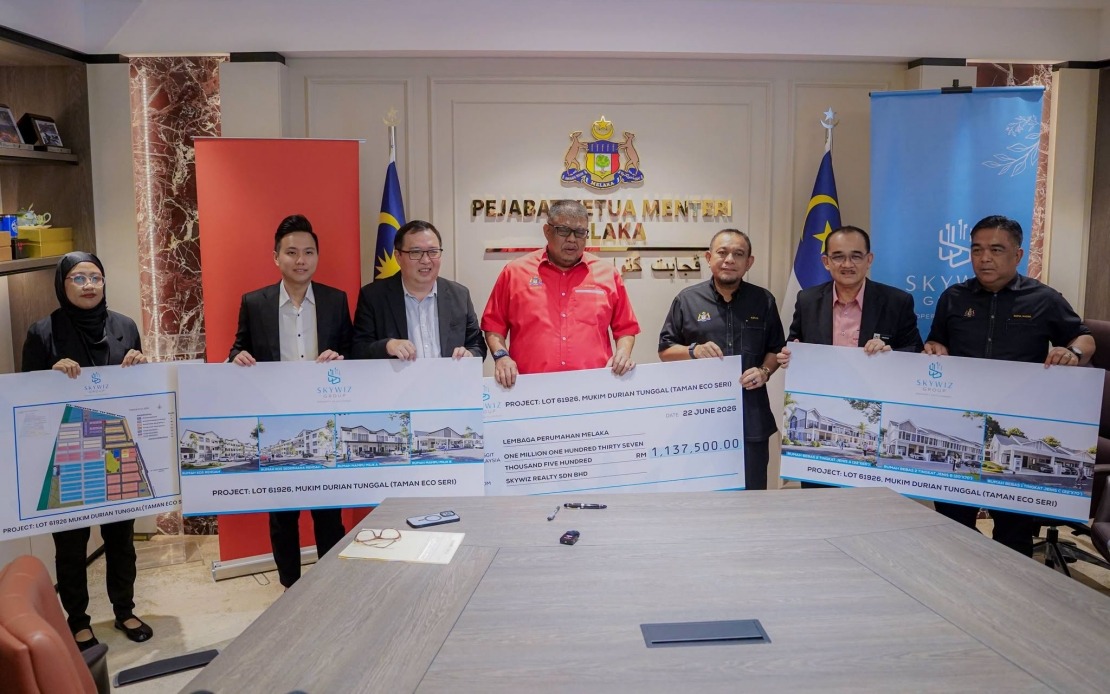
A concrete manifestation of this strategy materialised through an Affordable Housing Development Agreement signed between the Melaka Housing Board (LPM) and Skywiz Reality Sdn Bhd. The developer will undertake a substantial 903-unit residential project across a 26.56-hectare site in Mukim Durian Tunggal, Alor Gajah. This mixed-tenure approach—combining 453 affordable units with 450 open-market units—reflects pragmatic development economics where cross-subsidisation enables affordability provision. The affordable segment comprises carefully differentiated housing categories: 61 low-cost units, 54 low-medium cost units, 200 Type A affordable homes, and 138 Type B affordable homes, suggesting nuanced targeting across different income segments within the affordable housing definition.
The financial implications carry significance for state revenue and housing board operations. The Skywiz Reality project is anticipated to generate RM2.38 million in returns for LPM, contributing to the public entity's financial sustainability and capacity for future initiatives. This revenue stream, multiplied across dozens of projects, creates financial momentum enabling further affordable housing expansion. Developers face a 90-day construction commencement timeline following receipt of Form B approval from the Hang Tuah Jaya Municipal Council (MPHTJ), establishing clear accountability mechanisms and preventing indefinite delays between approval and execution.
The state government's explicit commitment to project oversight signals recognition that policy intentions require sustained institutional monitoring to ensure actual delivery. LPM will maintain active involvement in implementation tracking, verifying compliance with construction schedules, specification adherence, and quality standards. This supervisory approach acknowledges that development agreements represent commitments requiring enforcement, not merely aspirational frameworks that parties may selectively honour.
For Malaysian residents and policymakers, this Melaka initiative offers a replicable model for addressing identified market failures through modest regulatory intervention. The lift mandate addresses a straightforward accessibility problem with cascading benefits: improved marketability for developers, enhanced accessibility for elderly residents, and reduced unsold inventory that represents wasted state resources and unmet housing demand. Other Malaysian states managing similar challenges with aging shoplots and residential complexes might consider comparable standards, particularly in urban and peri-urban areas where lift installation costs represent manageable proportions of total development expenditure.
The broader Southeast Asian context makes this particularly relevant. Across the region, rapid urbanisation has generated substantial residential development without always prioritising accessibility standards appropriate for diverse demographic cohorts. As populations age and urbanisation deepens, the principle that fundamental accessibility should accompany residential development carries increasing salience. Melaka's proactive approach positions the state as responsive to market realities while advancing inclusive urban development principles that benefit entire communities rather than only young, mobile residents.
The timing of this policy direction also reflects post-pandemic reassessment of residential preferences. Extended periods at home during lockdowns heightened awareness of living space quality, building amenities, and accessibility features. Buyers increasingly scrutinise whether properties accommodate future life stages and diverse mobility needs. Developers recognising these shifting preferences gain competitive advantage by embedding accessibility features rather than waiting for regulatory mandates. Melaka's policy initiative thus aligns state requirements with emerging market expectations, potentially accelerating voluntary adoption even before formal mandates take effect.
Moving forward, the practical implementation of lift requirements will depend on detailed policy documentation, developer education, and building inspector training. Clear guidelines regarding lift specifications, emergency procedures, and maintenance standards will prove essential for consistent application. The Melaka Housing Board's expanded oversight role demands adequate staffing and technical capacity to evaluate compliance. If executed effectively, this initiative could establish a template that influences development standards across Malaysia while directly addressing the practical accessibility needs of Melaka's residents.

