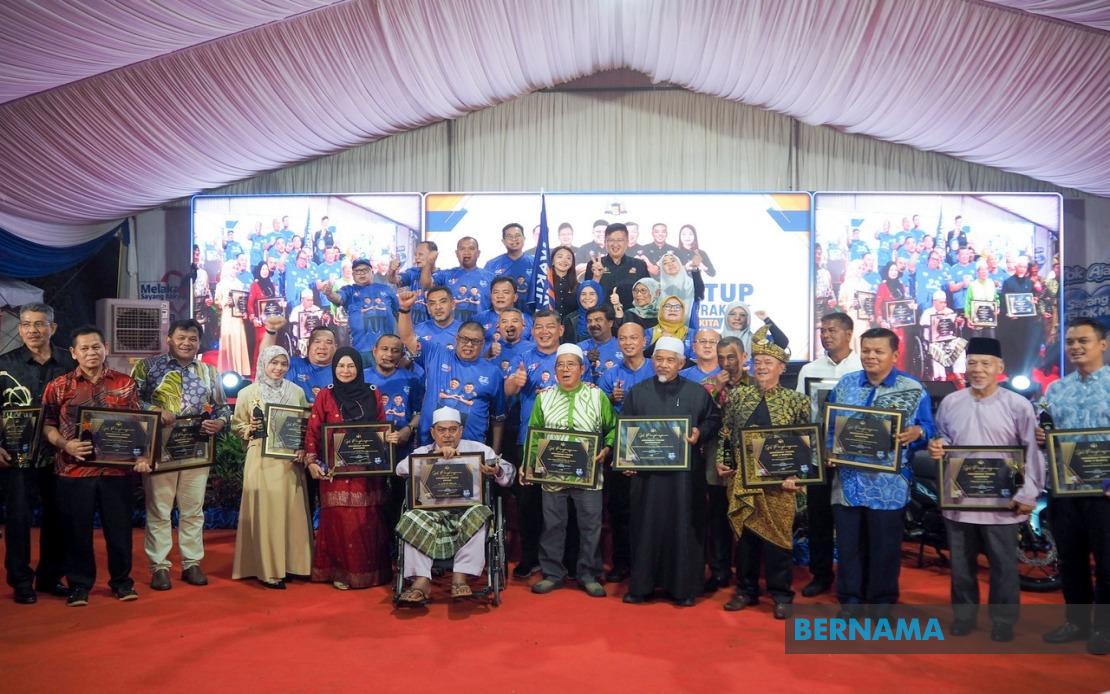
Melaka Chief Minister Datuk Seri Ab Rauf Yusoh has redefined how the state measures success for its Wakil Rakyat Untuk Rakyat (WRUR) programme, arguing that meaningful outcomes for ordinary citizens matter far more than tallying up the initiatives rolled out. Speaking at the closing ceremony for the WRUR scheme covering Kota Melaka parliamentary constituency, Ab Rauf stressed that genuine governance performance hinges on translating complaints and concerns into tangible solutions that visibly improve people's lives and address their immediate grievances.
The WRUR approach represents a deliberate shift towards what Melaka's leadership frames as responsive, bottom-up administration. Rather than concentrating resources on high-profile launches or press releases, the programme channels representatives directly to grassroots communities to systematically capture complaints, log them, and ensure accountability for their resolution. This methodology reflects growing frustration among Malaysian state governments with the traditional model of announcing grand schemes without demonstrating lasting improvements in service delivery or problem resolution.
Across 19 state constituencies, the WRUR initiative has accumulated 4,027 public complaints since inception, with verified resolution of 2,633 cases—representing a 65 per cent success rate. While this completion rate suggests reasonable operational efficiency, the Chief Minister's emphasis on the proportion resolved rather than raw figures signals a maturation in how Malaysian political leadership discusses governance outcomes. The framing acknowledges that not all complaints can or should be settled immediately, and that rushing resolutions without proper investigation or implementation can breed public cynicism.
Kota Melaka became the third parliamentary constituency to undergo the four-week WRUR programme implementation, following earlier rollouts in Alor Gajah and Hang Tuah Jaya. Over its duration, the scheme facilitated more than 500 individual programmes across five state constituencies, affecting over 200,000 residents. Within Kota Melaka specifically, officers processed 470 complaints, of which 31 reached resolution during the active phase, while the remainder entered a formal follow-up pipeline managed by responsible agencies.
A critical feature of Melaka's approach is its commitment to continued engagement after the initial programme closes. Ab Rauf issued explicit instructions to all relevant state departments to maintain monitoring of outstanding complaints and keep pursuing their resolution even as the formal WRUR push concludes. This institutional continuity reflects lessons learned from earlier community initiatives that generated public goodwill during launch phases but faded once formal timelines expired, leaving residents sceptical of future engagement efforts.
The programme's tangible outcomes extend beyond complaint resolution into direct service delivery. State assemblyman for Telok Mas Datuk Abdul Razak Abdul Rahman provided a five-year development summary for his constituency, detailing 328 local projects valued at nearly RM68 million. These ranged across conventional infrastructure priorities—road upgrades, drainage improvements, sewer system repairs—alongside social infrastructure including house renovations, community facilities, places of worship, business centres, sports venues, and school enhancements. The breadth of this portfolio suggests that grassroots listening exercises can genuinely inform strategic resource allocation.
Direct welfare assistance constituted another substantial component of Melaka's service footprint. Over the same period, 6,098 Telok Mas residents accessed food, welfare, and healthcare support valued at over RM1.2 million, while 213 medical beds reached families in need. The Jualan Rahmah and Jualan Murah programmes—government-subsidised retail initiatives—were deployed seventy times since 2022 to cushion residents against inflation, while roughly 15,000 residents accessed fuel assistance worth RM177,000. These measures illustrate how state governments attempt to translate cost-of-living concerns into immediate, visible relief.
Education features prominently in Melaka's articulation of impact. SPM candidates in Telok Mas benefited from dedicated support programmes affecting 1,694 students, while 255 Form Five top performers and tertiary students received educational grants totalling RM244,200. Such targeted assistance addresses a perennial Malaysian concern: whether talented students from modest backgrounds can access quality education. By publicising these figures, state leadership signals responsiveness to family anxieties about educational opportunity and social mobility.
Beyond routine service provision, Melaka is positioning tourism as a long-term economic and social development lever. The Ministry of Tourism, Arts and Culture allocated RM2.4 million to upgrade tourism facilities in Sungai Punggor and Alai, with completion targeted for 2027, while a separate RM300,000 commitment aims to transform Dataran Telok Mas into a tourism and local craft centre. The identification of Bukit Larang as a candidate geosite within the Melaka Geopark framework, scheduled for National Geopark assessment this October, exemplifies how heritage conservation and tourism branding can simultaneously support local identity and economic diversification.
For Malaysian and Southeast Asian observers, Melaka's recalibration of programme success metrics carries broader implications. As citizens across the region grow more sophisticated in evaluating government performance, official rhetoric increasingly emphasises concrete outcomes over symbolic gestures. The 65 per cent complaint resolution rate, while creditable, also invites scrutiny: which categories of complaints face barriers to resolution, how do completion timelines vary, and does resolution genuinely satisfy complainants or merely close administrative files? Transparency about these details would strengthen public confidence further.
The WRUR model also touches on institutional design questions facing Malaysian state and federal governance: whether elected representatives should primarily serve as ceremonial figures or operational problem-solvers, how to balance standardised service delivery with locally responsive adaptation, and whether complaint-driven administration can coexist with proactive social improvement. Melaka's emphasis on sustained engagement beyond formal programme windows suggests that genuine impact requires institutional persistence—a lesson relevant across Malaysia's federal system, where initiative-fatigue among public servants and communities alike can undermine longer-term effectiveness.
As Melaka continues rolling out WRUR across additional constituencies, the success ultimately will not be captured in government press releases or completion statistics, but rather in whether residents perceive that their elected representatives listen, their complaints matter, and that systemic responses follow. This redefinition of governance success—rooted in lived experience rather than programme volume—represents a maturation in how Malaysian political leadership discusses accountability, one that acknowledges that modern citizens demand substantive, verifiable improvements rather than mere activity.