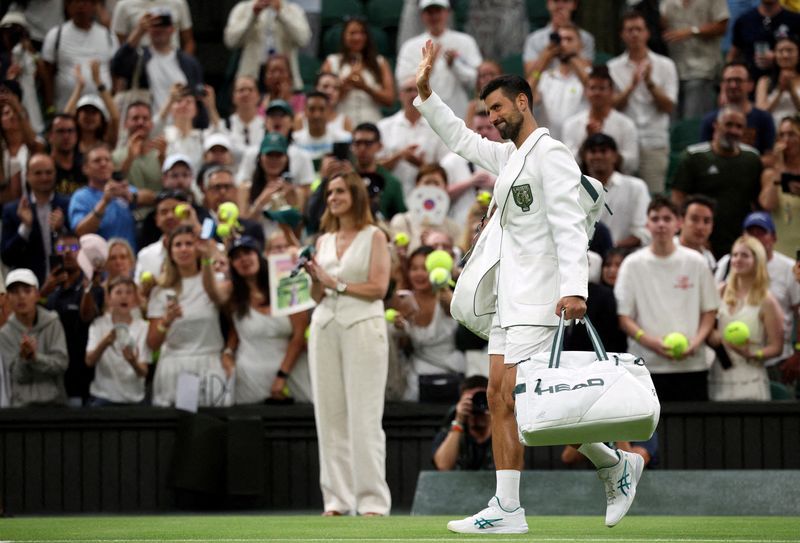
Men's professional tennis is experiencing a noticeable shift in how players approach one of sport's most formal dress codes, with this year's Wimbledon Championships showcasing an unprecedented level of sartorial ambition among male competitors. Novak Djokovic has captured attention in a personalised Lacoste blazer paired with tailored shorts, whilst sixth-seeded Taylor Fritz has turned heads in a white cotton Hugo Boss jacket, complemented by long trousers and a silk scarf—walk-on ensembles that blur the line between athletic competition and fashion runway.
This fashion-forward movement among male players follows closely in the footsteps of Japanese star Naomi Osaka, whose "Kill Bill" inspired kimono ensemble at the tournament has become one of the year's defining sporting fashion moments. The 14th seed has consistently pushed boundaries across all four Grand Slams this year, from her striking black Kevin Germanier skirt at Roland Garros to her jellyfish-inspired outfit at Melbourne Park, establishing a template for athletic self-expression that resonates far beyond traditional tennis circles.
Joelle Michaeloff, chief creative officer at Wilson sports brand, characterises what is unfolding at the All England Club as a watershed moment for male athletes in tennis. Speaking with insight into the broader industry dynamics, she emphasises that male players are finally matching their female counterparts in recognising clothing as a vehicle for personality and identity. This represents a marked departure from decades of understated convention, where male players largely deferred to sponsors' aesthetic choices rather than actively collaborating on design direction.
The commercial machinery underpinning these fashion statements cannot be overlooked. Sponsors now view Wimbledon walk-ons as premium marketing opportunities, carefully curating digital content and imagery for social media distribution. Nike and Osaka's team strategically shared videos of her kimono entrance before her first match, whilst Hugo Boss similarly promoted Fritz's tailored ensemble. This represents a fundamental shift in how brands leverage Grand Slam tournaments, transforming the court entrance into a coordinated media event that extends well beyond the viewing figures of traditional broadcast coverage.
Fritz himself articulates the calculated nature of these fashion choices, acknowledging both the promotional aspect and the inherent risks involved. His observation that "you can't walk out with an outfit and go out in the first round" reveals the unspoken pressure athletes face when making bold sartorial statements—the outfit's success becomes intrinsically linked to tournament performance. His progression to the third round without dropping a set has validated his investment in the Hugo Boss ensemble, allowing him to confidently disrobe his trousers, which feature detachable side seams for efficient removal, and transition seamlessly to match play.
Wimbledon's distinctive all-white requirement, unique among the four Grand Slams, initially appears restrictive compared to the colourful creativity permitted at Roland Garros, the US Open, and the Australian Open. Yet this very constraint has historically catalysed some of tennis's most memorable fashion moments—from British designer Ted Tinling's revolutionary white bodysuit in 1985 to Roger Federer's iconic jacket in 2007. The all-white mandate paradoxically encourages more sophisticated design thinking, compelling designers to work within a monochromatic palette where texture, silhouette, and material composition become the primary vehicles for creative expression.
Michael off notes that contemporary male players are increasingly seeking creative input throughout the design process, moving beyond passive acceptance of sponsor-selected garments. Karen Khachanov, the Russian third-round qualifier, exemplifies this emerging archetype—a player who insists on discussing every design element from fabric choice and colour gradation to neckline construction and fit specifications. This collaborative approach reflects a maturing understanding among athletes that clothing performance directly influences both confidence and movement freedom during competition.
However, not all fashion ambitions survive Wimbledon's rigorous approval process. Italy's Matteo Berrettini, a player who has climbed as high as sixth in the world rankings, discovered the sobering reality of the tournament's strict enforcement when his carefully conceived outfit was rejected for failing to meet the whiteness standards. His wry observation—"It was not white enough"—underscores how Wimbledon's regulatory apparatus, overseen by Eleanor Thomas and the All England Lawn Tennis Club's collections department, maintains institutional control over the fashion narrative even as it permits greater creative latitude.
The roots of this fashion-conscious approach extend deeper into tennis history than contemporary observers might assume. Michaeloff draws parallels not merely to Federer's celebrated 2007 appearance but to the pioneering style consciousness of 1960s and 1970s legends like Arthur Ashe, whose deliberate sartorial choices communicated cultural identity and social consciousness long before fashion became a mainstream talking point in professional tennis. This historical perspective suggests that what appears as a sudden trend actually represents the reanimation and amplification of a tradition that dominant discourse had suppressed.
Fritz's acknowledgement that women players have previously dominated the walk-on fashion conversation—transforming their court entrances into carefully choreographed productions—suggests that male players are finally recognising the strategic and cultural value of these moments. His speculation about future developments reflects genuine uncertainty regarding whether this year's enhanced male participation will establish a permanent fixture in tennis culture or represent a temporary phenomenon driven by particular personalities and sponsor interests.
Eleanor Thomas, whose role at the All England Club affords her comprehensive knowledge of tennis's sartorial history, has formally recognised Osaka's creations as iconic moments worthy of potential future museum exhibition. This institutional acknowledgement elevates fashion choices from mere commercial transactions to cultural artefacts meriting preservation and historical documentation. For Malaysian and Southeast Asian audiences following the sport, these moments carry particular resonance—Osaka's success in integrating East Asian aesthetic traditions into her athletic identity provides a powerful counternarrative to Western-dominated narratives of sporting glamour and professionalism.
The convergence of athlete agency, sponsorship strategy, and institutional tolerance for creative expression represents a meaningful evolution in how professional tennis presents itself to global audiences. As Djokovic demonstrates by exchanging grins with Rory McIlroy across Centre Court—playfully comparing his Lacoste blazer to the golfer's coveted Masters Green Jacket—these fashion moments generate genuine excitement and cross-sport cultural conversation. Whether this represents a permanent recalibration of masculine athletic expression or a momentary flourish remains uncertain, yet the willingness of elite male players to embrace sartorial creativity suggests that the traditional hierarchy separating fashion from competition continues its gradual dissolution.

