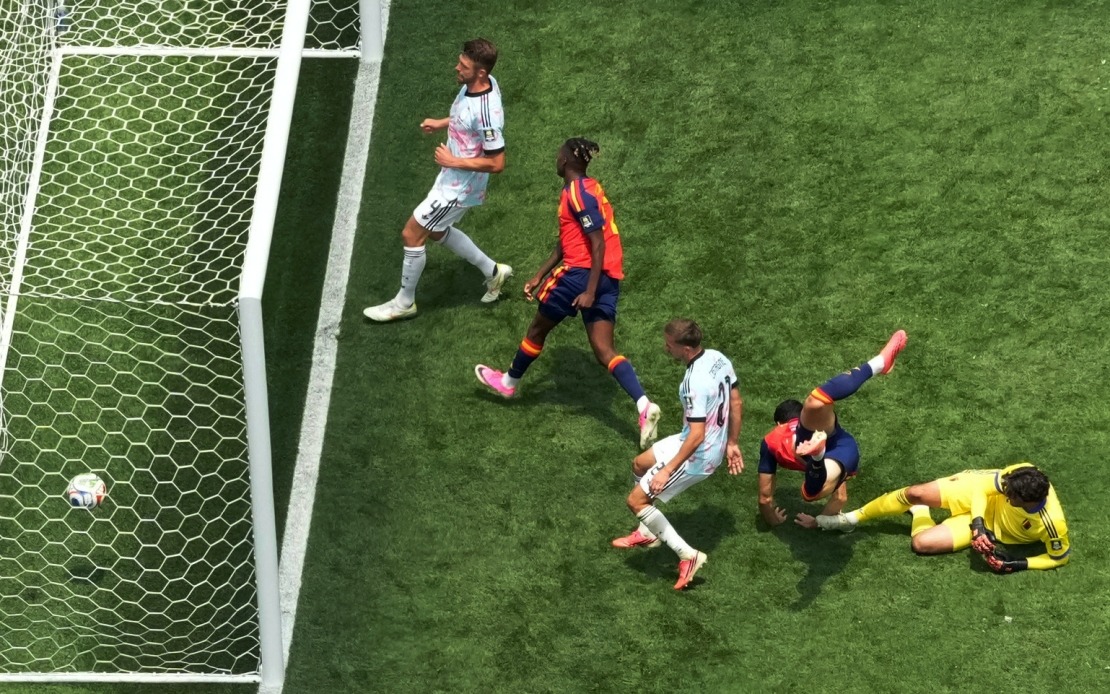
Spain has secured a place in the semi-finals of the FIFA World Cup 2026 after defeating Belgium 2-1 in a tightly contested quarter-final encounter at Los Angeles Stadium in California on Friday. The triumph marks the nation's return to the tournament's final four for the first time since 2010, when they claimed the World Cup crown. Midfielder Mikel Merino emerged as the architect of Spain's advancement, demonstrating his continued importance as a game-changing substitute by converting a crucial opportunity in the 88th minute.
Merino's match-winning contribution extends a remarkable pattern of impact from the bench. The Real Sociedad midfielder had already proven his worth in Spain's previous knockout fixture, netting the solitary goal that eliminated Portugal in the round of 16 last Monday. His ability to influence decisive moments when introduced as a substitute reflects both his tactical awareness and composure under pressure—qualities that have become increasingly valuable in knockout football where marginal differences determine progression.
Spain's dominance throughout the opening stages suggested an emphatic victory might be forthcoming. The side controlled possession and created genuine scoring opportunities, with 18-year-old Lamine Yamal, widely regarded as one of football's most exciting emerging talents, forcing Thibaut Courtois into an impressive save when his curling effort sailed narrowly wide of the left post in the 21st minute. This early period demonstrated Spain's superior technical quality and their manager Luis de la Fuente's tactical organisation, which has become a hallmark of their campaign.
The hosts broke the deadlock in the 30th minute through midfielder Fabian Ruiz, who capitalised on a rebound after Courtois had impressively denied Dani Olmo's initial attempt. The Belgian goalkeeper, at 34 years old, was proving to be an obstructive presence for Spain's attacking aspirations. His resilience continued moments later when he produced a spectacular low save to keep out Yamal's free-kick that appeared destined for the bottom corner in the 35th minute. Courtois's performance suggested Belgium might yet find a route back into the contest despite Spain's clear superiority.
Belgium equalised shortly before the interval through an unexpected avenue. Full-back Timothy Castagne delivered a well-timed cross from the right flank, which Charles De Ketelaere attacked with purpose, powering a downward header past goalkeeper Unai Simon in the 41st minute. The goal represented Spain's first concession of the tournament, indicating the generally strong defensive record La Roja had maintained throughout their campaign. This setback meant the sides entered the second half level, despite Spain's overall dominance in play.
The second period saw Belgium attempt to capitalise on their renewed momentum, with full-back Maxim De Cuyper testing Simon's defences a mere ten minutes after the restart. However, the effort lacked precision, striking the side netting rather than troubling the goalkeeper seriously. Courtois continued to represent an obstacle for Spain's attacking ambitions, producing consecutive saves within rapid succession to deny both Yamal and forward Mikel Oyarzabal. These interventions demonstrated the Belgian goalkeeper's enduring quality, even as his team struggled to exert meaningful pressure offensively.
A crucial turning point arrived in the 71st minute when Courtois, apparently nursing a leg injury, departed the field and was replaced by Manchester United goalkeeper Senne Lammens. This substitution would prove fateful for Belgium's hopes. Lammens's lack of match sharpness became evident when he fumbled a long-range effort from centre-back Pau Cubarsi, spilling the ball dangerously into the penalty area. Merino, demonstrating the predatory instincts required at this level of competition, reacted with precision to fire home a poacher's finish and restore Spain's lead in the 88th minute.
With the World Cup format expanded to accommodate 48 teams across the tournament hosted jointly by Canada, Mexico and the United States, Spain's progression represents a significant achievement in a field of increased competitive depth. The tournament, which commenced on June 11 and concludes on July 19, has generated considerable excitement across the global football community. The expansion format, the largest since the inaugural 1930 edition in Uruguay, means that reaching the semi-finals represents navigating one of the most competitive World Cup campaigns in contemporary football.
Spain's next challenge promises to be even more daunting. The side will face France in Dallas Stadium on July 15 after the two-time champions impressively dismantled Morocco 2-0 in their quarter-final clash on Thursday. This semi-final pairing represents one of European football's most compelling fixtures, pitting two sides with contrasting tactical philosophies and recent tournament pedigree against one another. France's recent dominance in World Cup competitions, coupled with Spain's possession-based attacking football, should produce an engaging contest that will likely determine which nation progresses to the final.
From a Southeast Asian perspective, Spain's advancement and the tournament format itself carry implications for developing football nations. The expanded 48-team World Cup format represents FIFA's stated commitment to globalising the competition and providing greater opportunities for emerging footballing regions. However, the dominance of established European and South American powers in the knockout stages suggests that despite structural changes, traditional elite nations continue to leverage their superior resources, infrastructure and player development systems to advance further in the tournament. Spain's success exemplifies how established nations can adapt tactical approaches and rely on exceptional individual talent, such as Merino's decisive interventions and Yamal's precocious ability, to maintain their competitive advantage.

