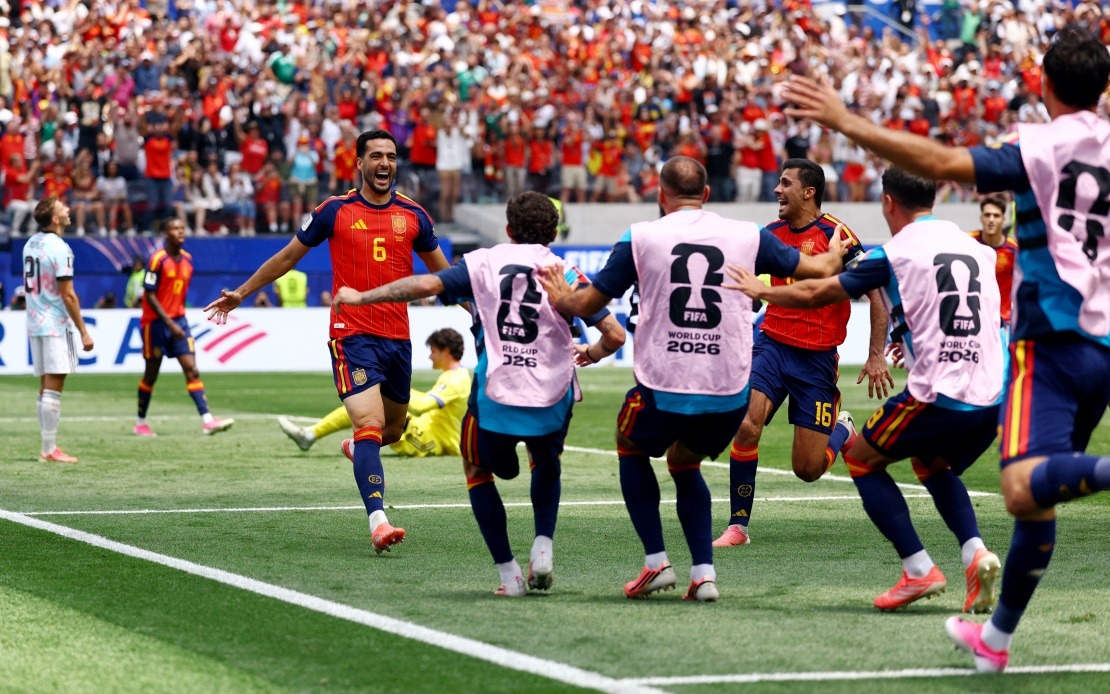
Spain advanced to the World Cup semi-final with a dramatic 2-1 victory over Belgium in Inglewood, California, with substitute Mikel Merino delivering the winning goal in the 88th minute. The result sets up a highly anticipated clash between two of Europe's strongest football nations, as La Roja will face France near Dallas on Tuesday in what promises to be one of the tournament's most competitive matches.
Spain's pathway to victory began with a composed opening performance, with Fabián Ruiz breaking the deadlock in the 30th minute to give the European champions the advantage. However, Belgium responded when Charles De Ketelaere found the net, levelling the match and breaking a remarkable streak for Spain's goalkeeper. Unai Simón had gone without conceding in competitive World Cup football, an extraordinary record spanning 649 minutes across two tournaments, until De Ketelaere's equaliser momentarily shifted momentum in Belgium's favour.
The turning point came midway through the second half when an injury to Belgian goalkeeper Thibaut Courtois forced the experienced stopper off the pitch in tears at the 71-minute mark. Senne Lammens, Manchester United's reserve keeper, entered the fray to replace Courtois in what would prove a fateful substitution. The change in personnel in the Belgian goal coincided with Spain's tactical adjustments, as fresh attacking options emerged from the bench.
Belgium's problems extended well beyond the goalkeeper situation. Captain Youri Tielemans was forced to withdraw during the warm-up phase due to what appeared to be a hamstring injury, depriving the side of crucial midfield control. Compounding these difficulties was the ongoing absence of Amadou Onana, whose knee ligament injury had already ruled him out of the competition. These absences left Belgium's midfield significantly weakened, unable to provide the defensive stability and ball-control rhythm that might have contained Spain's mounting pressure.
Spain capitalised on Belgium's defensive vulnerabilities following the introduction of additional attacking reinforcements from the bench. Nico Williams and Merino entered the fray to bolster Spain's offensive threat, and their presence immediately altered the dynamic of the match. The combination proved devastating in the closing stages, as Spain's superior depth and technical quality began to overwhelm a Belgian team already stretched by injury-forced absences.
The decisive moment arrived when Pau Cubarsi's long-range strike created the opportunity that Lammels failed to handle cleanly. The ball spilled from the Belgian goalkeeper's grasp, and Merino pounced on the loose ball to drive it high into the net. This was Merino's second crucial contribution from the bench in this tournament, replicating his impact in Spain's previous knockout encounter against Portugal in the round of 16, where he had similarly arrived as an impact substitute to secure Spain's passage.
France now looms as Spain's opponent in what will effectively be a rematch of their Euro 2024 semi-final, which La Roja won convincingly. The French side, twice World Cup champions in 1998 and 2018 and runners-up to Argentina in the 2022 final, have dominated their path through this tournament but will face their sternest examination yet. Spain's dominance against Belgium, despite the European champions' opposition being hampered by injuries, demonstrated the tactical sophistication and creative depth that makes Luis de la Cruz's side a genuine threat to France's aspirations.
Spain's World Cup pedigree, while limited to a single triumph in 2010, has been bolstered by recent success at the continental level. The victory over Belgium maintains La Roja's impressive form and sets up a semi-final encounter that many observers regard as the tournament's standout tie. France's experience as a two-time champion and their performance throughout the competition position them as slight favourites, yet Spain's recent tournament record and depth of talent suggest this will be a closely contested affair.
The scheduling of the semi-final near Dallas offers geographical advantage considerations for both teams, though the significance of venue pales in comparison to the quality of football each side can produce. Spain's ability to break down compact defences, demonstrated against Belgium despite the Belgians' injury crisis, will be tested against France's structured approach and their own formidable attacking resources. Merino's timely finish not only secured Spain's progression but also underscored the bench strength that may prove decisive in knockout football, where tactical adjustments and fresh legs often determine outcomes.
For regional audiences, Spain's advancement holds particular significance given the shared continental football heritage and the tactical evolution that European sides continue to demonstrate. The upcoming semi-final will showcase the tactical intelligence and technical proficiency that has come to characterise modern European football at its highest level, with both teams representing the continent's defensive organisation combined with creative attacking prowess.

