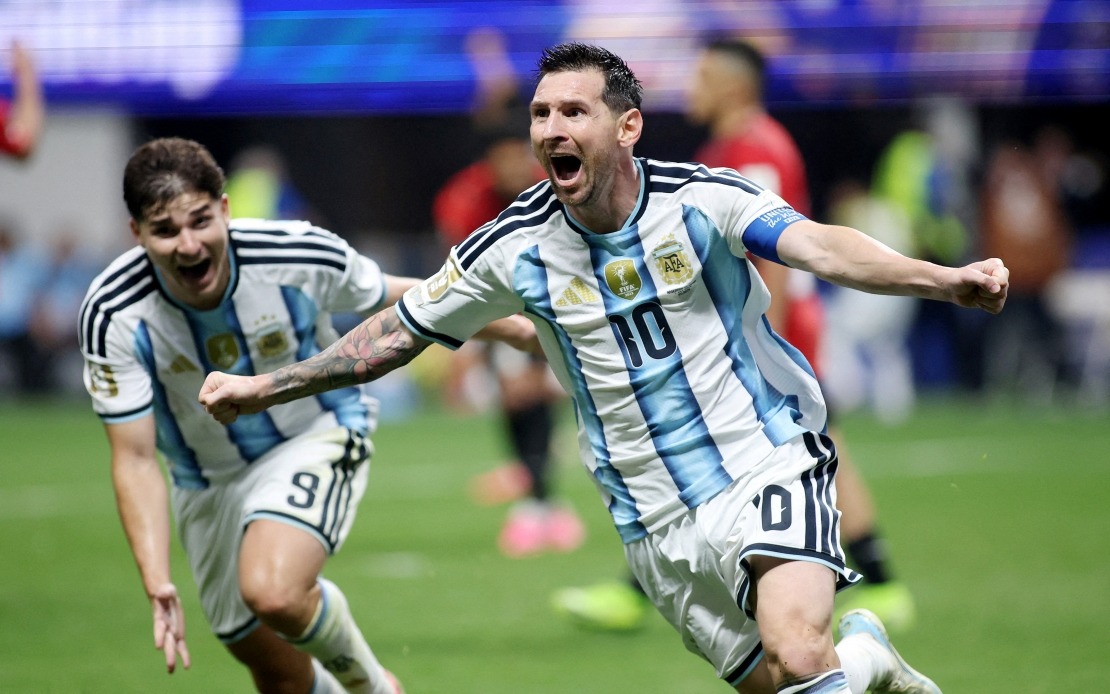
At 39 years old, Lionel Messi continues to defy expectations by leading Argentina's assault on a second World Cup title in North America. The legendary forward has already accumulated eight goals in this summer's tournament, matching France's Kylian Mbappé atop the scoring charts as the competition reaches its decisive stages. Yet for Messi, the race for individual honours represents far more than personal achievement—it symbolises the completion of a legacy that has already reshaped modern football's record books.
Messi's return to the World Cup stage comes less than two years after he orchestrated Argentina's triumph in Qatar in 2022, when he scored seven goals including two in the final to secure victory over France. That campaign appeared to many observers as the natural conclusion to a career defined by excellence and near-misses on football's grandest stage. The collective desire within the Argentine squad to deliver the sport's greatest honour before Messi's anticipated retirement seemed to have provided sufficient motivation for that 2022 triumph. Instead, the captain has chosen to extend his playing career, and his presence once again transforms Argentina's ambitions and his own pursuit of greatness.
The Golden Boot—awarded to the tournament's leading goal-scorer—represents one of the few major individual accolades that has escaped Messi's personal collection. Four years ago in Qatar, he finished second in this race, watching as Mbappé claimed the prize with a hat-trick in the final despite ending on the losing side. That disappointment appears to have stuck with the Argentine, who now stands at eight goals with several knockout matches remaining. Mbappé currently maintains a slight advantage through the tournament's tie-breaking criteria, specifically through his superior assist count and fewer minutes required to achieve his tally, though either player appears capable of separating themselves from the field in the coming fixtures.
Beyond the immediate battle with Mbappé, Messi has already secured a place among football's all-time World Cup goal-scorers. His career tally of 21 World Cup goals now stands just one behind Mbappé's current 21, though the French forward appears destined to eventually claim this record given his youth and trajectory. Together, both players have decisively surpassed Miroslav Klose's previous record of 16 goals, with England's Harry Kane having also climbed the all-time list to 14 goals in this tournament. This summer has fundamentally reshaped how football measures international goal-scoring excellence.
Messi's longevity across World Cup tournaments has produced unprecedented records that may never be surpassed. He and Cristiano Ronaldo have become the first male players to compete in six World Cups, and both have obliterated Lothar Matthäus' previous appearance record of 25 matches. Messi is positioned to make his 33rd World Cup appearance, establishing a gap of six matches over his Portuguese rival. This statistical dominance reflects not merely physical durability but an exceptional ability to maintain competitive relevance across nearly two decades of football's most demanding competition.
Examining Messi's World Cup evolution reveals a narrative of gradual ascent punctuated by a dramatic final flourish. His tournament debut in 2006 yielded a single goal, while the 2010 South African tournament passed without him finding the net. By 2014, when Argentina hosted the competition in Brazil—a nation Argentina regards with considerable rivalry—Messi contributed four crucial goals. His 2018 appearance in Russia yielded just one goal, suggesting his peak World Cup performances had perhaps passed. Yet at age 35 in Qatar, he produced more goals in that single tournament than across his previous four appearances combined, a renaissance that seemed improbable and defined that championship campaign.
Penalty-taking represents a notable complexity within Messi's World Cup narrative, one that has resurfaced during the current campaign. While four of his seven goals in Qatar came from the penalty spot, he demonstrated vulnerability from twelve yards by also missing a spot-kick in that tournament. This summer's competition has further exposed this vulnerability: Messi saw a penalty saved by Egypt's goalkeeper Mostafa Shobeir in the round of 16, and sent another wide during Argentina's group-stage encounter with Austria. Across his World Cup career excluding shootouts, Messi has converted only four of eight penalties attempted, a conversion rate that falls considerably below elite standards. However, his record in penalty shootouts remains immaculate, having succeeded in three decisive shootout scenarios including the 2022 final victory over France and a 2014 semifinal against the Netherlands.
The contrast between Messi's penalty-shootout success and open-play conversion from the spot highlights an interesting psychological dimension to his performances under extreme pressure. When outcomes are determined by sudden-death scenarios rather than a single attempt, Messi has delivered flawlessly. Conversely, the solitary penalty opportunity, while still high-pressure, appears to present different challenges. This nuance adds texture to his overall tournament performance and demonstrates that even at elite levels, individual circumstances and psychological factors influence outcomes.
Messi's career World Cup trajectory intersects meaningfully with broader narratives about athletic longevity and the evolution of professional football. At 39, competing at this level against younger competitors represents an exceptional achievement that transcends mere statistics. His presence transforms Argentina's tactical approach and psychological outlook, providing a stabilising force that influences outcomes beyond his direct goal contributions. The team's success in 2022 and their continued strength in this tournament validate the notion that elite player experience and winning mentality remain decisive factors even in modern football's increasingly athletic environment.
For Malaysian and Southeast Asian football audiences, Messi's continued excellence offers instructive lessons about professional standards and the dedication required to sustain excellence across decades. His World Cup record—whether measured by goals, appearances, or trophies—demonstrates the tangible rewards of sustained commitment to improvement. As younger competitors like Mbappé and other emerging talents challenge his records, the sport continues evolving, yet Messi's achievements provide a benchmark against which future greatness will be measured for generations to come.

