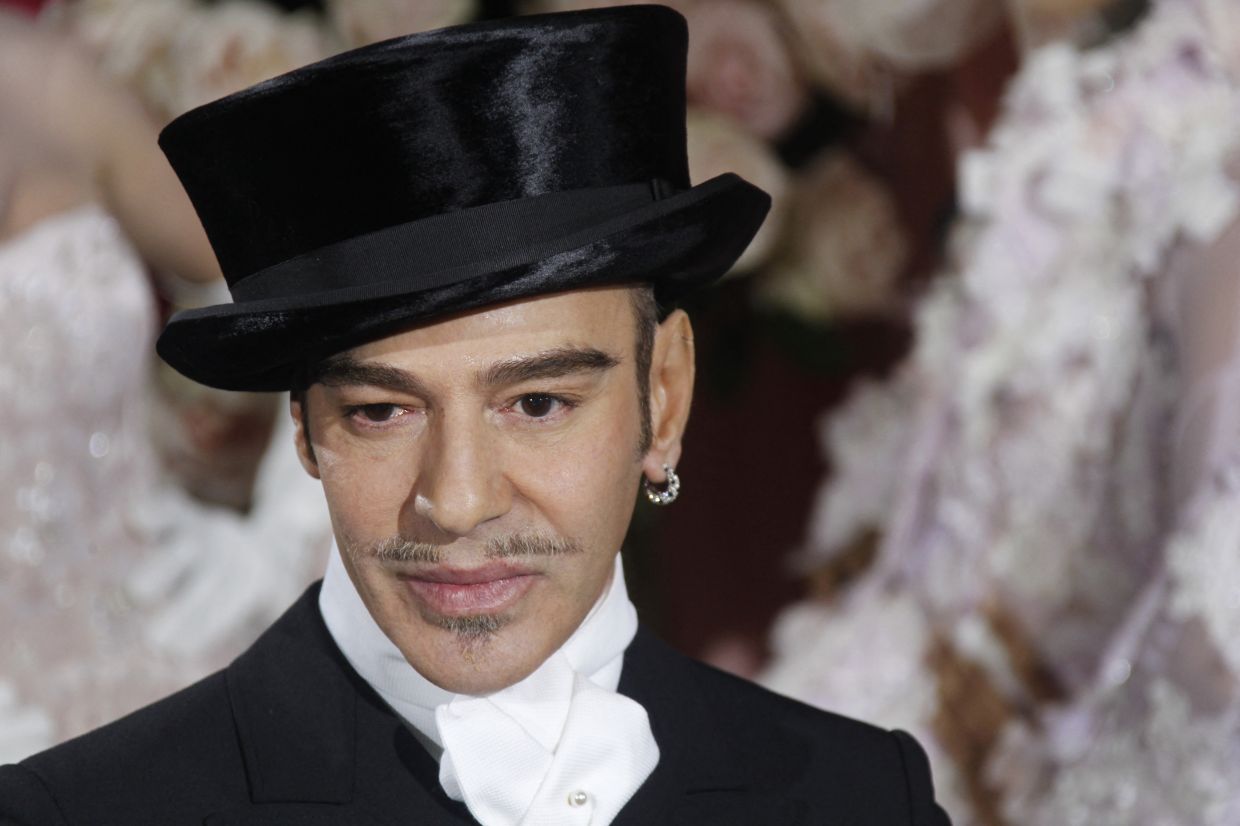
The Metropolitan Museum of Art has announced an audacious curatorial decision: its 2025 spring exhibition will be dedicated to John Galliano, the British designer whose meteoric rise to the pinnacle of French fashion was matched only by the precipitousness of his fall. The exhibit, which will launch at next May's Met Gala, positions Galliano as only the third living designer to receive a solo retrospective at the museum's prestigious Costume Institute—a distinction that acknowledges both the magnitude of his creative contribution to fashion history and the complex reckoning the institution believes must accompany such recognition.
Galliano's trajectory represents one of contemporary fashion's most dramatic arcs. As creative director of Christian Dior for nearly fifteen years, he commanded one of the industry's most influential posts, wielding extraordinary creative authority over a storied house with centuries of heritage. His designs became synonymous with theatrical virtuosity, historical referencing, and technical mastery that pushed the boundaries of what haute couture could express. Yet in 2010 and 2011, a series of antisemitic and racist remarks he made in public settings were recorded and circulated online, fundamentally fracturing his career and forcing the fashion establishment to confront uncomfortable questions about artistic genius and ethical responsibility.
The fallout was swift and severe. Dior terminated his position, and the French courts convicted him following a trial that addressed public insults based on race, religion, ethnicity, and national origin. For several years, Galliano existed in professional limbo, engaging in what the museum describes as both public and private rehabilitation efforts. Yet the fashion industry's appetite for genuine talent and innovation eventually created space for his return. In 2014, the Belgian luxury house Maison Margiela appointed him as creative director, a position he would hold for a decade, gradually rebuilding his reputation through consistently innovative collections that demonstrated the endurance of his creative vision.
The Met's decision to mount this retrospective is deliberately confrontational in its refusal to compartmentalize Galliano's legacy. Rather than presenting a sanitized celebration of his achievements, the institution has structured the exhibition in three distinct sections designed to prevent any easy separation between artistic accomplishment and ethical accountability. The curatorial team, led by Andrew Bolton who oversees nearly all of the Met's major fashion exhibitions, has framed the show as an examination of how Galliano "has remapped the world through fashion" while simultaneously considering "how his conduct, its consequences, and changing cultural values have reshaped our understanding of his work."
The first section, titled "Bearings," will directly confront the rupture caused by Galliano's 2010-2011 remarks. The museum's statement emphasizes that this portion will address "the antisemitic, racist, and anti-Asian conduct" that precipitated his dismissal from both Dior and his own eponymous label, as well as his subsequent conviction. Importantly, this section will also document his treatment for substance addiction and his later public acknowledgment of his actions—details that complicate any simplified narrative of either condemnation or redemption. Rather than treating his rehabilitation as an afterthought, the curators position it as integral to understanding his evolution as both a person and a creator.
The exhibition's second component, designated "Horizons," shifts focus to Galliano's creative wellsprings. This section excavates the historical references, geographical inspirations, artistic traditions, and performative traditions that have consistently animated his design philosophy. For decades, Galliano has been known for collections that synthesize disparate cultural and historical sources—a technique that, when executed with sensitivity and intellectual rigor, can produce profound results, yet when divorced from genuine understanding, risks exploitation. The curators appear to be inviting viewers to examine this tension directly.
The third and final section, "Atlas of Transformation," concentrates on what might be described as the purely technical dimensions of Galliano's contribution: his innovation in construction, his experimentation with materials and silhouettes, and his advancement of the craft itself. By positioning technical mastery last rather than first, the museum suggests that while Galliano's skills are undeniable, they cannot stand alone as justification for overlooking the harm caused by his speech. This sequencing represents a deliberate curatorial argument about how we should weight different aspects of an artist's legacy.
Sensitivity to the Jewish community was paramount in the exhibition's planning. The museum conducted extensive meetings with New York Jewish leaders to understand their perspectives and concerns, conversations that included not only Bolton and the museum's leadership but also Galliano himself and Vogue editor-in-chief Anna Wintour. These consultations signal an institutional acknowledgment that retrospectives involving figures responsible for bigotry cannot proceed as though such history exists in a realm separate from the communities directly affected by it.
For Malaysian and Southeast Asian observers, the Met's approach carries particular relevance. The region has experienced its own periodic controversies involving cultural figures whose artistic contributions were initially separated from troubling personal conduct or statements. The Galliano retrospective offers a template for institutions considering how to honor achievement while maintaining moral clarity. It refuses the false binary between cancellation and uncritical celebration, instead proposing that serious institutions can and should engage with complicated legacies—provided they do so with intellectual honesty and genuine consultation with affected communities.
Moreover, Galliano's story illuminates broader questions about redemption, accountability, and professional rehabilitation that resonate across cultures. His decade at Maison Margiela demonstrated that talented individuals can rebuild careers after significant ethical failures, but only through sustained commitment to behavioral change and genuine reckoning with past conduct. The Met's decision to feature him suggests that such transformation, when credible, merits recognition—though not forgetting.
The 2025 Met Gala will undoubtedly generate intense media scrutiny and public debate. Fashion observers will dissect both the collections on display and the exhibition's framing choices, while broader conversations about artistic legacy, cultural memory, and institutional responsibility will inevitably surface. In choosing to place Galliano in this spotlight while refusing to shy away from the problematic dimensions of his history, the Costume Institute has undertaken ambitious curatorial work that acknowledges fashion's genuine artistic significance while insisting it cannot exist in moral isolation.

