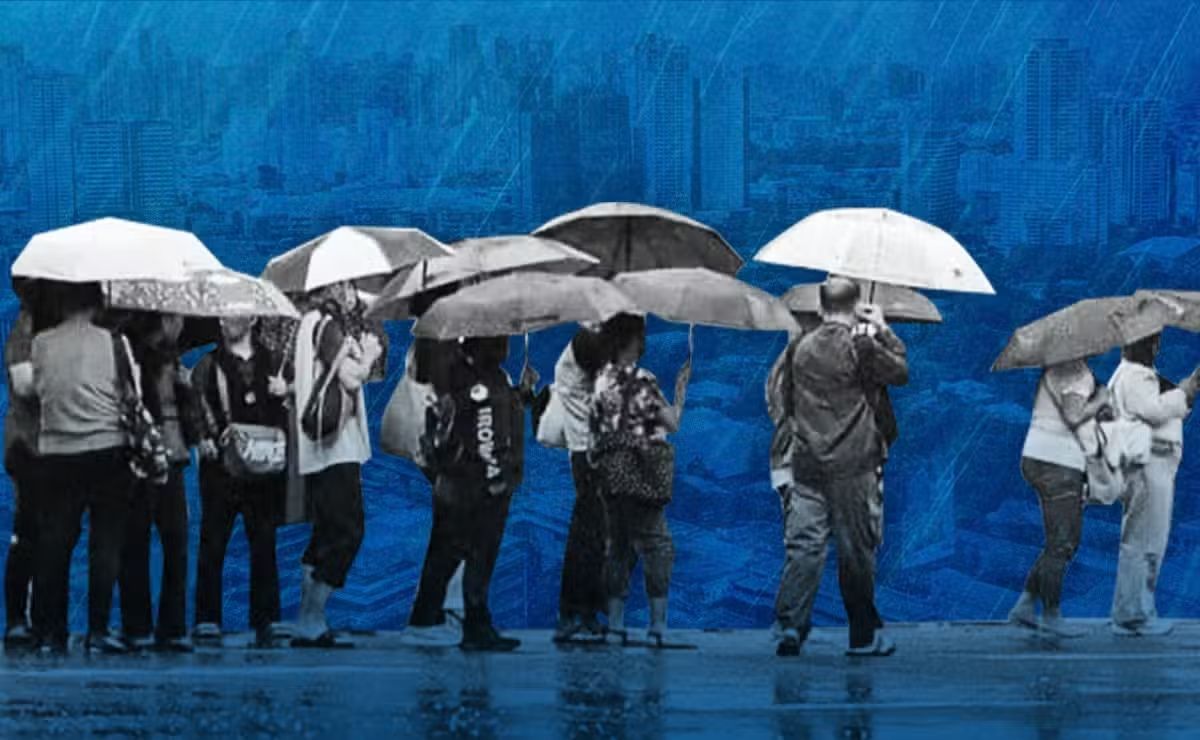
The Philippine capital absorbed roughly 483 millimeters of rainfall over a single 10-day span when southwest monsoon winds converged with successive tropical cyclones in early August, a deluge that data analysts argue signals deeper vulnerabilities in the region's capacity to manage water crises. The concentrated precipitation has rekindled debate about whether Metro Manila's existing flood defenses can withstand intensifying weather patterns and whether government resources directed toward protection schemes are reaching their intended targets.
Dr Alicor Panao, an associate professor at the University of the Philippines and data scientist, examined rainfall measurements across Metro Manila from August 5 to 14, drawing on information from 23 monitoring stations operated by the Philippine Atmospheric, Geophysical and Astronomical Services Administration (Pagasa). His analysis found that these stations collectively recorded an average cumulative total of 483.4 millimeters during the period, translating to roughly 48.3 millimeters daily—though the distribution proved highly uneven geographically and temporally.
The rainfall pattern contained a particularly intense spike. Nearly half of the entire 10-day accumulation fell within just two consecutive days, with August 9 and 10 bearing the heaviest loads. On August 9 alone, Pagasa's Airport monitoring station registered 226.5 millimeters, a striking figure that Panao characterized as extraordinary precipitation. This concentration created conditions where water management systems received minimal recovery time between successive surges.
While the 226.5-millimeter single-day reading is notable, it remains below Metro Manila's historical extreme from 2009. During that year, Tropical Storm Ondoy inundated the capital with unprecedented intensity, with Pagasa's Science Garden station measuring 455 millimeters in one calendar day—itself a record that had superseded the previous benchmark of 334 millimeters established in June 1967. The distinction matters because it suggests current infrastructure, though strained, theoretically accommodated more extreme conditions in living memory.
Yet Panao emphasized that treating rainfall purely through single-event metrics misses the critical challenge posed by cumulative loading. Over the 10-day window, the combined volume distributed uniformly across a square kilometer would yield approximately 483.4 million liters. Scaling this across Metro Manila's approximate 620-square-kilometer footprint produces a conceptual total equivalent to roughly 120,000 Olympic-standard swimming pools—approximately 193 pools per square kilometer. This massive volumetric perspective illustrates why infrastructure designed for peak flows struggles when successive weather systems prevent natural drainage cycles from completing.
Certain monitoring locations recorded particularly severe accumulations. Sitio Wawa measured 708 millimeters over the 10-day period, while San Mateo-2 logged 701 millimeters and La Mesa Dam recorded 645.5 millimeters, indicating that rainfall intensity varied substantially across the metropolitan area. These localized extremes suggest that some drainage basins received concentrations substantially exceeding regional averages, creating localized inundation despite adequate infrastructure elsewhere.
Panao's analytical perspective directs attention beyond hardware toward systemic governance questions. He contends that repetitive heavy precipitation leaves rivers, drainage networks and watershed systems insufficient time to normalize before subsequent rainfall arrives, rendering the physics of water management secondary to questions of operational integrity. This framing reframes flooding not primarily as a natural disaster but as an administrative outcome—the product of how infrastructure is specified, constructed and maintained across time.
Investigations have increasingly documented instances where flood-control funding failed to produce commensurate protective capacity. Reports have identified ghost projects—allocated resources that generated no infrastructure—alongside substandard construction and inflated pricing schemes. Some of these cases have apparently progressed toward criminal prosecution, suggesting systemic rather than isolated dysfunction. The implication for policymakers is uncomfortable: Metro Manila may possess nominal infrastructure capacity that underperforms owing to implementation failures rather than fundamental design inadequacy.
For Malaysian observers, the Metro Manila situation carries relevance given comparable climate exposure and infrastructure challenges across Southeast Asia. The region's major urban centers similarly face intensifying monsoon systems and occasional tropical cyclone activity, with drainage networks designed for historical rather than contemporary precipitation patterns. The Philippine experience underscores that capital expenditure on flood infrastructure proves insufficient without rigorous project governance, transparent competitive procurement, and sustained maintenance oversight.
The August rainfall episode also contextualizes broader regional climate adaptation debates. As meteorological patterns shift and extreme precipitation events occur with apparent greater frequency, cities throughout Southeast Asia confront whether existing infrastructure can adapt through modification or whether wholesale redesign becomes necessary. Panao's emphasis on the interval between successive weather events—essentially the "recovery time" for drainage systems—suggests that infrastructure sufficiency depends not merely on peak capacity but on frequency of loading.
For stakeholders monitoring flood risk across the region, Metro Manila's experience offers a cautionary case study in how nominal infrastructure capacity obscures actual protective function. The political economy of water management—the allocation of resources, quality of implementation, and accountability for outcomes—ultimately determines whether precipitation becomes manageable runoff or catastrophic inundation. Without structural reforms addressing governance and oversight, regional cities may find themselves simultaneously over-capitalized in phantom projects and under-prepared for real conditions.

