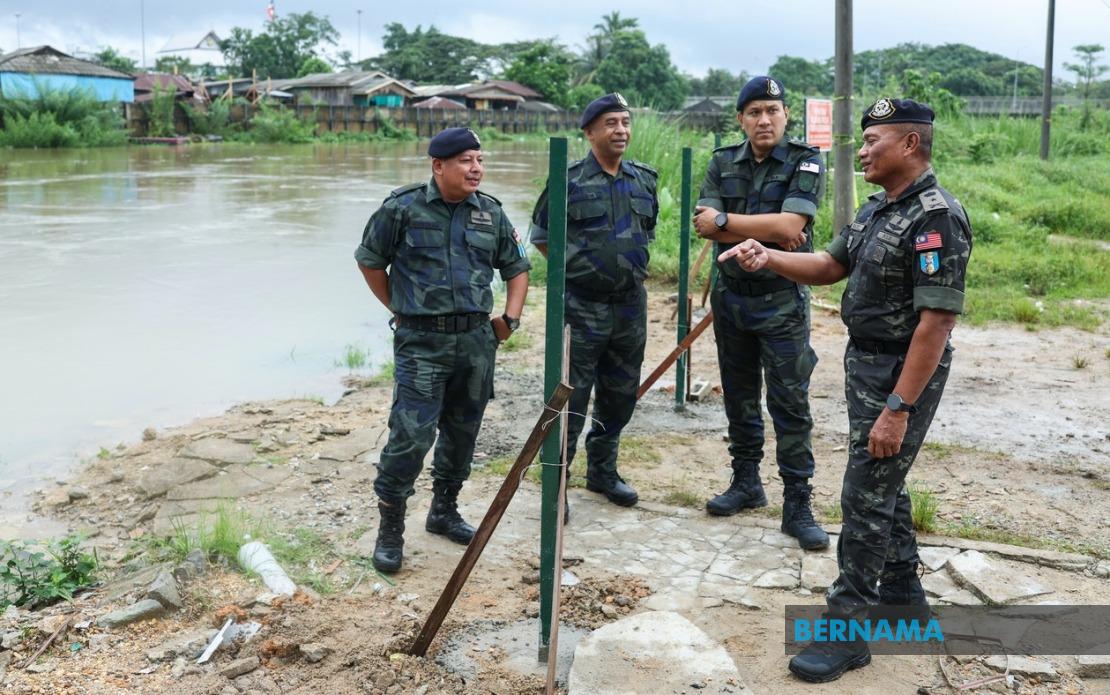
The General Operations Force has exposed an evolving smuggling strategy that breaks migrant arrivals into fragmented waves, a tactical adjustment designed specifically to circumvent heightened border security measures across Peninsular Malaysia. The discovery emerged during Operasi Taring Wawasan Kelantan when GOF personnel intercepted 13 undocumented nationals from Myanmar across separate enforcement actions centred in Kelantan's Pasir Mas district, revealing how criminal networks have adapted their approach to human trafficking in response to sustained law enforcement pressure.
Southeast Brigade GOF commander SAC Ahmad Radzi Hussain revealed that the operational methodology now prioritises small-scale, sequential deployments rather than consolidated group movements that had characterised earlier smuggling patterns. This refinement reflects a calculated risk assessment by trafficking organisations, who recognise that concentrated migrant clusters traversing border regions trigger heightened vigilance from security checkpoints and patrolling units. By fragmenting arrivals into discrete cohorts dispersed across forested terrain, smugglers aim to individualise each crossing event, reducing the operational signature that might alert authorities to coordinated human-trafficking activity.
The enforcement action commenced in the predawn hours at approximately 3.30 am on June 27, when GOF operatives acting upon intelligence observed a suspicious Proton Exora vehicle operating in Kampung Banggol Kemian. Upon detecting the security presence, the driver immediately abandoned the vehicle and fled into adjacent forest cover, successfully evading capture. Subsequent inspection of the abandoned car revealed four Myanmar nationals occupying the rear compartment, all lacking valid travel documentation. These individuals became the first cohort of arrests, but the larger operation was only beginning to unfold.
Within roughly one hour of the initial vehicle interception, GOF teams conducting systematic sweeps of the surrounding forest perimeter located an additional nine Myanmar nationals who had evidently arrived through irregular border crossings moments before. This secondary detention proved crucial to understanding the smugglers' new operational pattern. During questioning, all 13 detainees consistently reported having crossed the Golok River from Thai territory under guidance of two unidentified human traffickers who had deliberately staggered their entry points and forest drop-off locations. The intentional spacing of arrival sites served a dual purpose: minimising the visual and acoustic footprint of any single group movement whilst creating a geographic buffer that would complicate unified response by enforcement personnel.
The detainees, whose ages ranged between 20 and 37 years, revealed that they had been transported across the Golok River—Malaysia's maritime boundary with Thailand—by smuggling operatives who possessed detailed knowledge of temporal and spatial gaps in border patrols. The deliberate sequencing of their delivery into Malaysian territory through separate forest zones represented a calculated exploitation of logistical constraints facing security forces. Rather than risk apprehension as a consolidated unit, the syndicate orchestrated multiple micro-insertions, betting that scattered individuals would be more difficult to intercept than a visibly obvious convoy requiring a single coordinated intervention.
The ultimate destination disclosed during interrogation centred on the Kuala Lumpur metropolitan area, suggesting these migrants represented components of a larger recruitment pipeline funnelling undocumented labour into Malaysia's urban centres. The Klang Valley's construction, manufacturing, and service sectors have historically attracted irregular migrant workers, creating economic pull factors that sustain smuggling operations. By dispersing arrivals across Kelantan's interior before onward transport southward, smugglers reduce the concentrated presence of migrants at any single transfer point, diminishing the likelihood of discovery during intermediate stage transit.
Beyond the 13 detained individuals, authorities also seized the Proton Exora utilised for inland transportation, valued at approximately RM30,000. This vehicle represented tangible capital investment by the smuggling syndicate, indicating the commercial scale and profitability of the operation. The loss of such transport assets constitutes a genuine financial consequence for organised trafficking networks, though the mobile nature of such illicit enterprises typically permits rapid replacement through alternative vehicle acquisition.
All detainees were subsequently transferred to the Criminal Investigation Division of Pasir Mas district police headquarters for formal processing and investigative procedures. The legal framework governing their detention centres on Section 6(1)(c) of the Immigration Act 1959/63, which addresses unlawful entry and presence of foreign nationals within Malaysian territory. This legislative provision permits extended detention pending deportation proceedings, though investigations may also encompass trafficking complicity charges against the unidentified smuggling operatives who remain at large.
The tactical evolution observed in this case reflects broader international patterns in human smuggling, where enforcement pressure systematically incentivises criminal networks to innovate operational methodologies. As border security technologies and patrol coverage intensify, smugglers worldwide have shifted from large-scale group movements toward distributed networks, individual crossings, and maritime routes offering lower interception probabilities. Malaysia's experience mirrors disruption tactics documented across the Balkans-Turkey corridor, the US-Mexico border, and Southeast Asian maritime passages, where successful enforcement has driven adaptation rather than suppression.
For Malaysian authorities, this emerging pattern necessitates corresponding tactical adjustments in border surveillance and interior enforcement architecture. The intelligence-led operation that uncovered the staggered arrival scheme demonstrates the continued utility of conventional HUMINT and ground-level vigilance, yet the syndicate's ability to successfully execute 13 separate insertions—with only partial interception—suggests capacity constraints remain within security force deployments. The two smuggling operatives who deposited migrants in the forest and escaped apprehension indicate that eliminating the criminal infrastructure requires sustained pressure against the trafficking kingpins coordinating these operations, not merely interdiction of migrant arrivals themselves.

