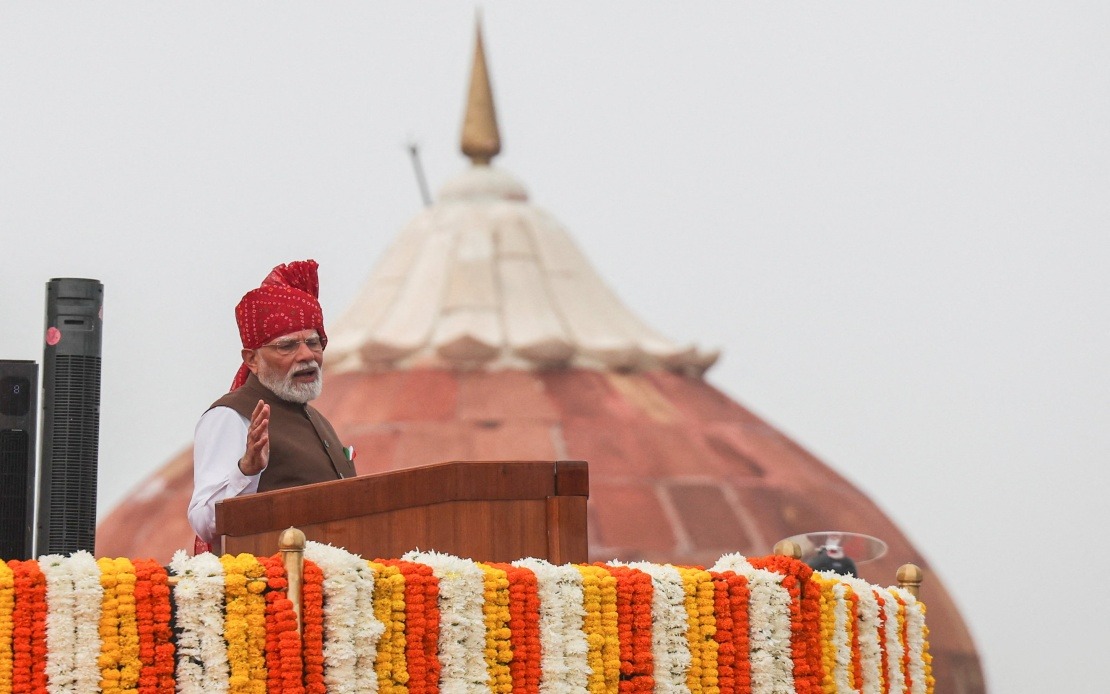
Prime Minister Narendra Modi used India's Independence Day address on Saturday to articulate a comprehensive vision for national self-sufficiency, positioning strategic autonomy in critical sectors as fundamental to India's transformation into a developed economy by 2047. Delivering his remarks from the Red Fort in Delhi, Modi framed the pursuit of greater domestic capability as inseparable from the nation's broader development aspirations, signalling that economic maturity depends fundamentally on reducing dependence on foreign suppliers and technologies.
India's semiconductor ambitions constitute a centerpiece of this strategy. Modi announced that three semiconductor manufacturing plants have already commenced operations, with projections indicating that between five and eight additional facilities will become productive within the next seven to eight years. This accelerated timeline reflects India's recognition that semiconductor self-sufficiency has become a geopolitical and economic imperative, particularly as global supply chains remain vulnerable to disruptions. For Malaysia, traditionally a hub for semiconductor manufacturing and testing, India's manufacturing push represents both a competitive challenge and potential opportunity for regional collaboration in an increasingly multipolar Asian tech landscape.
Nuclear energy security emerged as another cornerstone of Modi's self-reliance framework. India intends to establish 100 gigawatts of nuclear capacity by 2047, a target that underscores the administration's conviction that atomic power is essential for meeting projected energy demands without excessive fossil fuel dependence. More immediately, the government plans to commission five new nuclear reactors during the current decade. Modi emphasised that India's recent achievement in mastering fast-breeder nuclear technology represents a watershed moment, enabling the nation to substantially reduce reliance on imported nuclear fuel and enhance long-term energy sovereignty.
Renewable energy has simultaneously experienced remarkable expansion under Modi's tenure. Solar capacity has surged from just 2 gigawatts twelve years ago to 160 gigawatts currently, demonstrating that India can develop indigenous renewable infrastructure at scale. This transformation carries regional significance, as India's renewable trajectory influences energy pricing and technology standards across South Asia. Malaysia's own renewable energy ambitions could benefit from knowledge-sharing mechanisms and collaborative infrastructure projects with India's burgeoning solar industry.
Modi directed substantial resources toward unlocking new hydrocarbon reserves, allocating 850 billion rupees (approximately US$8.9 billion) for exploration in offshore regions previously considered commercially unviable or politically restricted. By recharacterising these areas as development opportunities rather than no-go zones, Modi signalled that India intends to maximise domestic petroleum and natural gas production, reducing vulnerability to volatile international energy markets and geopolitical supply disruptions that have periodically destabilised regional economies.
Defence manufacturing assumes strategic prominence within this self-reliance agenda. Modi stressed the necessity of building domestic expertise in unmanned aerial systems, counter-drone technologies, and hypersonic defence platforms. This emphasis reflects India's broader security concerns regarding maritime borders and technological competition with neighbouring powers. The cultivation of indigenous defence capabilities carries implications for the entire Indian Ocean region, potentially reshaping defence procurement patterns and technology transfer arrangements throughout Southeast Asia.
Central to Modi's messaging is the philosophical argument that purchasing globally available goods, however inexpensive or readily obtained, fails to cultivate national capabilities or test domestic technological competency. This rationale represents a deliberate pushback against free-market consumerism in favour of state-directed industrial policy and protectionist consumption patterns. Modi explicitly encouraged Indian citizens to prioritise domestically manufactured products, framing consumer choices as expressions of patriotic economic nationalism. Such rhetoric may accelerate import substitution across multiple sectors, with ramifications for Malaysian exporters and regional supply chains that have depended on tariff-free access to Indian markets.
The 2047 timeline itself warrants examination. By anchoring India's development trajectory to the centenary of independence, Modi creates a generational narrative encompassing infrastructure, human capital, and technological development. This extended planning horizon acknowledges that systemic economic transformation requires sustained policy commitment and capital investment beyond conventional electoral cycles. For Southeast Asian policymakers, India's long-term vision underscores the necessity of comparable strategic planning frameworks.
India's self-reliance strategy reflects broader geopolitical realignments reshaping Asia-Pacific dynamics. As global supply chains fragment and strategic competition intensifies, nations increasingly prioritise domestic capacity-building over efficiency-driven outsourcing. India's push mirrors similar initiatives undertaken by China, Japan, and Vietnam, suggesting a regional shift toward greater economic sovereignty and reduced vulnerability to external coercion. Malaysia must navigate these currents carefully, recognising both the commercial implications of India's import substitution and opportunities for deeper bilateral technological partnerships.
The emphasis on indigenous capability-building also acknowledges historical grievances regarding technology transfer and unequal development partnerships. By constructing domestic capacity in semiconductors, nuclear technology, and advanced defence systems, Modi positions India not merely as a consumer of global technology but as an innovator and producer within critical sectors. This reorientation enhances India's negotiating leverage in international forums and attracts foreign direct investment targeting the Indian market rather than using India as a low-cost manufacturing base.
Implementing this self-reliance agenda will require sustained fiscal commitment, institutional capacity-building, and protection of nascent industries from international competition during their development phases. The allocation of 850 billion rupees for hydrocarbon exploration exemplifies the capital intensity of such initiatives. Moreover, cultivating expertise in semiconductors, nuclear engineering, and advanced manufacturing demands investment in education, research infrastructure, and skilled workforce development. Success remains contingent on India's ability to maintain policy consistency across multiple electoral cycles and insulate strategic sectors from short-term political pressures.
For regional economies including Malaysia, India's trajectory carries dual implications. Commercial partnerships with Indian firms may face tariff barriers and local content requirements as New Delhi prioritises domestic suppliers. Simultaneously, India's technological advancement creates export opportunities for nations positioned to supply critical inputs or complementary services. The semiconductor ecosystem, renewable energy sector, and defence manufacturing will likely become key competition and collaboration zones throughout the 2030s and beyond.

