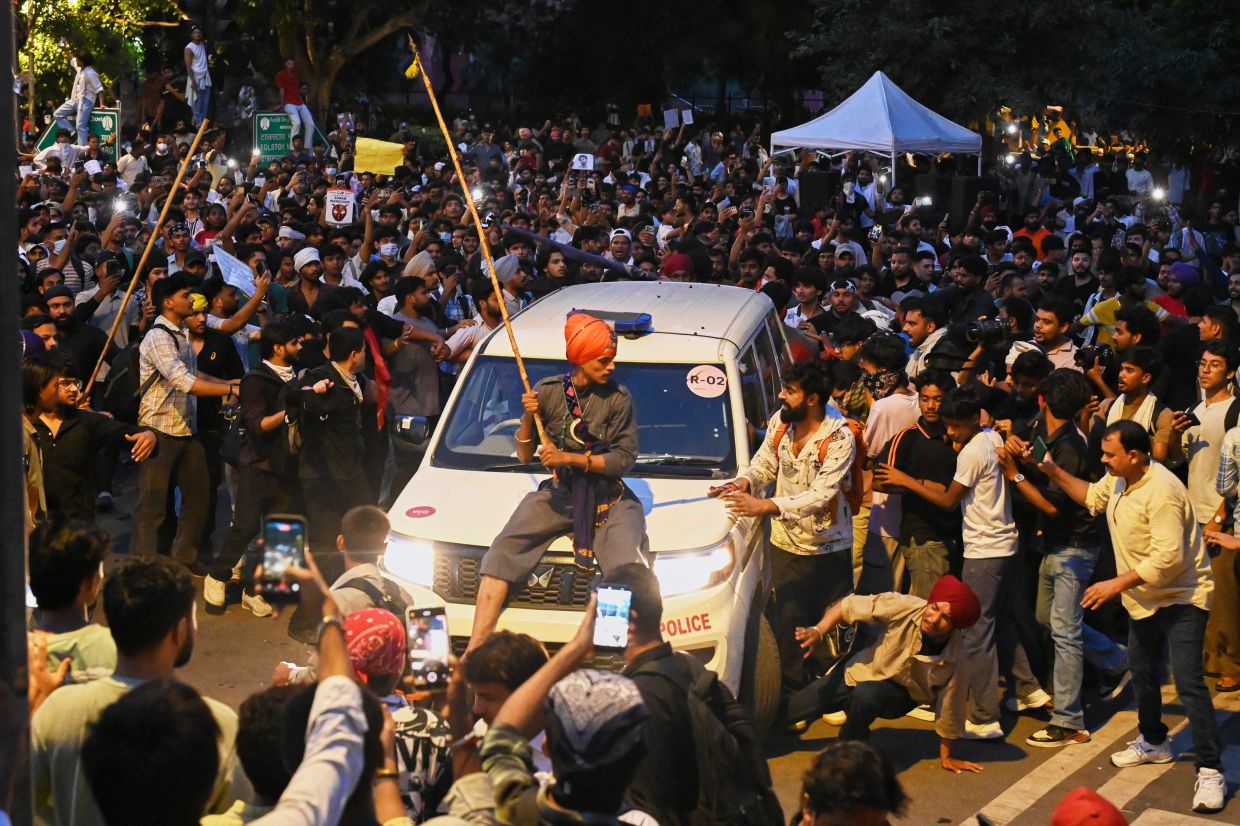
Indian Prime Minister Narendra Modi has responded to escalating student protests over examination fraud by pledging stringent action against those responsible, marking his first substantive engagement with what has become one of the most significant challenges to his government since winning re-election in 2024. Speaking through social media on Thursday, Modi asserted that no concern takes precedence over the welfare and future of India's youth, while committing to establish fast-track courts specifically designed to prosecute individuals involved in question paper leaks. His statement came as the capital remained tense following major demonstrations on Wednesday that spilled beyond designated protest sites, drawing renewed police intervention and deepening the standoff between authorities and demonstrators.
The protest movement, primarily driven by the Cockroach Janta Party (CJP) — a social media-based collective that emerged from a satirical critique of Chief Justice Surya Kant's controversial remarks comparing young people to cockroaches and parasites — has rapidly evolved into a broader challenge to Modi's administration. What began in May as a pointed mockery of perceived judicial insensitivity has matured into a comprehensive critique encompassing systemic educational failures, chronic youth unemployment, and what organisers characterise as an increasingly authoritarian governance model. The movement's ability to mobilise millions of digital followers into physical street protests demonstrates the potency of youth activism when channelled through contemporary communication platforms, a dynamic with particular relevance for Southeast Asian governments monitoring similar trends among younger populations.
The examination fraud crisis that catalysed these demonstrations reflects structural vulnerabilities in India's competitive testing apparatus. The leakage of a medical entrance examination question paper forced more than two million candidates to undertake complete retesting, an unprecedented disruption that exposed administrative lapses at a national scale. Compounding this breach, disputes surrounding the online marking system for examinations taken by approximately two million high school students have further eroded public confidence in educational credibility. For Malaysian observers, these failures in India's educational governance serve as cautionary markers, particularly as Malaysia itself manages increasingly complex examination systems and faces periodic concerns about integrity and accessibility.
The street confrontations that have defined this week's protests reached their most severe point on Monday when police deployed tear gas and baton charges against tens of thousands attempting to march toward parliament during the monsoon session's opening. Security forces reported that demonstrators responded with stone-throwing, creating what officials characterised as the most substantial street rally in New Delhi within approximately five years. At least 178 people sustained injuries in these clashes, a figure encompassing both security personnel and protesters, according to police records. The intensity of the response raises questions about proportionality and crowd management protocols, issues that resonate across the South Asian region where youth activism increasingly challenges state authority.
Wednesday's renewed violence at Jantar Mantar, a traditional protest epicentre in the Indian capital, resulted in late-night confrontations that the CJP characterised as heavy-handed police repression. Movement spokesperson Ashutosh Ranka documented internet shutdowns and what he described as brutal treatment of demonstrators, claims that authorities disputed by asserting that protesters had initiated violence by hurling stones and plastic bottles at officers. This competing narratives around police conduct and protester behaviour reflect a broader pattern of mutual escalation that threatens to harden positions on both sides. The digital shutdowns, in particular, warrant scrutiny from Southeast Asian civil society observers given the region's ongoing debates about emergency powers and internet freedom.
Opposition political parties have seized upon the protest momentum to challenge Modi's authority through parliamentary disruption and public statements. Rahul Gandhi of the Congress Party used social media to directly accuse the Prime Minister of orchestrating the educational system's deterioration and shielding culpable officials from accountability. This political opportunism, while predictable, underscores how youth-driven movements inevitably become entangled with factional competition among established parties. The opposition's mobilisation suggests that the education crisis has penetrated elite political consciousness as a legitimacy-threatening issue rather than a narrow administrative problem.
Geographically, the protest movement has transcended New Delhi's boundaries with demonstrations materialising in major metropolitan centres including Mumbai, Bengaluru, and Patna. This dispersal indicates that grievances around educational integrity and youth opportunity resonate across India's diverse regions rather than remaining concentrated in the capital. The movement's national reach complicates governmental response options, as localised suppression becomes less effective when agitation is simultaneously occurring across multiple major population centres. For policymakers elsewhere in South and Southeast Asia, this pattern suggests that youth discontent, once mobilised, develops organisational momentum that administrative centralisation struggles to contain.
The international dimension of these protests has extended into neighbouring Bangladesh, where students announced a Thursday evening torch rally explicitly expressing solidarity with Delhi demonstrators. This transnational gesture carries considerable symbolic weight given Bangladesh's experience in 2024 when student-led movements toppled the Sheikh Hasina government. The ideological and tactical connections forming between Indian and Bangladeshi youth activism suggest an emerging regional consciousness among younger cohorts who recognise shared grievances around educational access, employment prospects, and governance legitimacy. Malaysian youth observers following these developments may identify parallel frustrations within their own context.
Modi's assurance regarding fast-track courts represents an attempt at administrative remediation designed to address the movement's immediate grievances while avoiding broader structural critiques of educational governance. However, observers note that while prosecuting individuals responsible for paper leaks may restore marginal faith in institutional competence, it does not necessarily resolve systemic vulnerabilities that permitted such breaches to occur repeatedly. The discourse around punishment and accountability thus operates at multiple levels — the movement demands recognition of institutional failure alongside individual culpability, whereas governmental response has narrowed focus toward prosecutorial measures. This gap between youth expectations and official response may sustain protest momentum despite Modi's direct engagement.
The emergence of the CJP as a politically significant actor through predominantly digital organising reveals how social media platforms continue reshaping political engagement patterns in South Asia. The movement's evolution from satirical critique to substantive political challenge demonstrates the contingent nature of online activism, where ironic commentary can crystallise into genuine organisational capacity when underlying grievances prove sufficiently acute. This trajectory holds implications for understanding how contemporary youth politics operate across Asia's democracies, where digital natives increasingly prefer decentralised, network-based movements over traditional hierarchical party structures.
As these demonstrations continue, Modi's government faces a compound challenge: immediate pressure to demonstrate responsiveness through punitive measures against examination fraud while simultaneously addressing deeper anxieties about educational quality, employment creation, and governance accountability that the CJP movement has articulated. The degree to which fast-track courts and administrative reforms satisfy demonstrator demands will substantially determine whether this moment represents a transient crisis or a more enduring legitimacy challenge. For Malaysia and other regional governments, these developments offer both warning and precedent regarding youth activism's evolving capacity to challenge state authority in the digital age.

