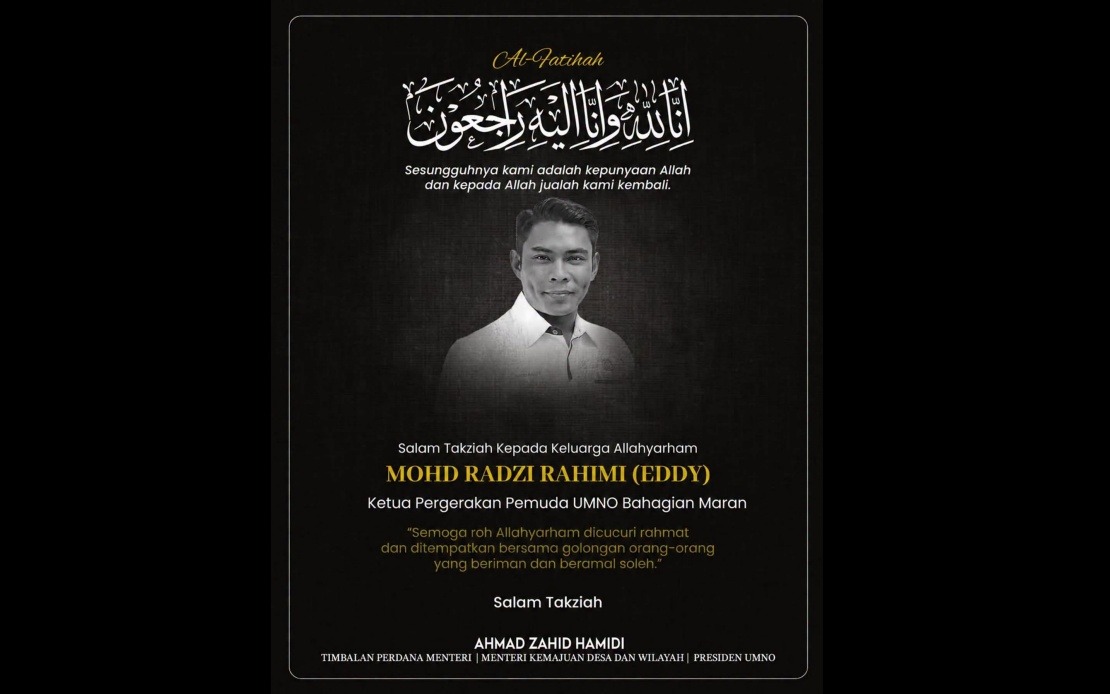
UMNO president Datuk Seri Dr Ahmad Zahid Hamidi has expressed his condolences following a tragic accident in Bentong that claimed the lives of prominent party member Maran UMNO Youth chief Mohd Radzi Rahimi, along with his wife and brother-in-law. The incident, which occurred on August 3, has sent shockwaves through the party hierarchy, with Ahmad Zahid describing the loss as particularly significant to both the Maran branch and the broader Pahang UMNO Youth wing.
The fatality resulted when a falling tree struck the vehicle carrying the victims, an incident that underscores the unpredictable hazards that can emerge during adverse weather conditions. Among those in the vehicle was a five-year-old child who also lost his life in the collision. The tragedy extended to a second child, believed to be the twin of the deceased boy, who survived the impact but sustained injuries requiring hospitalisation at Bentong Hospital.
Mohd Radzi, 40, held a leadership position within UMNO's youth structure at a time when party grassroots mobilisation remains crucial for both state and national political developments. His role as Maran UMNO Youth chief positioned him as an influential voice within the party's younger demographic, a segment that parties across Malaysia consistently work to engage and energise for electoral purposes. The loss of someone in such an organisational position carries implications beyond immediate family grief, affecting the party's institutional capacity within a key state.
Ahmad Zahid's public response on Facebook served as the official party acknowledgment of the tragedy, framing the incident within the context of UMNO as an extended family unit. His statement that "no words can describe what they are going through" reflected the severity of the loss, particularly given the circumstances involving multiple family members being killed simultaneously. This phrasing also acknowledged the compound nature of the tragedy—not merely the loss of a political figure, but the decimation of a family unit in a single moment.
The Pahang UMNO Youth wing, to which Mohd Radzi contributed through his Maran role, represents a significant component of the party's organisational structure in one of Malaysia's largest states. Pahang has historically been a traditional UMNO stronghold, though the party's control at state level has shifted in recent years, making the retention and development of capable youth leadership particularly important for long-term party sustainability. The sudden departure of an established youth leader creates a void in the party hierarchy that will need to be addressed during a period that may already be internally complex.
Traffic accidents involving falling objects such as trees remain a concern across Malaysia, particularly during monsoon seasons and periods of severe weather when root systems weaken and branches become unstable. This incident highlights the broader environmental and safety challenges that affect all motorists, regardless of status or profession. For Bentong specifically, this tragedy raises questions about roadside vegetation management and whether enhanced monitoring protocols might prevent similar incidents in the future.
The involvement of two young children in the vehicle adds another dimension to the human cost of this accident. The injured child's survival, while fortunate, represents both psychological and physical trauma that the family unit will bear. The death of a twin or near-twin age child raises particular concerns about the surviving sibling's psychological wellbeing in the wake of such a sudden and catastrophic loss.
Within UMNO, such incidents affecting party officials inevitably prompt reflection on institutional continuity and succession planning. While the party's structures exist to absorb such losses, the unexpected removal of an active and engaged leader at branch level does create operational disruptions. The process of identifying and transitioning a replacement for Mohd Radzi's roles within Maran UMNO Youth will likely unfold over the coming weeks, with particular attention to whether the party can quickly mobilise experienced individuals to prevent any perceived vacuum in local branch leadership.
The broader context of Malaysian politics has seen increasing emphasis on generational transition and youth engagement across political parties. UMNO, seeking to broaden its appeal particularly among younger voters who have shown inclination toward alternative political options in recent elections, relies on capable young leaders at branch and divisional levels to connect party messaging with youth constituencies. Losses such as this affect not just individual branches but the broader momentum that parties attempt to build across their organisational networks.

