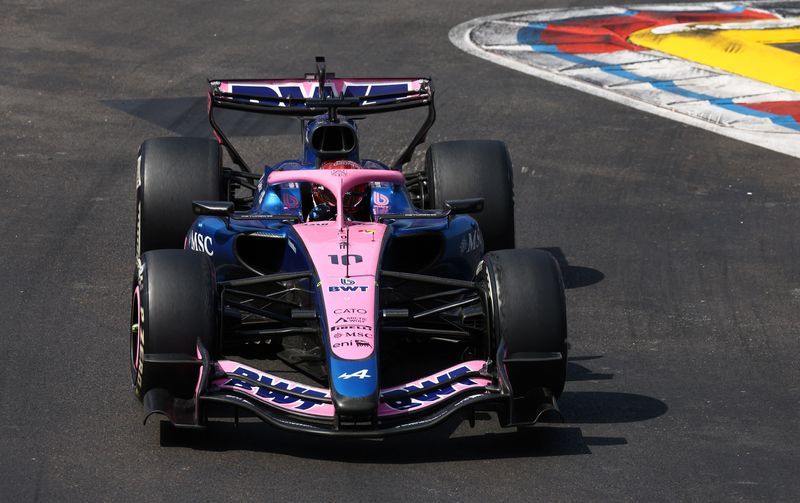
The governing body of Formula One, the FIA, announced on Tuesday that its international court of appeal will require two to three weeks to deliver a verdict on the disputed finishing order from June's Monaco Grand Prix, one of the sport's most prestigious events. The closed-door hearing held in Paris will determine whether Alpine driver Pierre Gasly retains third place or whether Red Bull's Isack Hadjar ultimately claims the podium finish, a decision with cascading implications for the championship standings of drivers ranked immediately behind these two.
The Monaco Grand Prix has become entangled in a procedural dispute that illustrates the complexities of Formula One's penalty system and raises fundamental questions about consistency and fairness in stewardship of the sport. Gasly crossed the finish line in third position on June 7, seemingly securing a valuable haul of championship points. However, two post-race five-second penalties for exceeding pit-lane speed limits saw him demoted to seventh, bumping Hadjar up to claim the podium spot alongside Mercedes' championship leader Kimi Antonelli and Ferrari's Lewis Hamilton.
The situation took another dramatic turn when Alpine successfully petitioned for a right to review on June 12, with stewards accepting the team's technical evidence that a timekeeping error had occurred during the original penalty deliberation. This reversal meant Gasly was reinstated to third place, requiring Hadjar to relinquish the trophy he had already celebrated with champagne on the podium. The subsequent appeals filed by Red Bull and McLaren on June 16 keep the final podium positions in limbo as the court considers the implications.
McLaren's decision to appeal stems from the situation affecting its driver Oscar Piastri, who received identical pit-lane speeding penalties to Gasly but served them during the race rather than having them applied afterwards. This critical distinction means Piastri's penalty served cannot be overturned under the existing regulatory framework, whereas Gasly's post-race penalties proved vulnerable to review. Team principal Andrea Stella articulated McLaren's concerns at the Dutch Grand Prix weekend, emphasizing that the disparate treatment of drivers receiving the same infraction raised serious questions about the fairness and integrity of the sport's administrative processes.
The handling of penalties has exposed what appears to be an inequitable system where the timing of penalty application determines its reversibility. Piastri suffered a loss of championship points because his penalties were served immediately, while Gasly benefited from the opportunity to overturn his post-race penalties through procedural review. This asymmetry extends beyond McLaren's interests; Mercedes driver George Russell, another title contender, also received a pit-lane speeding penalty but served his as a drive-through penalty during the race. Russell reportedly pleaded with officials to apply his penalty post-race, hoping to preserve the possibility of overturning it as Gasly managed to do.
The stewards themselves acknowledged the inequitable nature of the situation when they initially overturned Gasly's penalties, noting that the outcome created unfairness for other drivers. In their written reasoning, they pointed out a fundamental regulatory constraint: there exists no provision in Formula One's regulations empowering stewards to reverse a penalty that has already been served during competition. The stewards suggested such a power would be impractical to implement, yet this logic did not prevent them from overturning Gasly's post-race penalties.
This paradox lies at the heart of the appeal, with McLaren and Red Bull arguing that the principle of consistent application of penalties has been compromised. If stewards possess the authority to overturn post-race penalties based on evidence of procedural error, then arguably drivers who served equivalent penalties during the race should receive equivalent remedies. The alternative view holds that regulations exist as written, and post-race penalties exist in a different procedural category that permits review, while in-race penalties are final by their nature.
For Malaysian and Southeast Asian motorsport enthusiasts, the Monaco appeal illustrates how Formula One's governance structures handle disputes that carry financial and sporting consequences worth millions of dollars. The drawn-out resolution process, spanning from June to late August or early September, demonstrates the sport's commitment to thorough adjudication but also highlights inefficiencies in the system. Similar disputes have plagued Formula One in previous seasons, prompting calls for clearer regulatory guidance and more transparent decision-making processes.
The championship implications of the court's decision extend beyond the three drivers directly affected. With multiple drivers in contention for the championship, each point gained or lost in pursuit of the title carries enormous weight. McLaren has emerged as a serious championship threat this season, and the restoration or denial of Piastri's points could shift the balance in its battle against other top teams. Similarly, Red Bull's interest in clarifying Hadjar's status reflects the team's championship ambitions.
Formula One's next race at Monza on September 6 will take place under the shadow of this unresolved matter, with drivers, teams, and officials aware that the Monaco podium remains provisionally determined. The debut of Madrid's new circuit on September 13 follows shortly thereafter, maintaining the packed racing calendar that characterizes the modern Formula One season. The court's decision, whenever it arrives, will set a precedent for how future disputes involving penalty reversals are adjudicated, potentially influencing stewarding practices for the remainder of the season and beyond.

