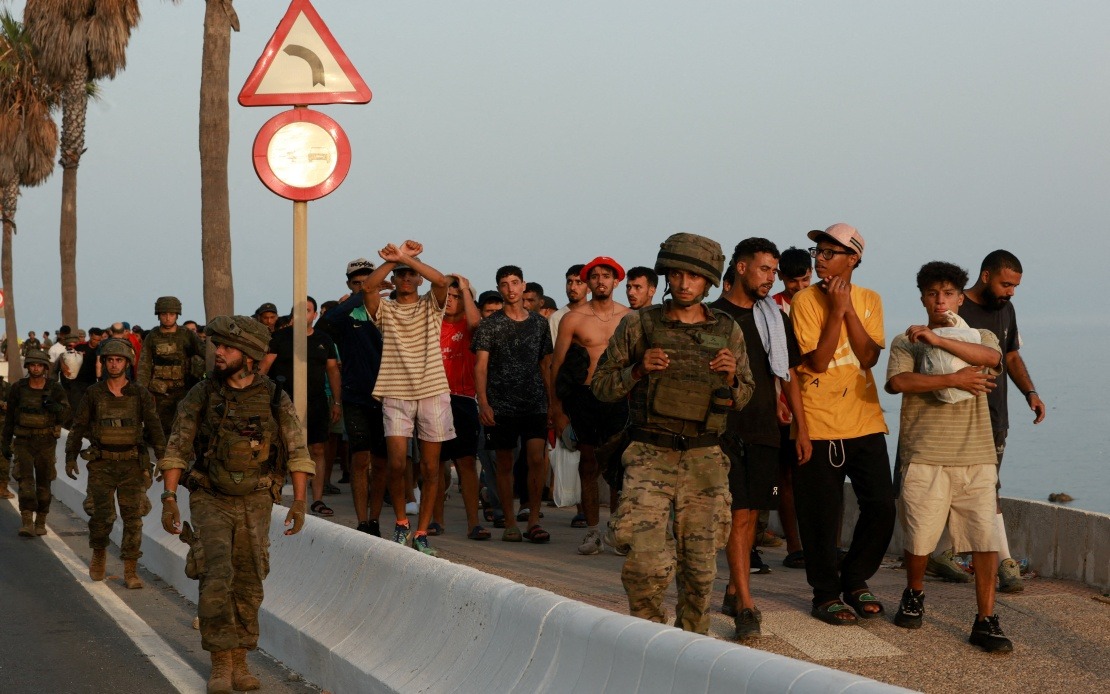
Morocco's Interior Ministry has pinpointed social media misinformation and organised human trafficking as the principal drivers behind an unprecedented wave of migrant crossings into the Spanish enclave of Ceuta over recent days. The ministry attributed the surge partly to false narratives spreading online and misunderstandings regarding a Spanish court decision that migrants incorrectly believed would permit them to enter Europe without immediate deportation. This convergence of deceptive information and criminal smuggling networks created conditions for one of the region's most significant recent migration events.
The scale of the movement has been staggering. While estimates from Spanish and international sources suggest between 50,000 and 60,000 migrants reached Ceuta within a compressed timeframe of just several days, Morocco's own count stands at approximately 40,000 individuals who successfully crossed into the territory, supplemented by around 1,135 additional people who attempted entry via nearby Melilla. The figures underscore the speed and magnitude of the phenomenon, with arrivals flooding an enclave whose resident population stands at merely 85,000 people.
The disparities in casualty figures between Moroccan and Spanish authorities highlight the difficulty in establishing precise data amid the chaos and confusion. Morocco reported 11 deaths among those attempting the crossing, whereas Spanish officials documented at least 72 fatalities during the migration events connected to Ceuta. These deaths represent the human cost of irregular migration, reflecting the desperation driving individuals to undertake perilous sea journeys and the lethal consequences when such endeavours go catastrophically wrong. The significant gap between reported figures suggests that comprehensive accounting for all victims remains incomplete.
Moroccan authorities indicated ongoing coordination with Spanish counterparts to verify additional death reports within Ceuta itself and to conduct the painstaking process of identifying victims and determining their nationalities. This cooperation reflects the bilateral nature of the migration challenge in the Strait of Gibraltar region, where both nations share responsibility for managing irregular movement across one of the world's busiest maritime corridors. The identification process carries particular importance for bereaved families across multiple countries seeking information about missing relatives.
The role of misinformation in facilitating this migration event warrants closer examination for regional implications. Social media platforms have become conduits for narratives—accurate or false—that shape migrant perceptions of opportunity and risk. In this instance, garbled interpretations of Spanish legal decisions created expectations that prompted hundreds of thousands to embark on journeys they might otherwise have reconsidered. For Southeast Asian nations hosting substantial migrant communities and confronting their own irregular migration challenges, this episode demonstrates how digital information ecosystems can precipitate sudden, large-scale population movements with destabilizing consequences.
Human trafficking networks exploiting these dynamics represent organised criminality that transcends national borders. By capitalising on both legitimate desperation and inflated hopes generated through social channels, smugglers orchestrated movements that generated substantial profits while exposing migrants to extreme danger. The pattern reflects trafficking operations throughout the Indo-Pacific region, where criminal organisations similarly manipulate aspirations and leverage information vacuums to move vulnerable populations across dangerous routes.
The Spanish court ruling that reportedly sparked migrant expectations requires contextualisation. Rather than granting blanket permission for entry, the decision likely addressed specific procedural or humanitarian considerations. The misinterpretation—whether genuinely innocent confusion or deliberately exaggerated by traffickers—illustrates how legal developments in destination countries can be weaponised as recruitment messaging by smuggling networks. Such distortions of legal reality create false confidence among migrants and generate sudden surges at specific junctures.
For Malaysia and other Southeast Asian nations, this incident offers instructive lessons about managing migration pressures in an interconnected world. While the Ceuta surge involved North African and sub-Saharan migrants targeting Europe, parallel dynamics affect Asian corridors where people from Bangladesh, Myanmar, and elsewhere seek passage through Thailand and Malaysia toward third countries. The intersection of misinformation, trafficking networks, and legal misinterpretation creates comparable conditions for chaotic population movements. Authorities across the region must develop coordinated strategies addressing both the information environment and criminal networks simultaneously.
Morocco's emphasis on external factors—misinformation and trafficking—provides partial explanation while potentially deflecting attention from underlying conditions that render migration attractive despite extreme risks. Economic disparities, limited opportunity structures in origin countries, and instability in certain regions create genuine push factors that no amount of counter-misinformation can eliminate. Sustainable solutions require addressing root causes while simultaneously combating criminal networks and managing information flows more effectively.
The incident also underscores Spain's vulnerability as Europe's primary entry point for Mediterranean migration. The Spanish government faces pressure to secure its borders while humanitarian organisations emphasise the vulnerability of migrants. For Malaysia, which similarly experiences competing imperatives regarding border security and humanitarian obligation toward displaced populations, Spain's dilemma resonates acutely. Managing both immigration control and human protection demands sophisticated policy frameworks that acknowledge genuine humanitarian needs while preventing exploitation by criminal operators.
Regional cooperation emerged as essential in this case, with Morocco and Spain coordinating response efforts despite broader tensions in their bilateral relationship. This pragmatic cooperation on operational matters—identifying victims, verifying reports, establishing nationalities—demonstrates that migration management requires transcending political differences when human lives are at stake. Similar cross-border coordination has proven essential in Southeast Asia, where Thailand, Malaysia, and other nations have increasingly formalised mechanisms for addressing maritime migration and trafficking even amid other disagreements.
Moving forward, Morocco's attribution of the surge to misinformation and trafficking points toward dual policy responses: enhanced counter-messaging addressing false narratives while simultaneously intensifying law enforcement against smuggling networks. Both approaches require sustained investment and multilateral cooperation. For the broader region watching these developments, the Ceuta episode demonstrates that migration crises emerging from converging technological, criminal, and informational dynamics demand similarly multifaceted responses rather than border-enforcement solutions alone.

