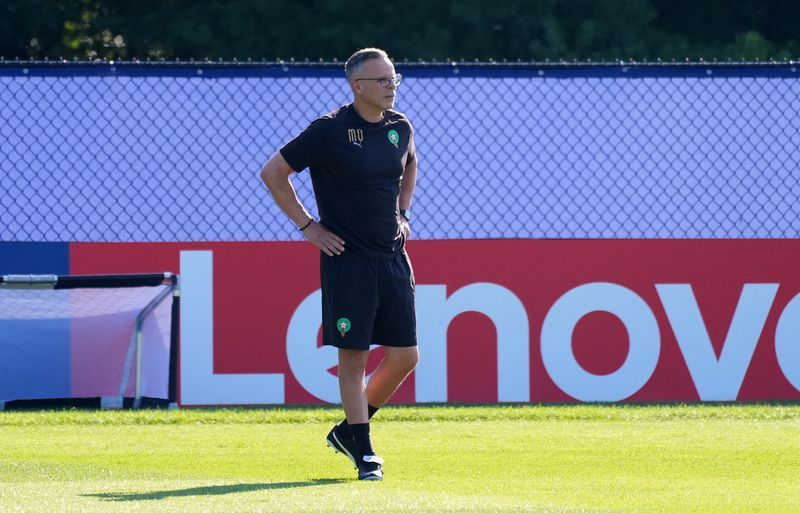
Morocco's pursuit of World Cup glory will tolerate no distractions from congratulatory remarks about their tournament performance to date. Coach Mohamed Ouahbi made clear on Wednesday that his squad views any recognition of their achievements as premature, with a quarter-final meeting against France looming on Thursday in what amounts to a high-stakes rematch of their dramatic semi-final encounter eighteen months earlier in Qatar.
The psychological positioning matters considerably. When France eliminated Morocco in December 2022, the North Africans were positioned as the tournament's most unexpected challengers—underdogs who had exceeded all reasonable expectations by reaching the semi-finals. That narrative of pleasant surprise has evaporated entirely. Morocco has since evolved into a recognised World Cup contender, having dispatched both the Netherlands and Canada in successive knockout rounds following a commanding group-stage campaign. The burden of expectation has shifted from simply participating to actually winning.
Ouahbi's refusal to dwell on past accomplishments reflects this transformed status. In his press conference, he explicitly rejected the notion that merely reaching this stage constituted sufficient success. "We will take stock at the end of the tournament," he stated, signalling that intermediate milestones hold no value in his tactical philosophy. The coach's language was notably unambiguous: premature self-satisfaction represents a trap that successful teams must avoid. His insistence that Morocco had not come this far to accept anything less than the ultimate prize underscores the mental toughness required at this level of competition.
The matchup itself carries particular resonance. France remains the tournament's most accomplished recent participant, holding the 2018 World Cup title and having contested the 2022 final. The defending champions dispatched Paraguay in the round of sixteen with clinical efficiency, securing a 1-0 victory through a Kylian Mbappe penalty kick. This ability to win without dazzling performances demonstrates France's championship pedigree—a quality Ouahbi implicitly acknowledged by labelling France as favourites, even as he insisted his own team would contest the result with absolute commitment.
France's attacking resources pose a distinctive threat. Beyond Mbappe, who has already scored seven tournament goals and captains the national team, the forward line encompasses Ousmane Dembele, Michael Olise, and Bradley Barcola. Collectively, this represents one of the most formidable attacking units ever assembled at a World Cup, with multiple players capable of delivering decisive moments. Morocco's defensive organisation will face unprecedented examination against such concentrated firepower.
Ouahbi's tactical message centred on intensity and absence of regret. He spoke of needing to perform at "2,000%" and abandoning any mindset that viewed their quarter-final appearance as a satisfactory outcome. This framing positions Morocco as a team with unfinished business rather than one content with historical progress. The coach's perspective aligns with how elite competitors approach knockout football—every match represents the only match that matters, and previous achievements carry no weight once the referee's whistle sounds.
The continental and regional significance adds another dimension. A Morocco victory would represent African football's most substantial World Cup achievement since Cameroon's quarter-final appearance in 1990, and would advance an Arab nation to the semi-finals for the first time. These broader implications undoubtedly inform Ouahbi's unwillingness to celebrate prematurely. The weight of continental expectation demands success, not mere participation.
For Malaysian and Southeast Asian observers, Morocco's trajectory offers instructive lessons about tournament football evolution. A team that entered their previous World Cup as an outlier has transformed through tactical development and player maturation into a genuine contender. This progression demonstrates that sustained improvement across multiple competition cycles can elevate national teams beyond their historical positioning. Morocco's refusal to rest on previous achievements also illuminates the mentality required to compete consistently at elite levels.
France's challenge involves managing the psychological complexity of facing a resurgent opponent while remaining focused on their own ambitions. Mbappe's prolific scoring form provides clear momentum, yet Morocco's experience in reaching this stage twice in eighteen months suggests tactical sophistication and psychological resilience. The quarter-final will likely determine whether France's attacking dominance can overcome Morocco's organised defensive structure.
Ouahbi's consistent messaging about rejecting premature satisfaction demonstrates sophisticated tournament management. By refusing to acknowledge his team's achievements as sufficient, he maintains psychological pressure on his players to extend their run. This approach contrasts sharply with coaches who might seek to build confidence through acknowledging progress. Instead, Ouahbi channels ambition entirely toward advancement, treating the quarter-final as merely another step toward the ultimate objective.
The tactical preparation occurring behind closed doors will prove decisive, but Ouahbi's public positioning has already established a clear standard: anything less than victory would constitute underperformance relative to Morocco's stated objectives. This demanding framework reflects how contemporary international football operates at its highest level, where genuine title ambitions demand absolute commitment at every stage.

