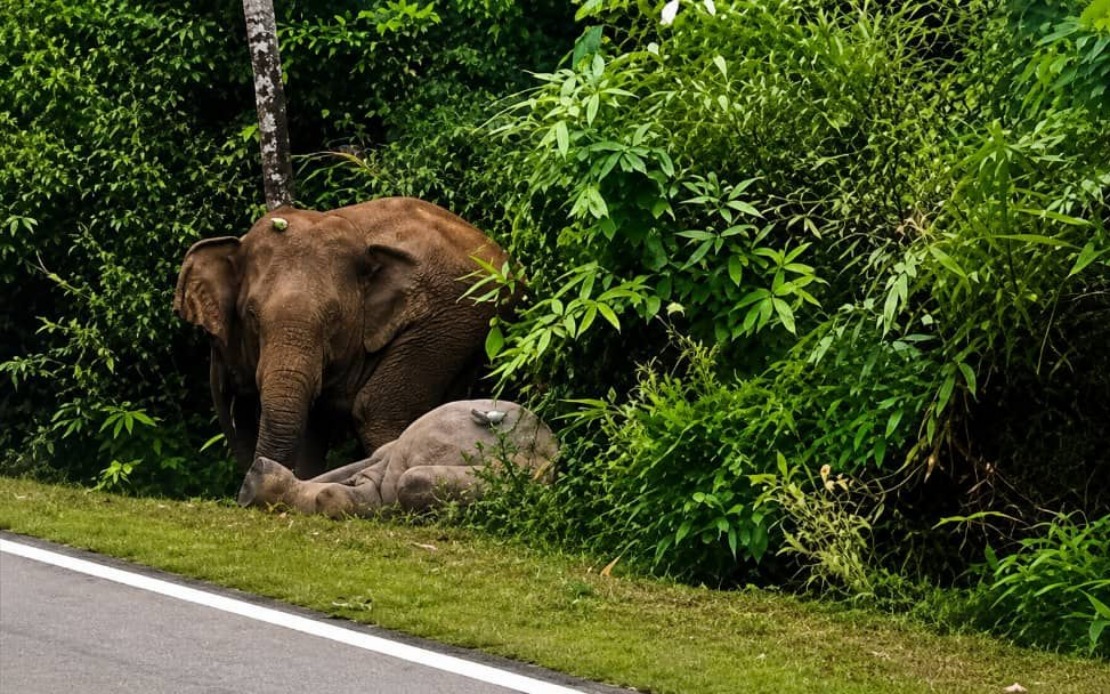
The death of a young elephant on a Johor road this morning has reignited concerns about human-wildlife conflict in Malaysia, as a grieving mother refused to abandon her offspring for hours following a vehicle collision. The incident, which occurred at 2.28 am on Jalan Felda Nitar in Mersing, saw a five-year-old female calf fatally struck by a Perodua Bezza, with the mother remaining motionless at the scene throughout the morning. Video footage circulating on social media captured the distressed adult elephant's vigil, drawing immediate parallels to a similarly harrowing incident in Gerik, Perak, that unfolded on Mother's Day last year and became a symbol of the escalating tensions between Malaysia's expanding human infrastructure and its dwindling elephant populations.
Authorities responded swiftly after receiving notification around 8.30 am, with the Johor Department of Wildlife and National Parks (Perhilitan) deploying four personnel for initial assessment. Officers determined that the deceased calf measured approximately 150 centimetres in body length, with a front footprint width of 11 inches and rear footprint width of 14 centimetres, indicating the animal was still in its younger years. The young elephant, identified as female with no visible tusks, belonged to the Jamaluang-Mersing ID group, a particular family unit of Borneo's shrinking wild elephant population that conservation authorities have been monitoring for years.
The tragedy's human toll extended beyond the animal kingdom. The 31-year-old driver of the Perodua Bezza sustained significant leg injuries when his vehicle struck the elephant and subsequently plummeted into a five-metre-deep ravine beside the road. Fire and Rescue Department personnel were deployed to extract the trapped motorist from the wreckage, adding another dimension to what might initially appear as a simple wildlife accident but represents a complex failure of infrastructure, wildlife management, and public safety measures to coexist effectively.
The Perhilitan spokesman's account revealed that despite warning signs indicating elephant crossings previously positioned throughout the area, the stretch of road remains inherently dangerous, particularly during nocturnal hours when darkness compounds visibility challenges for drivers navigating territory frequented by large animals. This detail underscores a persistent problem across Malaysia: protective signage, while necessary, often proves insufficient when roads traverse elephant corridors and migration routes. The warning markers represent acknowledgment of the problem but fall short of addressing the fundamental incompatibility between wildlife habitats and transportation infrastructure.
To facilitate the mother elephant's eventual departure from the accident scene, the Elephant Capture Unit from the Johor Elephant Sanctuary was summoned to assist Perhilitan personnel in gently herding the grieving animal back into nearby forest cover. The calf's remains were subsequently interred at the location, a pragmatic response that nonetheless highlighted the grim regularity with which such incidents now occur. Following the animal's return to the forest, conservation officials announced plans for enhanced nocturnal patrols throughout the subsequent nights, designed to monitor the mother's wellbeing and discourage any return migration toward the hazardous roadway.
This incident evokes uncomfortable memories of the Gerik tragedy from May 11 last year, which achieved viral status and captured unprecedented national attention to human-elephant conflict. In that earlier incident, a young elephant became pinned beneath a container lorry after collision, whilst video footage showed the apparent mother attempting to lift the heavy vehicle—a heartbreaking display of maternal desperation that resonated across Malaysian society. The Gerik event, occurring on Mother's Day, transformed abstract wildlife statistics into emotionally visceral reality for millions of Malaysians who viewed the footage, generating sustained discourse about conservation priorities and developmental practices that increasingly encroach upon elephant habitats.
The recurrence of such tragedies within a single year signals acceleration in human-elephant encounters rather than isolated incidents. The Jamaluang-Mersing elephant group, like other populations across Peninsular Malaysia and Sabah, faces mounting pressure as forest fragmentation forces animals to traverse populated areas searching for food, water, and passage between remaining habitat patches. Road infrastructure, whilst essential for human commerce and mobility, creates lethal barriers and collision zones that wild elephants cannot navigate safely, regardless of warning signage or cautionary measures.
For Malaysian policymakers and conservation practitioners, these successive tragedies present an urgent challenge demanding integrated solutions beyond reactive crisis management. Addressing the underlying drivers of human-elephant conflict requires examining land-use planning decisions, evaluating whether alternative transportation routes might bypass critical elephant corridors, and considering wildlife-crossing infrastructure such as elevated overpasses or underpasses that enable safe animal passage. The current model of posting warning signs and conducting post-incident patrols, whilst better than complete inaction, represents a partial and ultimately insufficient response to systematic habitat loss.
The implications extend beyond Malaysia's borders, as the nation's approach to balancing development and wildlife protection influences conservation practices throughout Southeast Asia. Countries facing similar pressures from infrastructure expansion and human population growth observe Malaysian outcomes when evaluating their own policies. Furthermore, the Mersing and Gerik incidents contribute to international conversations about megafauna conservation during periods of rapid economic development, offering cautionary lessons about the long-term costs of failing to incorporate wildlife needs into transportation planning.
For residents and travelers utilizing roads that cross elephant territory, heightened awareness and modified driving behaviors represent immediate protective measures. Reducing speed through identified crossing zones, especially during hours of darkness, maintaining heightened alertness, and reporting deceased animals to authorities promptly can incrementally reduce casualties. However, individual behavioral modifications cannot substitute for systemic changes to road infrastructure and development planning that prioritize wildlife corridor preservation.
The mother elephant's seven-hour vigil beside her dead calf ultimately speaks to elephants' complex emotional and social bonds—their capacity for grief and maternal attachment mirrors human experience in ways that resonate with public consciousness. Each such incident, widely documented and shared through social media, gradually builds societal pressure for meaningful conservation action. Whether these accumulating tragedies will catalyze substantive policy changes or remain isolated incidents generating temporary outrage remains an open question that Malaysian authorities must urgently address.

