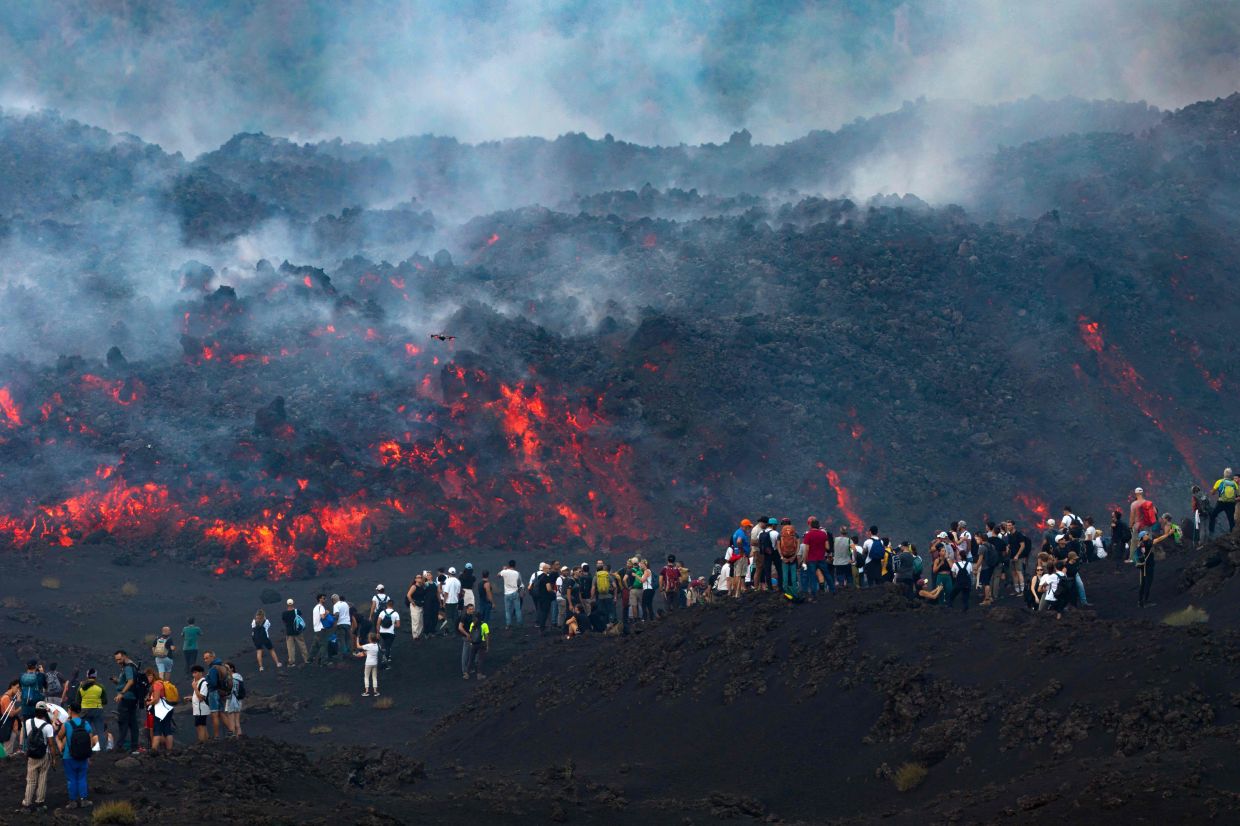
Europe's most towering active volcano, Mount Etna in Sicily, has transformed into an unexpected tourism magnet following days of continuous lava and ash emissions. The phenomenon reflects a broader human fascination with dramatic natural events, even when they pose genuine hazards. For local tourism operators, the eruption represents an unprecedented commercial opportunity alongside mounting concerns about visitor safety and the strain on local infrastructure and services.
The eruption's visual drama—captured in images now circulating globally—has created what some local professionals describe as a "touristic eruption." Daniele Perricelli, a 41-year-old guide operating through Guide Etna, notes the transformative impact on demand patterns. His company typically manages a few dozen visitors on evening hikes during average summer conditions, but the current situation has fundamentally altered this equilibrium. Daily requests have ballooned to approximately 300, representing a threefold increase that reflects the magnetic pull of witnessing active volcanic processes firsthand.
Ernesto Maria Magri, another experienced guide working in the region, characterises the phenomenon as appealing precisely because it permits observation under conditions perceived as manageable. The ability to maintain relative distance while still experiencing the volcano's raw power creates a psychological sense of controlled adventure—the thrill of proximity to danger without the perception of crossing into genuine peril. This calculation, however, may underestimate the actual risks involved.
The surge extends beyond paying customers. Local residents themselves have been ascending the mountain in substantial numbers to witness the natural spectacle. Guides report instances of unorganised crowds gathering near active lava flows, sometimes standing dangerously close to volcanic activity. These informal visitor patterns reveal how compelling natural events can override typical safety considerations, particularly among populations accustomed to living alongside geological volatility.
Many visitors opt to climb without engaging professional guides, driven either by cost considerations or overconfidence in their mountaineering abilities. This decision carries material consequences. Perricelli emphasises that Mount Etna's geological instability requires informed interpretation; the mountain's behaviour cannot be reliably predicted by untrained observers. Recent instances have included visitors ascending in unsuitable footwear—flip-flops—a choice that exemplifies the gap between hazard awareness and actual visitor preparation.
The regulatory framework attempting to manage visitor access operates on an altitude threshold system. Climbers may independently reach approximately 2,400 metres, beyond which mandatory guide accompaniment applies. This structured approach aims to balance public access with safety management. However, enforcement during periods of high visitation becomes progressively challenging. Perricelli reports that approximately 2,000 people attempt ascents each evening, creating congestion that undermines both safety protocols and the quality of the experience itself.
Social media scrutiny has focused on high-profile visitors who appeared to position themselves uncomfortably near active lava. Italian television personality Diletta Leotta drew particular criticism for photographs suggesting excessive proximity to flowing volcanic material. Professional guides note, however, that positioning several metres away from cooled lava at lower elevations does permit legitimate observation and photography without extreme hazard exposure.
The eruption's disruption extends beyond the mountain itself. Mount Etna's ash emissions have forced repeated flight suspensions at Catania International Airport, which processes approximately 12 million passengers annually and functions as Sicily's principal air gateway. Since Saturday, hundreds of flights have faced cancellation, affecting both tourists attempting to reach the island and those departing. The cascading economic impact touches hotels, rental car companies, and restaurants dependent on visitor throughflow, even as the volcanic spectacle itself drives some new arrivals.
Italy's civil protection authorities have assigned Mount Etna a yellow alert classification, the second tier on a four-level scale. This status indicates frequent eruptions with potential for explosive events, warranting heightened monitoring and public advisories. The framework acknowledges that volcanic activity will continue, requiring sustained management protocols balancing visitor access against documented hazards.
The situation illuminates a persistent tension in modern tourism. Natural phenomena of genuine geological significance and inherent danger attract visitors precisely because of these characteristics. Safety officials and commercial operators must navigate between restricting access—economically and socially costly—and permitting activities with quantifiable risks. Mount Etna's current eruption demonstrates how difficult this balance becomes when natural spectacle reaches sufficient intensity to overwhelm normal cautionary impulses.
For Southeast Asian readers, the scenario carries parallels to volcanic regions across the archipelago, from Indonesia's Mount Merapi to the Philippines' Taal Volcano. Similar patterns of conflicting pressures—tourism revenue generation versus legitimate safety concerns—recur whenever dramatic geological events occur in inhabited regions. The question of how to permit meaningful public engagement with natural phenomena while maintaining reasonable protective standards remains fundamentally unresolved, with Mount Etna's current experience adding fresh dimensions to an enduring challenge.

