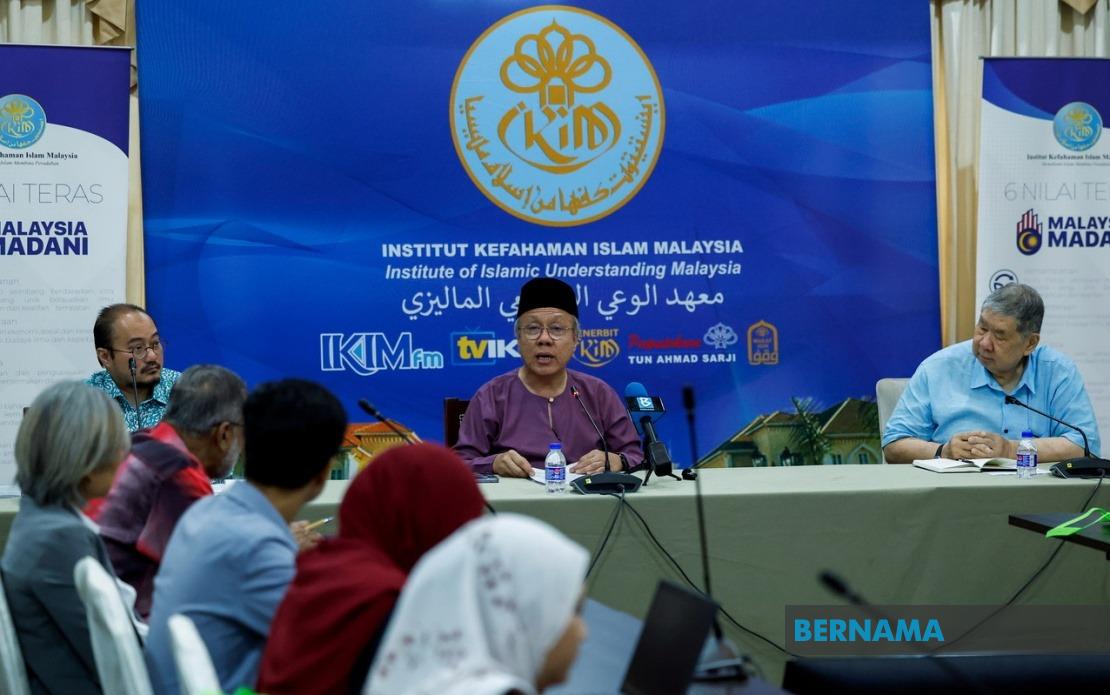
Three major Malaysian institutions came together in Kuala Lumpur to address a matter that has generated significant public scrutiny: the Royal Commission of Inquiry findings into Tabung Haji. The Malaysian Press Institute, the Institute of Islamic Understanding Malaysia and Tabung Haji itself jointly organised a closed-door briefing session designed to equip media practitioners with authoritative information about the pilgrimage fund's governance challenges and recovery efforts. The programme, held at IKIM's premises on August 14, represents a coordinated attempt to shape the narrative surrounding an institution that holds deep cultural and religious significance for Malaysia's Muslim community.
Tabung Haji Group Managing Director and Chief Executive Officer Mustakim Mohamad led the substantive discussion, providing journalists with an insider's perspective on the RCI proceedings and the organisation's response mechanisms. The gathering brought together over twenty media representatives alongside senior figures from the collaborating institutions, including MPI president Datuk Yong Soo Heong and IKIM Director-General Associate Professor Datuk Dr Mohamed Azam Mohamed Adil. The two-hour session allowed for direct question-and-answer exchange, suggesting an effort to move beyond prepared statements and engage with substantive concerns that news organisations might raise.
From the perspective of media management, MPI president Yong framed the initiative as essential infrastructure for responsible reporting. He characterised the briefing as a platform enabling journalists to access verified information about Tabung Haji's stabilisation strategies and confidence-building measures. By positioning accurate information dissemination as central to the institution's recovery, Yong implied that media coverage carries substantial weight in either accelerating or hindering public restoration of faith in the organisation. He specifically highlighted the value of collaboration between media, Islamic education, and the fund management sectors in addressing what he termed an issue of national importance.
Yong's comments suggest consideration of expanded similar initiatives. He indicated that comparable programmes could be rolled out in other Malaysian states through alternative formats, including dialogue sessions and town halls. This point carries significance for regional media landscapes, where information access often concentrates in capital cities. Extending these briefings beyond Kuala Lumpur would theoretically provide journalists in Penang, Johor, Sabah and Sarawak with comparable opportunities to engage directly with Tabung Haji leadership, potentially reducing reliance on secondhand reporting or government press releases.
A particularly notable framing emerged from IKIM's director-general, who sought to reposition the RCI and its implications entirely. Mohamed Azam argued forcefully that characterising the matter as involving religious or racial dimensions would represent a fundamental misreading of the situation. Instead, he insisted, the core substance concerns management integrity and institutional accountability. This distinction matters considerably, as Malaysia's political and social environment sometimes reflexively interprets challenges facing Islamic institutions through communal or identity-based lenses. By redirecting focus toward governance standards and fiduciary responsibility, IKIM appeared to be attempting prophylactic messaging against divisive interpretations.
Mohamed Azam further emphasised that the RCI matter fundamentally concerns trust—a characteristic shared by all financial institutions regardless of religious affiliation or cultural particularity. He explicitly appealed to journalists to adopt and communicate this narrative, framing accurate media reporting as instrumental to restoring depositor and broader public confidence. This represents a somewhat transparent instrumentalisation of journalism, yet it also reflects genuine institutional stakes. Tabung Haji manages savings accumulated over decades by millions of Malaysian Muslims preparing for hajj pilgrimage, making the fund's credibility genuinely material to individual financial security and spiritual planning.
The emphasis on Tabung Haji's unique status within Malaysia's Islamic financial ecosystem underscores why the RCI findings generated such extensive concern. As an institution specifically entrusted with managing resources connected to one of Islam's five pillars, Tabung Haji carries symbolic weight extending beyond conventional financial performance metrics. When governance questions surface regarding such an institution, they intersect with questions about stewardship of religiously significant resources. Mohamed Azam's point about restoring confidence in Tabung Haji's credibility as a uniquely Islamic financial entity captures this duality—the fund must function effectively as a financial mechanism while simultaneously upholding the trust associated with its religious purpose.
From a Southeast Asian perspective, the Malaysian case illustrates broader challenges facing Islamic financial institutions across the region. Countries including Indonesia, Brunei, and Singapore host Islamic banks and funds managing depositor resources. When governance issues emerge at such institutions, related questions about management capability, regulatory oversight, and institutional reform become pressing for multiple stakeholders. Malaysia's approach—convening media, Islamic educational institutions, and fund management in coordinated information sessions—represents one model for addressing reputational and confidence challenges.
The media literacy programme also reflects evolving relationships between government-adjacent institutions and journalism in Malaysia. Rather than issuing statements or holding conventional press conferences, the three organisations chose an educational framing, positioning journalists as learners requiring enhanced understanding of complex institutional matters. This approach acknowledges that effective coverage of technical issues like fund governance, investment management, and regulatory responses requires journalists to move beyond surface-level reporting. Simultaneously, it creates space for institutional actors to shape how journalists conceptualise problems and solutions.
The timing and composition of the briefing deserve consideration. Holding a closed-door session rather than an open press conference creates a more controlled information environment while still reaching significant media representation. By including IKIM—an institution focused on Islamic understanding and interfaith dialogue—alongside Tabung Haji and the press institute, the organisers signalled attention to potential communal sensitivities and the need for measured, context-aware communication. This triangular partnership acknowledges that managing perception around Islamic institutions in Malaysia requires coordination across religious education, media, and institutional leadership.
Looking forward, the success of this briefing model may encourage similar initiatives when other major Malaysian institutions face public scrutiny. The approach provides institutional leadership with direct access to media gatekeepers while offering journalists authoritative information sources before finalising stories. For depositors and broader publics, the quality and framing of subsequent media coverage will largely determine how they interpret the RCI findings and Tabung Haji's recovery trajectory. The programme's effectiveness will ultimately be measured not in immediate coverage but in whether journalists subsequently report on the fund's governance and reforms with the accuracy and contextual sophistication that the three organisations clearly hoped to cultivate.

