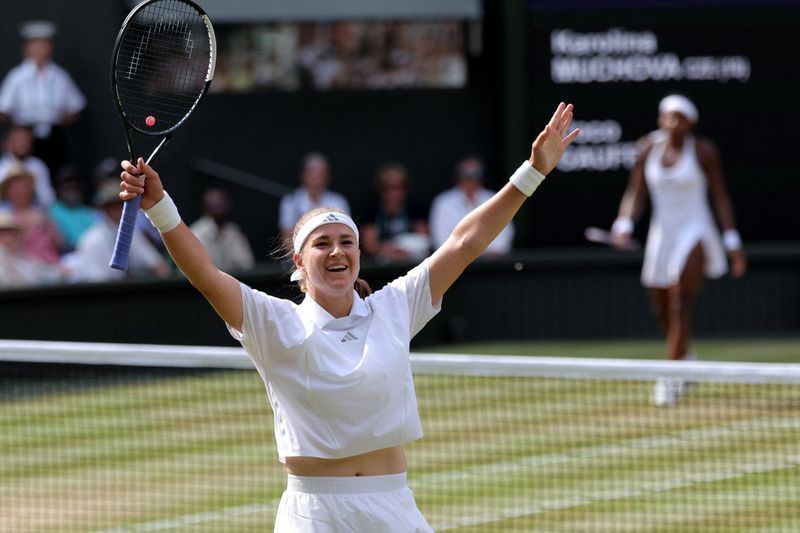
Karolina Muchova of the Czech Republic has advanced to her first Wimbledon final after an extraordinary semi-final encounter against seventh-seeded American Coco Gauff, prevailing 6-2 1-6 7-6 in a gripping contest that stretched beyond two and a half hours. The 28-year-old 10th seed engineered a dramatic turnaround in the decisive third set, saving a match point before ultimately converting her second opportunity as Gauff sent a forehand wide in the closing moments of a match that epitomised the unpredictability and raw tension that makes Wimbledon tennis so compelling.
Muchova's victory sets the stage for a potentially historic all-Czech final at a Grand Slam tournament, contingent on her compatriot Linda Noskova advancing past Ukrainian Marta Kostyuk in the second semi-final scheduled for Thursday. Should Noskova prevail, it would mark the first occasion that two players from the Czech Republic have contested a major championship final. The possibility underscores the remarkable depth of Czech women's tennis in recent years, with the nation producing three Grand Slam champions in four years following Marketa Vondrousova's triumph at this same tournament in 2023 and Barbora Krejcikova's success in 2024.
What renders Muchova's achievement particularly noteworthy is the considerable physical impediment she contends with at the All England Club. The Czech player suffers from a grass allergy that requires constant pharmaceutical and physiological management, necessitating she rely on "a lot of pills, sprays, eyedrops" merely to participate competitively on the grass courts. Despite this uncomfortable reality, she produced grass-court tennis of considerable quality and tactical intelligence when it mattered most, demonstrating that technical excellence and mental fortitude can transcend physical disadvantages.
The first set belonged almost entirely to Muchova, who seized the initiative by breaking Gauff's serve in the third and fifth games. The American's struggles were evident when she produced a wild forehand into the back hoardings, surrendering her service game for the second time. Muchova consolidated her dominance with a powerful 111 mph ace that secured the set, leaving little doubt about her intention to control proceedings. The temperature on Centre Court during this opening stage was oppressive, yet Muchova's varied grasscourt arsenal—featuring clever slice work, precise placement, and athletic court coverage—functioned with remarkable effectiveness.
Gauff, however, demonstrated precisely why she has earned such respect within professional tennis circles. The American has built a reputation for resilience and competitive fire, having survived four consecutive three-set matches to reach the semi-finals. Rather than surrendering momentum after losing the first set, Gauff methodically worked her way into the contest, finally converting on her ninth break point opportunity to claim a 3-1 lead in the second set. A subsequent break established a commanding 5-1 advantage, and with her mother enthusiastically cheering from the player's box, Gauff levelled the match after the opening set deficit.
The decisive third set showcased the highest quality of tennis from both competitors. Having weathered two contrasting sets—one dominated by Muchova, the other by Gauff—both players elevated their strokemaking considerably in the decider. Powerful forehand exchanges and commanding backhand hitting produced tennis of genuine beauty and intensity. This tit-for-tat battle extended the match to a tiebreak where nerves, experience, and tactical acumen would ultimately prove decisive.
Gauff created opportunities to seize control, generating two break point chances that would have given her a 5-4 lead in the third set. These moments represented the American's best opportunity to move toward victory, yet Muchova's competitive instincts proved sharper in these critical junctures. Rather than folding under pressure, the Czech player exhibited the sort of composure and problem-solving that characterises elite athletes. She managed to escape the predicament, and once she had weathered this storm, the momentum shifted decisively in her direction.
The match tiebreak itself proved to be a theatre of high-wire drama. Muchova produced the sort of shotmaking that defines memorable sporting moments—including an audacious diving volley winner executed amid evident desperation and a perfectly weighted lob that left Gauff stranded. These stroke selections earned Muchova her first match point, yet Gauff refused to yield immediately, extending the contest momentarily. On Muchova's second opportunity, however, Gauff's resilience finally fractured when her forehand found the net, concluding a contest that will be remembered for its intensity, quality fluctuations, and ultimate vindication of Muchova's nerves and grasscourt craft despite her physical challenges.
For Malaysian and Southeast Asian tennis enthusiasts, Muchova's progression holds particular significance. Her unlikely path to a Grand Slam final—hampered by a grass allergy that would seem career-limiting on these particular courts—demonstrates that mental strength and technical excellence can overcome substantial physical obstacles. In regional context, her achievement serves as inspiration for players across Asia who face similar biological or environmental disadvantages in pursuing elite tennis. Furthermore, the prospect of a Czech final maintains the recent trend of Central European success at the sport's highest level, a pattern that demonstrates how smaller nations with strong junior development systems and supportive domestic infrastructure can produce world-class competitors who can compete with the tennis powerhouses of America and Western Europe.

