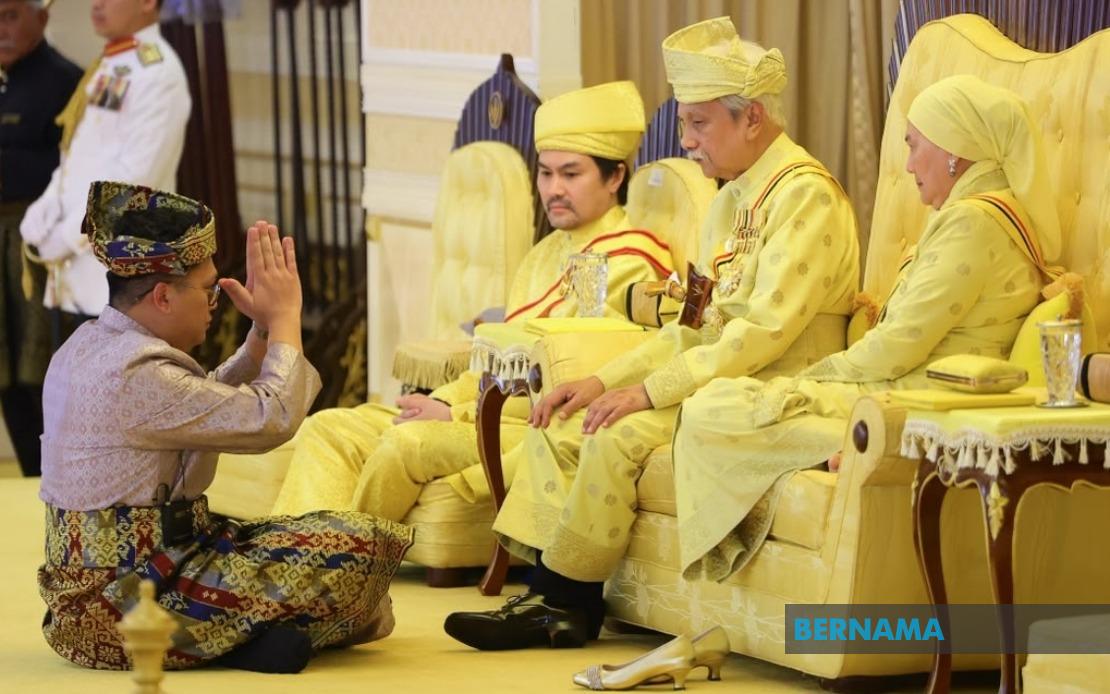
Muhammad Faris Johari has officially assumed the position of 11th Undang of Luak Sungei Ujong following his formal installation by Tuanku Muhriz Tuanku Munawir, the Yang Dipertuan Besar of Negeri Sembilan, during a traditional ceremony at Istana Besar Seri Menanti on June 27. The appointment reflects the continuation of the state's customary leadership structure and the ceremonial protocols that govern the selection and investiture of Negeri Sembilan's traditional rulers and chieftains, whose roles remain deeply embedded within the constitutional framework of the state's governance.
The installation proceedings followed established protocol, commencing with the Orang Empat Istana—the traditional council of four palace officials—formally seeking the Yang Dipertuan Besar's approval before advancing with the ceremony. Once consent was granted, Muhammad Faris recited his oath of allegiance to the ruler, a solemn commitment that binds him to serve the institution of the Yang Dipertuan Besar and uphold the duties associated with his new office. Tuanku Muhriz subsequently proclaimed Muhammad Faris as the rightful holder of the Undang position and conferred upon him the noble title Datuk Klana Petra, thereby elevating his standing within the state's hierarchy of traditional leadership.
The Yang Dipertuan Besar used the occasion to reiterate the expectations placed upon Negeri Sembilan's traditional leadership cadre, emphasising that the commitments undertaken during such ceremonies must be observed with genuine sincerity, unwavering integrity and a deep sense of personal and collective responsibility. His remarks underscored the significance of these ceremonial moments not merely as formal transitions of power, but as reaffirmations of the bonds that connect the state's traditional rulers to their sovereign and to the broader framework of constitutional monarchy that characterises Malaysian governance.
Tuanku Muhriz addressed the gathering of Orang Kaya—the hereditary chiefs who form the upper echelon of Negeri Sembilan's customary system—reminding them of their obligation to maintain steadfast loyalty to the institution of the Yang Dipertuan Besar and to cultivate relationships characterised by respect and deference toward both the ruler personally and the Palace as an institution. This exhortation reflects an ongoing tension within Malaysia's traditional leadership systems, where maintaining the relevance and authority of customary institutions requires constant reinforcement of their legitimacy and the commitment of those who hold office within them, particularly as modern governance structures and contemporary political dynamics sometimes challenge the traditional prerogatives of these bodies.
The ceremony drew attendance from prominent figures within Negeri Sembilan's royal household and government, including Tunku Ampuan Besar Tuanku Aishah Rohani Tengku Besar Mahmud, Tunku Besar Seri Menanti Tunku Ali Redhauddin Tuanku Muhriz, and Tunku Panglima Besar Tunku Zain Al-'Abidin. The presence of Menteri Besar Datuk Seri Aminuddin Harun and departmental heads underscored the interconnection between customary authority and the state's administrative machinery, demonstrating that while these spheres operate according to different principles, they function in tandem to govern Negeri Sembilan's affairs.
In his address, the Yang Dipertuan Besar articulated a philosophical framework for effective governance at the customary level, stressing that relationships grounded in reciprocal respect, mutual trust and consensual decision-making form the bedrock upon which Malaysia's constitutional monarchy and the preservation of traditional customs depend. These principles carry particular weight in Negeri Sembilan, which uniquely among Malaysian states practises Adat Perpatih—an ancient system of matrilineal customary law—rather than the patrilineal systems prevalent elsewhere in the peninsula. The Yang Dipertuan Besar's emphasis on preserving these values through the Orang Kaya's stewardship reflects awareness that globalisation and social change pose ongoing challenges to the survival of Adat Perpatih in contemporary Malaysian society.
Muhammad Faris, now 28 years old, brings professional credentials shaped by contemporary education and training to his traditional office. Born on October 30, 1997, he completed a degree in accountancy at Universiti Teknologi MARA and subsequently qualified as a chartered certified accountant through the ACCA programme in 2022, demonstrating that even those assuming roles steeped in centuries of tradition now typically bring formal qualifications and technical expertise to their positions. His marriage to Sharifah Amirah Syed Ismail Ash-Shahab aligns with customary expectations regarding the matrimonial arrangements of those entering the ranks of Negeri Sembilan's hereditary nobility.
The convergence of his professional background and his new traditional responsibilities illustrates a broader pattern within Malaysian society whereby individuals occupying positions within customary hierarchies operate across multiple systems of knowledge and authority simultaneously. Muhammad Faris's training in accounting and modern business practices could potentially bring valuable perspective to the administration of any resources or properties traditionally associated with the Undang position, though the precise scope of his practical authority and duties within contemporary Negeri Sembilan governance structures remains defined by the state's constitutional arrangements and customary protocols.
The installation of Muhammad Faris represents part of a broader ceremonial calendar within Negeri Sembilan's governance, as the same day witnessed a second royal audience scheduled to formalise the installation of the 22nd Undang of Luak Rembau. This clustering of installations reflects the periodic rotation and succession of positions within Negeri Sembilan's unique system of collective monarchy, wherein different Luaks—the territorial divisions of the state—each maintain their own Undang while remaining subordinate to the Yang Dipertuan Besar. The simultaneous investiture of multiple officeholders emphasises the interconnectedness of these positions and the way they collectively constitute the state's governance apparatus.
For Malaysian observers, the ceremony demonstrates the continued vitality of traditional institutional arrangements in a modern nation-state, even as globalisation and political modernisation reshape many aspects of governance across Southeast Asia. Negeri Sembilan's preservation and active use of its customary institutions, including Adat Perpatih and the elaborate ceremonial protocols governing the investiture of its traditional leaders, distinguishes it within Malaysia and reflects broader Southeast Asian dynamics whereby societies attempt to balance indigenous traditions with contemporary administrative requirements. Muhammad Faris Johari's appointment thus carries significance extending beyond his personal advancement, serving as a visible marker of Negeri Sembilan's continued commitment to maintaining these distinctive institutional frameworks.

