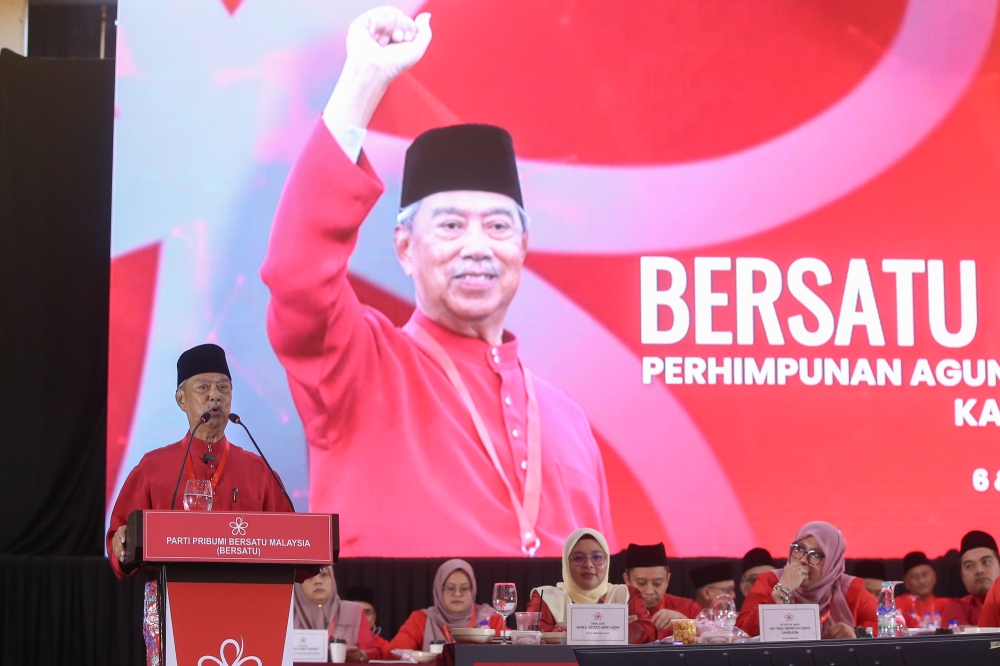
Tan Sri Muhyiddin Yassin, the president of Parti Pribumi Bersatu Malaysia, launched a sharp critique of the Perikatan Nasional coalition, asserting that his party has been systematically excluded from meaningful participation despite remaining a formal member. The statement represents a significant escalation in tensions within a political coalition that has undergone considerable strain in recent months, with Muhyiddin articulating grievances about the direction and decision-making processes within Perikatan's leadership structure.
The Bersatu leader's comments strike at what he characterizes as a fundamental contradiction in Perikatan's current strategic pivot. By pursuing closer alignment with Umno, Muhyiddin contends that the coalition has abandoned the principles of inclusive Malay-Muslim representation that ostensibly bind it together. His assertion that this arrangement lacks genuine substance as a unity mechanism reflects deeper ideological and organizational fractures within the broader Malay political establishment, where multiple parties compete for dominance within the same electoral constituency.
Muhyiddin's grievance speaks to a pattern of marginalization that Bersatu members have observed within coalition structures. When a party claiming to represent significant Malay-Muslim interests finds itself sidelined in favour of more established rivals, it raises questions about the hierarchy of influence and decision-making authority within multi-party coalitions. For Malaysian readers familiar with coalition politics, this scenario mirrors earlier conflicts where smaller partners have struggled to maintain relevance within larger political structures dominated by parties with greater parliamentary representation.
The accusation that Perikatan has effectively shut out Bersatu carries implications for how the coalition might perform in future electoral contests. A coalition fractured by internal resentment and perceptions of unfair treatment often struggles to project unity to voters. Bersatu's grassroots mobilization capacity, particularly in certain states, could be significantly diminished if party members feel their leadership has lost meaningful influence within the broader coalition framework. This internal discord becomes visible to the electorate and undermines the coalition's credibility.
Muhyiddin's characterization of the Umno alliance as lacking authenticity deserves particular scrutiny. The Bersatu president appears to be questioning not merely the political optics but the philosophical coherence of combining parties with markedly different origins and constituencies. While both Umno and Bersatu claim to champion Malay-Muslim interests, their historical trajectories, organizational bases, and policy emphases have diverged considerably. Authentic Malay unity, in Muhyiddin's implicit argument, would require genuine integration rather than tactical accommodation.
The timing of these remarks reflects broader uncertainties about Malaysia's political direction. With the government navigating complex economic challenges, managing religious sensitivities, and addressing concerns about institutional integrity, coalition stability becomes consequential for governance capacity. A coalition perceived as hollowed out by internal conflict may struggle to implement coherent policy agendas, particularly on matters requiring cross-party consensus or affecting core constituencies.
For Southeast Asian observers tracking Malaysian politics, these developments illustrate how coalition dynamics remain fluid and contested. Unlike systems where party mergers or defections create cleaner transitions, Malaysian coalitions often maintain formal unity while experiencing functional fragmentation. Parties remain nominally allied while pursuing distinct interests, creating ambiguity about which statements reflect coalition consensus and which represent factional positions.
The exclusion complaint also raises practical questions about resource distribution, candidate selection, and portfolio allocation within the broader political structure. When a party president believes his organization has been denied fair consideration in these matters, it frequently signals approaching structural changes. History suggests that such grievances, when left unaddressed, typically lead to either formal departures or dramatic realignments that reshape the political landscape.
Muhyiddin's invocation of genuine Malay unity appears designed to appeal to traditional constituencies while positioning Bersatu as the more principled actor. By suggesting that others have abandoned authentic representation in favour of calculated positioning, he attempts to reclaim moral authority and differentiate Bersatu's identity. This rhetorical strategy proves particularly potent in Malaysian politics, where appeals to communal authenticity resonate powerfully across the Malay-Muslim demographic.
The practical consequences of these tensions could reverberate through multiple political and governance channels. State-level administrations where Bersatu holds significant representation might experience coordination difficulties. Legislation dependent on coalition unity could face unexpected obstacles. More significantly, voter confidence in the coalition's ability to deliver cohesive governance could erode, potentially affecting electoral performance in constituencies where coalition politics determine outcomes.
Going forward, whether Perikatan's leadership can address Bersatu's grievances through substantive power-sharing adjustments or whether these tensions will culminate in formal reorganization remains uncertain. The Malaysian political system has demonstrated considerable adaptability in accommodating fractious coalitions, yet there are limits to how much internal friction the electorate will tolerate before seeking alternative political arrangements. Muhyiddin's statement thus carries significance extending beyond immediate coalition management to broader questions about the stability and credibility of Malaysia's political structures.

