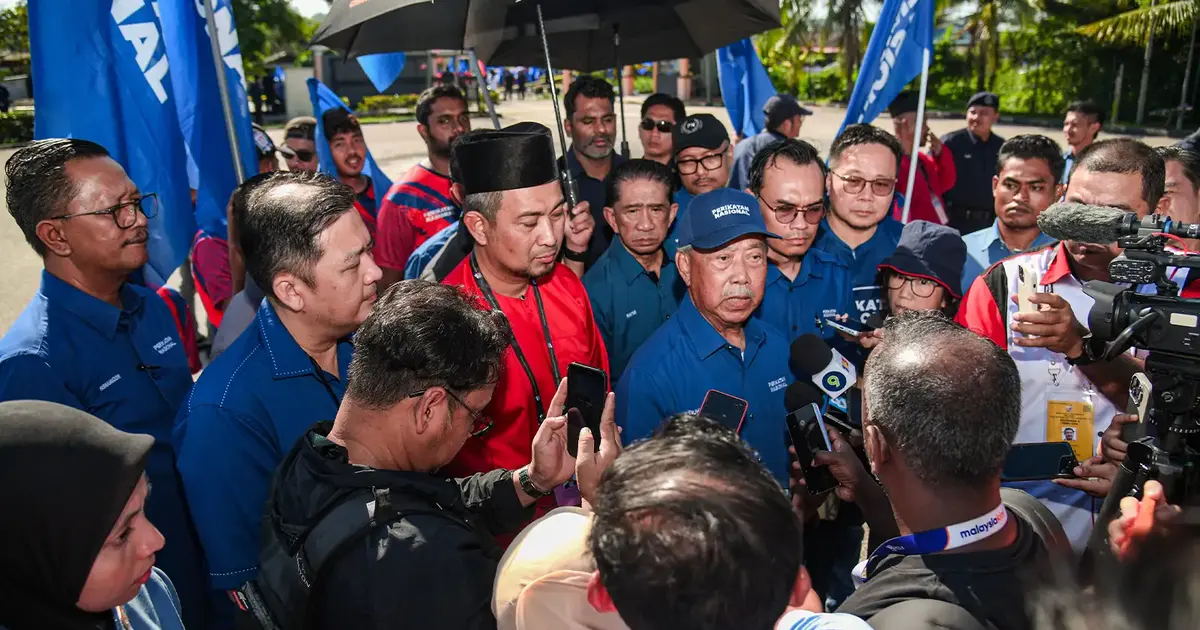
Perikatan Nasional's chances of securing state-level administration remain viable, according to Bersatu president Muhyiddin Yassin, who projects the coalition's potential to translate parliamentary and grassroots strength into control of state legislatures across Malaysia. His statement reflects PN's strategic calculations as the coalition navigates an increasingly fragmented political landscape, where state governments represent crucial platforms for policy implementation and political advancement. The assertion underscores PN's ambitions beyond its current parliamentary footprint, particularly as state elections loom in coming years across various Malaysian jurisdictions.
Muhyiddin's confidence draws from what he characterises as PN's consolidated internal structure and widening external support network. The coalition, which comprises Bersatu, PAS, and several other parties, has demonstrated electoral viability in recent contests, and the Bersatu leader appears intent on leveraging this momentum toward territorial expansion at state level. His remarks suggest a deliberate strategy to position PN as a credible alternative administration at sub-federal levels, where state governments wield considerable authority over land, agriculture, education, and local development—areas directly affecting residents' daily lives.
Crucially, Muhyiddin identified Muda as a significant political ally operating outside PN's formal coalition structure. This development reflects the fluid nature of Malaysian coalitional politics, where parties frequently maintain semi-formal working relationships while preserving operational independence. Muda, the relatively new progressive party led by Syed Saddiq Syed Abdul Rahman, has emerged as a potential kingmaker in state politics, particularly in areas where it has cultivated substantial youth and urban support. By acknowledging Muda's partnership potential, Muhyiddin signals PN's willingness to construct broader electoral blocs at state level, enabling the coalition to bridge gaps in demographic reach and geographical representation.
The strategic value of such alliances becomes apparent when examining state-level mathematics. Many Malaysian states feature fractured legislatures where no single coalition commands overwhelming majorities, rendering smaller parties and independent candidates pivotal. By maintaining formal coalition discipline while cultivating external partnerships, PN can present itself as a more flexible political entity capable of assembling diverse governance coalitions. This approach contrasts with potential rivals, including Pakatan Harapan, which operates under tighter structural constraints and formalized power-sharing agreements that sometimes limit maneuverability.
Muhyiddin's projection also reflects PN's current institutional strengths. The coalition's presence in Kedah, Terengganu, and other states provides established administrative machinery, party infrastructure, and incumbent advantage—factors that historically prove decisive in state elections. Additionally, PAS's deep organizational roots and community networks, particularly in peninsular states, furnish PN with grassroots mobilization capabilities that younger competitors struggle to replicate. These structural advantages constitute genuine political capital that PN can deploy toward expansion ambitions.
However, the coalition confronts substantial headwinds. Public perception issues stemming from various controversies continue to weigh on PN's popularity in some demographics, particularly urban areas and among younger voters—constituencies where Muda maintains relative strength. Furthermore, internal tensions within PN occasionally surface, particularly regarding policy priorities and resource allocation among coalition members. These friction points could undermine cohesion during intensive state campaign periods when unity proves essential.
The timing of Muhyiddin's remarks carries political significance. Multiple state elections appear likely within the medium term, and PN evidently seeks to frame the narrative around its readiness and capability to govern. By publicly articulating confidence and highlighting external alliances, the Bersatu president attempts to solidify PN's image as a serious contender rather than a transitional political configuration. Such messaging carries particular weight among fence-sitting voters and party members evaluating their political allegiances.
For Malaysian federalism more broadly, PN's expansion at state level would materially reshape governance dynamics. A coalition controlling multiple states would gain platforms to showcase alternative policy approaches, contest national narratives, and accumulate resources for potential federal challenges. Simultaneously, any success in state elections would strengthen Muhyiddin's standing within PN's internal hierarchy, consolidating his leadership position against potential rivals.
The inclusion of Muda in Muhyiddin's calculation also hints at evolving political realignments. Muda's independence from established coalitions has allowed it to position itself as an alternative to both PN and Pakatan Harapan, potentially capturing votes from dissatisfied supporters of both entities. By formalizing working arrangements with Muda without absorption into PN's rigid coalition structure, Muhyiddin preserves Muda's separate identity while establishing practical cooperation mechanisms. This arrangement potentially appeals to Muda's supporters, who value the party's operational autonomy and distinct policy platform.
Looking forward, Muhyiddin's confidence in PN's state-government potential requires testing through actual electoral performance. While the coalition possesses genuine strengths, Malaysian voters in state contests have demonstrated willingness to punish coalitions perceived as complacent or to experiment with new political formations. The coming state elections will clarify whether PN can indeed translate its current positioning into tangible territorial control, and whether alliances with parties like Muda prove durable or merely transactional arrangements shaped by immediate electoral calculations.

