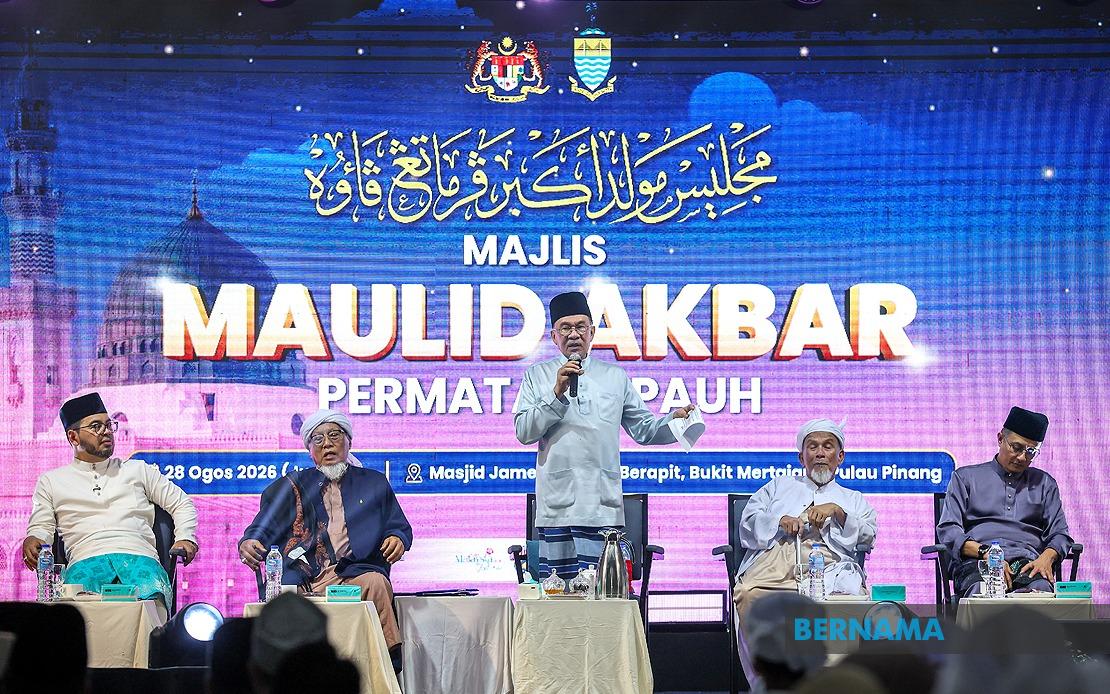
Prime Minister Datuk Seri Anwar Ibrahim has called on Malaysian Muslims to become exemplars of moral conduct and integrity in their daily lives, positioning ethical behaviour as the cornerstone of both community respect and the nation's development trajectory. Speaking at a Maulid Akbar ceremony held in conjunction with National Day celebrations at Masjid Tengah in Bukit Mertajam on August 28, Anwar emphasised that the standing Muslims enjoy in society should be earned through concrete demonstrations of virtue rather than inherited or assumed through religious identity alone.
The Prime Minister outlined a comprehensive vision of how Muslims ought to conduct themselves in both public and private spheres. Visible commitment to diligence, honesty in business and official dealings, and the scrupulous rejection of corruption would create a foundation of public trust, he argued. By extension, when people observe Muslims honouring their commitments, refusing to exploit positions of authority, and conducting themselves with transparency, respect naturally follows. Anwar framed this not as an abstract moral imperative but as a practical social contract—integrity generates credibility, and credibility generates the influence necessary to serve communities effectively.
Central to Anwar's message was the assertion that Islam itself carries an inherent message of compassion and universal goodness that transcends sectarian or ethnic boundaries. This theological positioning carries particular significance in Malaysia's multi-confessional context, where interfaith tensions occasionally surface. By grounding Islamic practice in messages of inclusivity and welfare for all citizens regardless of their faith background, Anwar sought to reframe Islam's social role as fundamentally unifying rather than divisive. The implication is that Muslims who truly embody Islamic values will naturally become guardians of community cohesion and cross-communal prosperity.
Anwar introduced the concept of balance as essential to Muslim life and development, arguing that Muslims must simultaneously cultivate knowledge, spiritual depth, moral fortitude, and material advancement. This framework directly addresses a longstanding tension within Muslim-majority societies between secular progress and religious observance. Rather than treating these as competing priorities, Anwar presented them as complementary aspects of holistic human flourishing. The articulation suggests that there is no inherent conflict between technological mastery and moral integrity, between economic dynamism and spiritual rootedness—provided the latter dimensions serve as guiding principles rather than afterthoughts.
The Prime Minister explicitly connected this ethical vision to Malaysia MADANI, the government's overarching development framework. He contended that policies, economic growth figures, and technological achievements alone cannot sustain a nation's progress without a bedrock of faith, character, and moral principle underpinning all activities. This represents a significant statement about the kind of development model Anwar envisions for Malaysia—one where material advancement is not an end in itself but a means serving broader human and moral purposes. The implication is that Malaysia's competitiveness depends not merely on its GDP or technological capacity but on the trustworthiness and integrity of its institutions and citizens.
Anwar employed the metaphor of reaching for the sky while remaining rooted in the earth to illustrate this balance. The phrase encapsulates the tension between ambition and groundedness, between forward momentum and stable values. In the Malaysian context, where rapid urbanisation, globalisation, and technological change have sometimes created anxiety about erosion of traditional values, this framing offers reassurance that modernisation need not be accompanied by moral relativism. The metaphor also subtly warns against the pursuit of progress at any cost—a relevant caution in an environment where high-profile corruption cases have occasionally involved senior officials who accumulated impressive technological and economic credentials.
The presence of Minister in the Prime Minister's Department (Religious Affairs) Dr Zulkifli Hasan at the event underscored the government's institutional commitment to this ethical agenda. The joint appearance suggested that promoting moral leadership among Muslim communities is not merely a matter of rhetorical emphasis but an active government priority requiring coordination across religious and administrative portfolios. This institutional backing lends weight to Anwar's message and signals that the government intends to operationalise these principles through policy and resource allocation.
Anwar particularly emphasised the importance of seeking guidance from Islamic scholars and creating structured channels through which religious leaders and government officials can engage in constructive dialogue. This reflects an acknowledgment that implementing an ethics-centred development model requires genuine partnership between religious and secular authorities rather than unilateral directives from government. The call for scholars to provide advice suggests a more consultative approach to governance in matters affecting Muslim communities and, by extension, the nation as a whole.
For Malaysian readers, particularly Muslim Malaysians, Anwar's remarks carry several layers of significance. On one level, they constitute a direct appeal to personal moral accountability—a reminder that religious identity carries behavioural expectations and that the public image of Islam is partially shaped by the conduct of its adherents. On another level, they articulate a vision of Muslim civic participation grounded in universal values and community welfare rather than sectional interest or identity politics. Furthermore, by tying personal and communal virtue to Malaysia's broader development ambitions, Anwar positions moral leadership as a national asset comparable to human capital, infrastructure, or natural resources.
The underlying argument also carries implications for governance and institutional reform. If Muslims in positions of responsibility are to genuinely exemplify the virtues Anwar described—transparency, diligence, honesty, resistance to corruption—this will require institutional changes, accountability mechanisms, and cultural shifts within government and the civil service. The assertion that Malaysia MADANI cannot succeed without moral foundations implicitly acknowledges that previous development efforts may have suffered from insufficient attention to ethical dimensions and suggests that addressing this gap is now viewed as strategically essential.
More broadly, Anwar's emphasis on Muslims as moral exemplars reflects a deliberate positioning of Islam as compatible with, and indeed essential to, Malaysia's modernisation agenda. This counters narratives—sometimes promoted by both secularists and conservative Islamists—that portray religion and development as inherently antagonistic. By arguing that moral integrity and technological progress reinforce rather than undermine each other, and that Muslims can and should be at the forefront of both, Anwar presents an integrative vision that may appeal across ideological divides.
The challenge implicit in Anwar's call is whether this ethical framework can be sustained and translated into concrete institutional practice. Exhortations to moral conduct are necessary but insufficient without structural reforms, accountability systems, and incentive structures that reward integrity and penalise corruption. The coming months and years will reveal whether Malaysia MADANI moves beyond rhetorical emphasis on values to implement substantive changes in governance and institutional culture that make good character and integrity genuinely rewarded in both public and private sectors.

