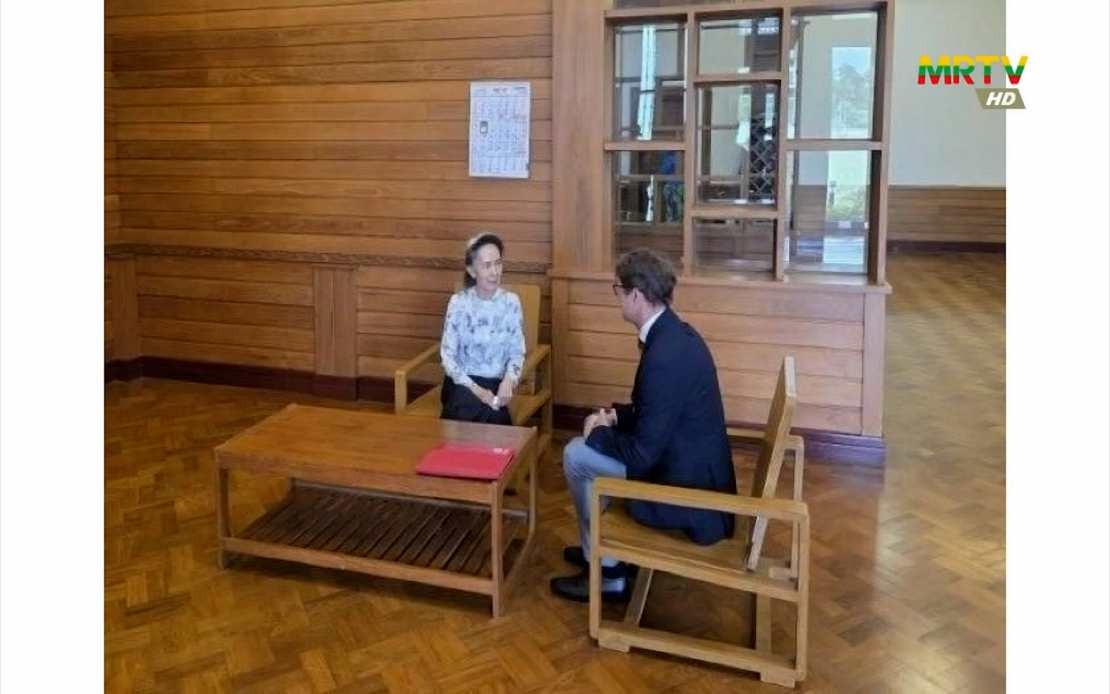
Myanmar's military-controlled government announced on Monday that detained former civilian leader Aung San Suu Kyi had met with a representative of the International Committee of the Red Cross, providing what amounts to the first visible evidence of international contact with the 81-year-old Nobel Peace Prize winner in the nearly four years since the armed forces seized power. Government spokeswoman Khine Khine Soe disclosed the meeting with Arnaud de Baecque, the ICRC's Resident Representative to Myanmar, through a Telegram message that included photographs of the encounter at the capital, Naypyitaw, marking a significant shift in the military administration's stance on foreign access to the incarcerated politician.
The move comes as regional governments, particularly fellow members of the Association of Southeast Asian Nations, have intensified diplomatic pressure on the junta to permit independent verification of Suu Kyi's physical and mental well-being. Since the February 2021 dawn coup that toppled her elected administration and plunged the resource-rich nation of 51 million people into deepening instability, the exact location and health status of Myanmar's most internationally recognised political figure have remained shrouded in official secrecy. The military regime has consistently maintained that Suu Kyi enjoys good health, yet has resisted calls from both ASEAN partners and international human rights organisations to grant access to credible observers.
Photographs released by the government spokeswoman depicted Suu Kyi dressed in traditional Burmese clothing seated across from Baecque in what appeared to be a minimally appointed room containing only basic furnishings. A second set of images offered rare domestic details, showing the political leader cutting a birthday cake with her name inscribed upon it, surrounded by mundane household items including a clothes rack and storage containers. A fourth photograph displayed the cake itself, marked with the inscription "Happy Birthday Aunty Suu 19.6.2026," though independent verification of when these images were captured or their authenticity could not be established. The circumstances and timing of the photographic documentation raised questions about the controlled nature of the encounter and whether it had been staged specifically for international consumption.
Suu Kyi has endured an extraordinary judicial ordeal since her detention began. Following a series of closed-door trials conducted in the months after the coup, military courts convicted her on multiple charges including corruption, election fraud incitement, and breaches of state secrecy regulations, ultimately imposing a 33-year sentence. Subsequent legal proceedings saw this sentence reduced first to 27 years and then diminished by an additional one-sixth in April, leaving her with approximately 18 years of her term still remaining, according to members of her legal defence team. Political allies and human rights monitors have consistently characterised these prosecutions as retaliatory measures designed to neutralise her influence and remove her from national politics, arguing that the charges lack substantive legal merit.
The absence of direct family contact has intensified international concern about her physical condition. Suu Kyi's son, Kim Aris, revealed in December that he maintained virtually no reliable information regarding his mother's wellbeing, receiving only sporadic and second-hand reports about alleged heart difficulties, bone complications, and gum problems. He disclosed that years had elapsed without any direct communication from his mother, expressing profound anxiety that she might pass away without his knowledge or the ability to be at her side. These revelations from her immediate family underscored the extreme isolation imposed upon the detained leader and the genuine humanitarian dimensions of the international campaign for access.
The timing of the ICRC meeting followed the military administration's April announcement that Suu Kyi had been transferred to house arrest, a designation that technically permits different conditions than incarceration in formal detention facilities. This development coincided with a tightly controlled military-orchestrated election that enabled former junta commander Min Aung Hlaing to assume the presidency, consolidating military control through ostensibly electoral mechanisms. The sequence of events suggested that the regime may have calculated that a carefully controlled demonstration of Suu Kyi's accessibility could help deflect mounting criticism from regional partners without genuinely opening the door to independent monitoring.
ASEAN nations, which have sought to maintain diplomatic channels with Myanmar despite the coup's illegality under international law, have specifically requested opportunities to verify the junta's health assurances. Following an April meeting of foreign ministers in Bangkok, Thailand's chief diplomat Sihasak Phuangketkeow explicitly called for international access to Suu Kyi "so that we can be able to verify the claims" of her good health. The Philippines similarly submitted a formal request in May for an ASEAN special envoy to meet with the detained leader, only to face rejection from the military authorities. These rebuffals, prior to the Red Cross meeting, illustrated the administration's previous reluctance to expose the detention circumstances to external scrutiny.
For Malaysian policymakers and regional observers, the unfolding situation in Myanmar carries significant implications. As a fellow ASEAN member and neighbouring nation sharing land borders with Myanmar, Malaysia has vested interests in the country's stability and the promotion of democratic norms within the bloc. The treatment of Suu Kyi, universally recognised as a democracy symbol following her suffering under a previous military junta, serves as a bellwether for the international community's willingness to challenge authoritarian reversals. Moreover, Malaysia's own experience with political transitions and the rule of law makes the Myanmar situation an important case study in how regional organisations balance diplomatic engagement with principled stands against military overthrows of elected governments.
Suu Kyi's political biography provides essential context for understanding the current crisis. As the daughter of independence hero General Aung San, who negotiated Myanmar's liberation from British colonial rule and whose legacy carries profound nationalist significance, she inherited both symbolic weight and popular affection. During an earlier period of military rule, she endured a cumulative 15 years of house arrest at her family home on Yangon's Inya Lake, where she achieved legendary status by delivering passionate addresses to devoted crowds who gathered outside the metal gates of her residence. Her eventual transition to elected leadership represented a democratic triumph that inspired regional and global observers, making the 2021 coup a particularly devastating blow to Southeast Asian hopes for democratic deepening.
The military administration's selective opening to Red Cross access, while still refusing broader international monitoring, reflects the junta's strategic calculation that it can manage its international image while maintaining substantive control over information flows. The staged photographs, carefully composed and released through official channels, served as evidence of the regime's willingness to cooperate with humanitarian actors without granting the kind of unrestricted access that might expose uncomfortable realities. For regional neighbours including Malaysia, the challenge lies in determining whether such gestures represent genuine shifts toward transparency or mere tactical concessions designed to reduce external pressure while the underlying detention regime continues unabated.
The broader question of Myanmar's trajectory remains uncertain as ASEAN grapples with balancing constructive engagement against the principles that ostensibly underpin the bloc's commitment to democracy and human rights. The junta's treatment of Suu Kyi—one of Asia's most internationally recognised democracy advocates—will likely continue to define perceptions of Myanmar's place within a rules-based regional order. Whether the Red Cross meeting represents a prelude to more substantial international access, or merely an isolated publicity exercise, will become clearer through the junta's subsequent actions regarding both Suu Kyi and the broader restoration of democratic governance in Myanmar.

