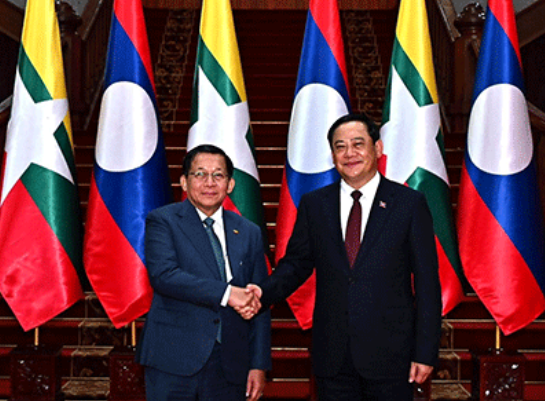
Myanmar's President Min Aung Hlaing brought a high-level delegation to Vientiane from July 3-5 to mark seven decades of diplomatic relations with Laos and chart a new course for expanded regional partnership. The visit underscored the enduring strategic importance both nations place on their connection, with Laos hosting what constituted President Min Aung Hlaing's first official foreign engagement since assuming office. The ceremonial welcome at the Presidential Palace demonstrated the symbolic weight Laos attached to the occasion, with President Thongloun Sisoulith and his wife Naly Sisoulith extending full state honours to their Myanmar counterpart.
During formal talks at the palace, the two leaders conducted a comprehensive review of existing cooperation frameworks while setting priorities for the coming period. Their discussion ranged across bilateral matters to regional and international concerns, reflecting the depth of engagement between these two Mekong-linked nations. The dialogue revealed mutual satisfaction with existing arrangements while identifying fresh opportunities for collaboration. President Thongloun took the occasion to congratulate Myanmar on its recent general election and new government formation, explicitly expressing optimism about Myanmar's trajectory under President Min Aung Hlaing's stewardship—a gesture of diplomatic warmth that acknowledged Myanmar's complex political circumstances.
The two sides identified defence and security cooperation as a priority area, alongside commitments to strengthen border management and intelligence sharing. This emphasis carries particular resonance given both nations' shared interest in maintaining stability along their frontier regions. The agreement to deepen collaboration within multilateral frameworks including the Association of Southeast Asian Nations, the United Nations, and the Mekong-Lancang Cooperation mechanism situates the bilateral relationship within broader regional architecture. This positioning suggests both countries view their partnership as extending beyond bilateral convenience to contribute to wider Southeast Asian stability and prosperity.
Prime Minister Sonexay Siphandone separately met with the Myanmar President at his office, underlining the whole-of-government engagement that characterised the visit. The Prime Minister emphasised how the state visit would consolidate decades of established friendship, while welcoming the concrete outcomes materialised through signed cooperation agreements. This parallel engagement ensured that both executive branches could align on implementation mechanisms and demonstrate political will at the highest levels of government. The messaging from both sides consistently emphasised mutual trust accumulated through regular high-level exchanges, suggesting a relationship grounded in personal rapport among decision-makers rather than purely transactional arrangements.
Parliamentary dimensions received significant attention when President Min Aung Hlaing met with National Assembly President Xaysomphone Phomvihane. Their discussion centered on strengthening institutional ties between Laos' legislature and Myanmar's Union Parliament, with particular focus on monitoring implementation of bilateral agreements. This legislative-level engagement reflects sophisticated understanding that sustainable cooperation requires oversight mechanisms and popular accountability. Xaysomphone framed the visit as recognition of the historic friendship between nations, while simultaneously committing his institution to ensure that memorandums of understanding and other agreements delivered tangible benefits to ordinary citizens rather than remaining symbolic gestures.
Two significant cooperation documents emerged from the talks. A memorandum of understanding on tourism cooperation between Laos' Ministry of Culture and Tourism and Myanmar's Ministry of Hotels, Tourism and Culture signals growing recognition of both nations' potential to market their cultural heritage jointly. The decision to establish friendship city relations between Vientiane and Naypyidaw created an institutional mechanism for sustained municipal-level engagement. These agreements suggest bilateral cooperation is expanding beyond traditional state-to-state channels toward people-to-people connections through tourism and cultural exchange. Additionally, Myanmar handed over snake antivenom serum to Laos' Ministry of Health, a practical health security gesture addressing shared public health challenges across the border region.
The visit incorporated carefully orchestrated ceremonial dimensions that reinforced diplomatic messaging. President Min Aung Hlaing's wreath-laying at the Unknown Soldier Monument paid tribute to Lao revolutionary sacrifice, while his participation in a traditional Baci blessing ceremony and attendance at a state banquet demonstrated cultural respect and willingness to embrace Lao traditions. These elements transcended mere protocol, signalling deep regard for Lao sovereignty and historical experience. The inclusion of a Luang Prabang component to the itinerary, where the Myanmar delegation would visit UNESCO World Heritage temples and cultural landmarks, further embedded the visit within frameworks of regional cultural appreciation and preservation.
For Malaysia and broader Southeast Asia, this Myanmar-Laos partnership development carries strategic implications. The emphasis on Asean cooperation and multilateral frameworks suggests both nations view regional stability as a collective endeavour rather than matter for bilateral posturing. Myanmar's deliberate choice of Laos for its first major state visit since President Min Aung Hlaing's recent electoral transition signals Myanmar's commitment to maintaining Asean relationships and regional integration despite its internal political transitions. Laos, as chair of Asean in 2024 and a close neighbour of Myanmar, positioned itself strategically through this engagement.
The focus on border security, information sharing, and cross-border air pollution management reflects pragmatic recognition that contentious regional challenges require cooperation rather than confrontation. Both nations share the Mekong River corridor and face common environmental pressures, making coordinated approaches essential. The Mekong-Lancang Cooperation framework, emphasised repeatedly in official statements, represents a broader platform through which Laos and Myanmar can coordinate with China on development priorities. This multi-layered approach to partnership—combining bilateral, Asean, and multilateral dimensions—demonstrates sophisticated regional engagement strategy.
For Malaysian policymakers and business leaders, the expansion of Myanmar-Laos cooperation in trade, investment, and transport creates both opportunities and considerations. Enhanced regional connectivity between these nations could reshape logistics networks and supply chain configurations across Southeast Asia. The emphasis on labour cooperation suggests growing recognition of labour mobility challenges, relevant given Malaysia's own reliance on regional migrant workers. The tourism cooperation agreement could redirect visitor flows and economic benefits within the region, with implications for competing destinations.
The visit also reflected Myanmar's desire to normalise its regional standing following recent political turbulence. By staging a significant state engagement focused on deepening established relationships rather than pursuing dramatic new initiatives, Myanmar signalled stability and continuity to regional partners. Laos, as a fellow socialist-oriented state with longstanding ties to Myanmar, provided an appropriate venue for this reassurance campaign. The characterisation of the visit as marking 70 years of diplomatic relations emphasised historical depth and suggests both nations view their partnership as rooted in revolutionary solidarity and shared ideological foundations.
Looking forward, the institutional mechanisms established through this visit—the bilateral cooperation committee, parliamentary exchanges, and friendship city arrangements—will determine whether agreements translate into sustained engagement or remain aspirational documents. The success of these arrangements will influence whether Myanmar's regional rehabilitation continues smoothly or encounters obstacles. For Southeast Asian nations navigating the complex dynamics of Myanmar's integration, observing implementation of these Laos-Myanmar agreements provides indicators of Myanmar's commitment to substantive regional cooperation beyond diplomatic protocol.

