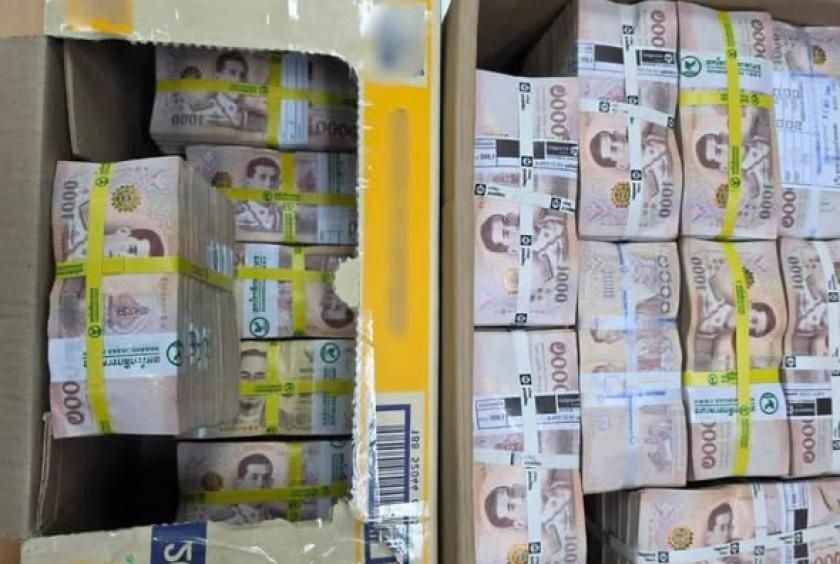
A Myanmar national faces charges after Thai authorities intercepted an attempt to smuggle more than 23 million baht across the Thai-Myanmar border at Mae Sai, underscoring persistent enforcement challenges at one of the region's most critical trade gateways. The 31-year-old driver, operating a vehicle registered in Myanmar, was apprehended during a routine customs inspection at the Friendship Bridge checkpoint on the Thai side, where vigilant officials uncovered the carefully concealed cache of Thai currency stashed within seemingly innocuous food products.
The discovery came about when customs personnel at the Mae Sai facility decided to conduct a thorough search of the private vehicle as it transited the Friendship Bridge. The methodical inspection revealed bundles of 1,000-baht banknotes strategically packed inside cartons of dried fish and potatoes, with the currency wrapped in multiple layers of plastic bags to prevent detection. This concealment technique reflects the sophistication that smugglers employ when attempting to move large sums across international borders, particularly in a region where informal cross-border commerce frequently masks more illicit transactions.
The full extent of the contraband emerged as customs staff systematically examined the cargo. The first carton yielded approximately 17 million baht, while a second container held an additional 6.023 million baht, bringing the total seizure to 23.023 million baht, equivalent to roughly 689,000 US dollars at current exchange rates. The substantial amount suggests this was not a minor personal currency transfer but rather part of a larger commercial operation designed to move significant wealth across the border while circumventing official channels and regulatory oversight.
Thai authorities have characterized the alleged offence as a serious breach of multiple legal frameworks governing international commerce and financial flows. The suspect now faces charges under Thailand's Customs Act, which sets strict penalties for attempting to move regulated goods—including currency—without proper declaration and authorization. Additionally, the arrest implicates Thailand's foreign exchange control regulations, which exist to maintain monetary stability and prevent the kind of untracked capital flows that can distort local economies and facilitate money laundering.
The apprehension highlights the critical role that border checkpoints play in interdicting illegal financial movements across Southeast Asia. The Mae Sai-Tachileik crossing represents one of the busiest and most strategically important commercial corridors in the region, facilitating legitimate trade worth billions of dollars annually between Myanmar and Thailand. However, this high volume of legitimate traffic also creates opportunities for smugglers to blend illicit movements with lawful commerce, making the work of customs officials increasingly complex and resource-intensive.
Forest authorities have detained the suspect at Mae Sai Police Station, where he remains while investigators work to build a comprehensive case against him. Beyond the immediate charges related to currency smuggling, Thai police appear focused on identifying the broader network behind this operation. Such investigations typically aim to uncover the originators of the cash, the intended recipients on the Thai side, and any accomplices who may have facilitated the transport or coordinated the cross-border exchange. The interconnected nature of transnational smuggling networks means that a single arrest often represents merely the visible tip of a more complex criminal enterprise.
This incident arrives amid broader regional concerns about illicit financial flows and the use of border zones for money laundering activities. Southeast Asia remains vulnerable to such operations, given the region's significant informal economy, multiple currency zones, and the relative ease with which large sums can be moved across porous borders. Countries throughout the region, including Malaysia, have grappled with similar challenges as they attempt to tighten controls while maintaining the economic vitality of legitimate cross-border trade.
The Myanmar angle adds particular significance, given ongoing economic and political volatility in that country since the 2021 military coup. Large-scale movement of Thai baht out of Myanmar often reflects efforts by individuals or entities to preserve wealth outside the jurisdiction, protect assets from potential seizure, or finance activities that operate outside formal banking channels. Thai authorities' determination to prosecute this case vigorously sends a message about the seriousness with which they treat such violations, particularly when they involve attempts to drain Thai currency resources.
For Malaysian observers, this incident underscores vulnerabilities that exist across the entire ASEAN region's border infrastructure. While Malaysia's major international checkpoints benefit from advanced scanning technology and significant investment in customs enforcement, less prominent crossing points and the sheer volume of daily traffic remain potential weak points. The Mae Sai case demonstrates that even at well-monitored checkpoints, determined smugglers will continue attempting increasingly sophisticated concealment methods, requiring customs agencies to remain perpetually vigilant and adaptive in their detection strategies.

