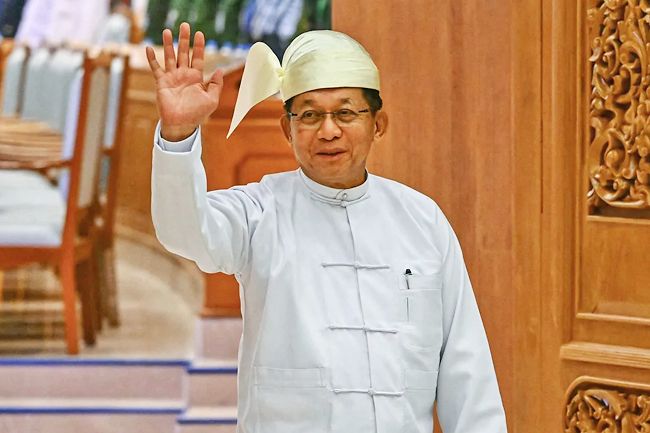
Myanmar's military leader Min Aung Hlaing is set to visit Bangkok on August 6 and 7 for talks with Thai Prime Minister Anutin Charnvirakul, according to Thailand's Foreign Minister Sihasak Phuangketkeow. The planned engagement comes as Thailand intensifies diplomatic manoeuvres to restore Myanmar to the centre of Southeast Asian affairs following the junta's 2021 coup, which displaced the democratically elected government of Aung San Suu Kyi.
The announcement follows what Sihasak characterised as candid discussions among ASEAN foreign ministers in Manila about the most effective pathway to reintegrate Myanmar. Though the country technically remains an ASEAN member, it has been formally barred from the bloc's principal forums and decision-making bodies since the military takeover nearly three years ago. This suspension reflects the international community's disapproval of the coup and the subsequent crackdown on civil society and opposition movements.
Thailand's proactive stance on Myanmar reintegration is shaped by the practical realities of geography and demographics. As the nation sharing the longest border with Myanmar and hosting millions of Rohingya and other refugees fleeing the conflict, Bangkok faces immediate pressures that other ASEAN capitals do not. The humanitarian toll of Myanmar's internal conflict—including ongoing civil war and ethnic tensions—creates both moral imperatives and security concerns for Thailand, making engagement a matter of strategic necessity rather than purely diplomatic preference.
Sihasak articulated Thailand's approach as fundamentally pragmatic, describing it as a "dual-track" strategy that addresses immediate bilateral concerns whilst maintaining theoretical commitment to ASEAN's longstanding peace framework. The approach acknowledges transnational challenges that demand bilateral cooperation, particularly drug trafficking, human smuggling, and organised crime networks that exploit the porous border region. These issues affect Thailand directly and require channels of communication with Myanmar's military authorities regardless of the junta's political status within ASEAN.
However, Thailand's push for reintegration has created visible fractures within ASEAN itself. Several member states, particularly those with stronger democratic traditions and human rights commitments, view accelerated engagement with the junta as tacit acceptance of military rule and abandonment of principles enshrined in the ASEAN Charter. The bloc's consensus-based decision-making process has meant that efforts to formally readmit Myanmar to major forums have stalled, exposing competing interests and values among members that transcend the Myanmar question alone.
Sihasak raised a critical methodological issue during recent ASEAN consultations: the need to establish measurable benchmarks for assessing Myanmar's progress toward democratisation and peace. He suggested several potential indicators, including whether the junta would grant ASEAN's special envoy access to detained political leaders like Aung San Suu Kyi, or whether reduced violence along the Thai-Myanmar border could serve as evidence of trajectory improvement. This framework-setting reflects Thailand's attempt to create objective criteria that could justify reintegration to sceptical ASEAN members without demanding immediate wholesale transformation.
The foreign minister emphasised the necessity of realistic expectations, cautioning that Myanmar's political and security situation would not resolve overnight. He characterised the process as necessarily incremental, suggesting that meaningful progress would accumulate gradually through sustained engagement rather than dramatic breakthrough moments. This messaging appears designed to manage both international expectations and the domestic political sensitivities of ASEAN members concerned about appearing weak on democracy and human rights.
Significantly, Sihasak expressed hope that Myanmar's recent elections—widely regarded as neither free nor fair, and which resulted in Min Aung Hlaing's installation as president—might paradoxically create openings for dialogue with ethnic armed organisations and democratic opposition groups. He suggested that Thailand could potentially facilitate such conversations among groups operating in border regions, positioning bilateral engagement as a foundation for broader regional stabilisation.
Parallel to Thailand's bilateral outreach, the broader ASEAN community is reconsidering institutional mechanisms for Myanmar engagement. Philippine Foreign Minister Theresa Lazaro revealed that ASEAN is exploring the appointment of a permanent, full-time special envoy to Myanmar, acknowledging that the current system of annual rotation among member states has proven ineffective. This structural reform reflects recognition that Myanmar's complexity demands sustained, experienced diplomatic attention rather than the revolving-door approach that has characterised recent years.
The proposed permanent envoy position carries significant implications for how ASEAN manages its most destabilised member. A dedicated diplomatic position would provide continuity of policy, deeper relationships with Myanmar's leadership, and better capacity to monitor compliance with ASEAN's five-point consensus framework. It also signals potential acknowledgment that addressing Myanmar's internal dynamics requires more sophisticated engagement than current mechanisms permit, though such a position might also face resistance from members who view it as legitimising the junta's continued rule.
For Malaysia and other Southeast Asian nations, these developments underscore the region's challenge in balancing humanitarian concerns, democratic principles, and pragmatic security interests. Myanmar's internal instability generates refugee flows, drug trafficking, and transnational organised crime that affect all ASEAN members. Yet reengaging the junta without demonstrable movement toward democratic restoration risks setting precedent for tolerating military coups within the region.
Thailand's diplomatic initiative reflects a calculation that sustained isolation has yielded minimal results over nearly three years, and that measured engagement might prove more effective at encouraging incremental reform. Whether this strategy succeeds depends partly on whether Myanmar's junta demonstrates any willingness to address the governance and human rights concerns that prompted its ASEAN suspension in the first place.

