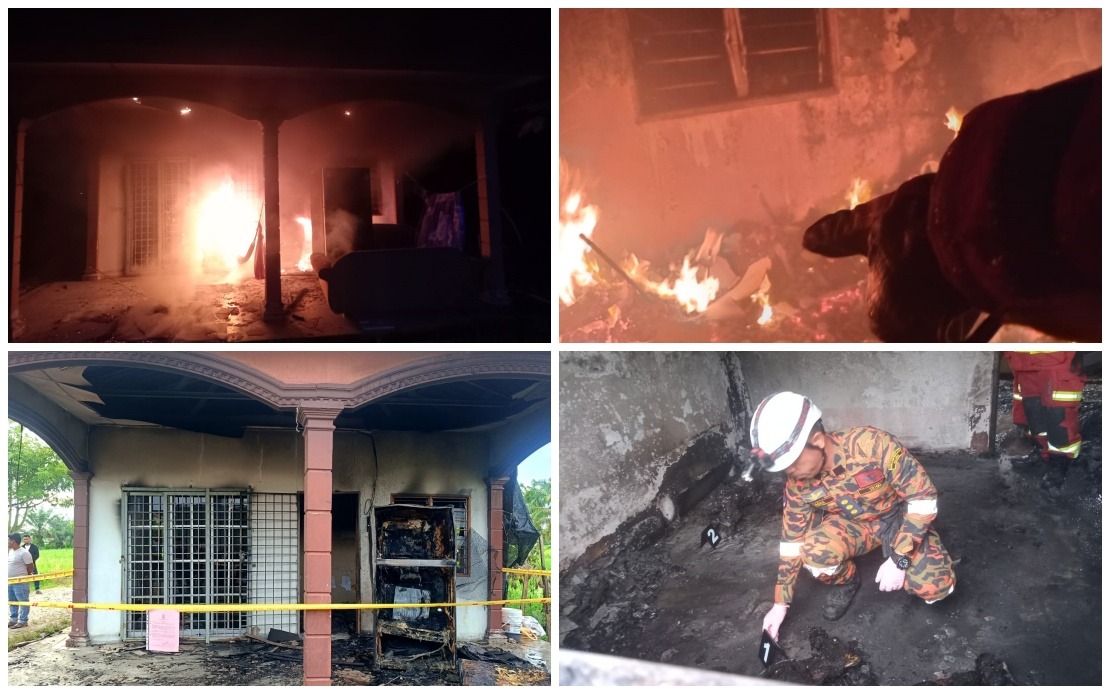
A tragedy unfolded in the early hours of Friday in Taman Serai Maju, Bagan Serai, when a residential fire claimed the lives of three members of a Myanmar refugee family. The deceased have been identified as Mohd Yunus Nor Ali, 27, and his two young sons, Muhammad Woheed Mohd Yunus, 6, and Mohamad Aheed Mohd Yunus, 3. The man's wife, Saniya Jahan Juma Abul Kasim, 24, survived the fire but suffered burns to her hands and feet and was transported to hospital for medical attention.
Emergency responders were alerted to the fire at 5.17 am through the MERS 999 emergency line, with the Perak Fire and Rescue Department (JBPM) arriving at the scene just thirteen minutes later. Upon arrival, firefighters discovered a Class A residential structure measuring 20 feet by 40 feet engulfed in flames. The single-storey dwelling, which housed seven foreign nationals at the time of the incident, sustained approximately 70 per cent damage from the blaze. The scale and intensity of the fire presented immediate challenges to rescue personnel attempting to locate and extract trapped occupants.
According to Perak JBPM director Datuk Sayani Saidon, the injured woman was discovered outside the house when responders arrived and provided crucial information about her family's whereabouts. She informed rescue teams that her husband and two children remained trapped inside the burning structure. Acting swiftly, firefighters deployed the RECEO search and rescue protocol—a systematic approach prioritising life safety—and located all three victims in the first room where the fire had originated. Despite rapid response efforts, medical officers from the Ministry of Health who arrived at the scene were unable to revive them, and all three were pronounced dead at the location.
The surviving wife received initial emergency medical treatment at the scene before being evacuated by the Emergency Medical Rescue Services (EMRS) vehicle to a nearby hospital. Her condition, while serious, was considered stable enough for transfer. The three fatalities were subsequently handed over to the Royal Malaysia Police (PDRM) for investigation and standard procedures. Firefighters successfully contained and extinguished the blaze by 6.20 am, with the overall operation concluding by 7.35 am.
Investigations into the fire's origin are ongoing, though preliminary findings from the JBPM forensic team indicate that the flames originated in the first room—the same location where the three victims were found. The precise cause remains under examination, with fire investigators examining potential sources ranging from electrical faults to accidental ignition from household equipment or materials. The structural damage and intensity of the fire have complicated forensic analysis, but authorities expect to release more detailed findings as the investigation progresses.
This incident highlights ongoing vulnerability within Malaysia's refugee communities, particularly Rohingya populations residing in overcrowded residential settings. The Bagan Serai fire marks another tragic chapter in a pattern of fire-related incidents affecting displaced families living in substandard housing conditions. Refugee families often occupy shared or cramped accommodations with limited safety infrastructure, fire suppression equipment, and emergency exits—factors that significantly elevate mortality risk during fires. The presence of seven foreign nationals in a single residential unit suggests the kind of density that characterises informal refugee housing across Malaysia.
Rohingya and other Myanmar refugees have faced considerable challenges integrating into Malaysian communities since arriving in the country over recent decades. While Malaysia hosts approximately 180,000 registered refugees according to UNHCR data, many reside in economically disadvantaged areas with inadequate municipal services, including fire prevention and safety enforcement. Landlords renting to refugee families often prioritise rental income over safety compliance, leading to occupied structures that violate building codes and fire safety regulations.
The tragedy also raises questions about emergency preparedness and hazard awareness within refugee populations. Language barriers, unfamiliarity with Malaysian emergency procedures, and limited access to fire safety education can impede rapid evacuation during fires. The death of two young children in this incident underscores the particular vulnerability of refugee families with dependents, who may face additional obstacles during emergency situations.
Local authorities and fire safety officials have reiterated the importance of fire prevention measures in residential areas with high concentrations of foreign nationals. The JBPM has called for increased awareness campaigns targeting non-citizen residents regarding fire hazards, safe evacuation routes, and proper use of emergency services. Additionally, building inspectors are being urged to conduct more frequent compliance audits of properties housing refugee families, particularly in older structures where electrical systems and building materials may pose heightened fire risk.
The incident also resonates with broader humanitarian concerns surrounding the welfare of displaced populations in Southeast Asia. While Malaysia continues to provide temporary refuge to hundreds of thousands of displaced persons from Myanmar, Sri Lanka, and other conflict-affected nations, the living conditions afforded to these communities remain precarious. International organisations and local NGOs have advocated for improved housing standards, better access to essential services, and stronger legal protections for vulnerable refugee families.
Members of the Malaysian refugee advocacy community expressed grief over the loss while calling for systemic improvements to prevent similar tragedies. Community leaders have urged relevant government agencies to strengthen enforcement of fire safety codes in areas where refugee families are concentrated and to provide subsidised fire safety equipment such as smoke detectors and fire extinguishers in high-risk residential zones. They have also proposed targeted outreach programmes to educate refugee populations about fire prevention and emergency response procedures adapted for communities with limited English proficiency.
As investigations into the Bagan Serai fire continue, authorities are expected to release additional details regarding the structural and electrical condition of the house, maintenance records, and whether any safety violations preceded the incident. The findings may inform policy decisions regarding rental property oversight in areas serving refugee populations and contribute to ongoing debates about balancing housing accessibility with mandatory safety compliance. For now, the surviving wife faces a long recovery process while grieving the loss of her husband and two young sons—a outcome that underscores the persistent vulnerabilities confronting displaced families seeking stability in Malaysia.

