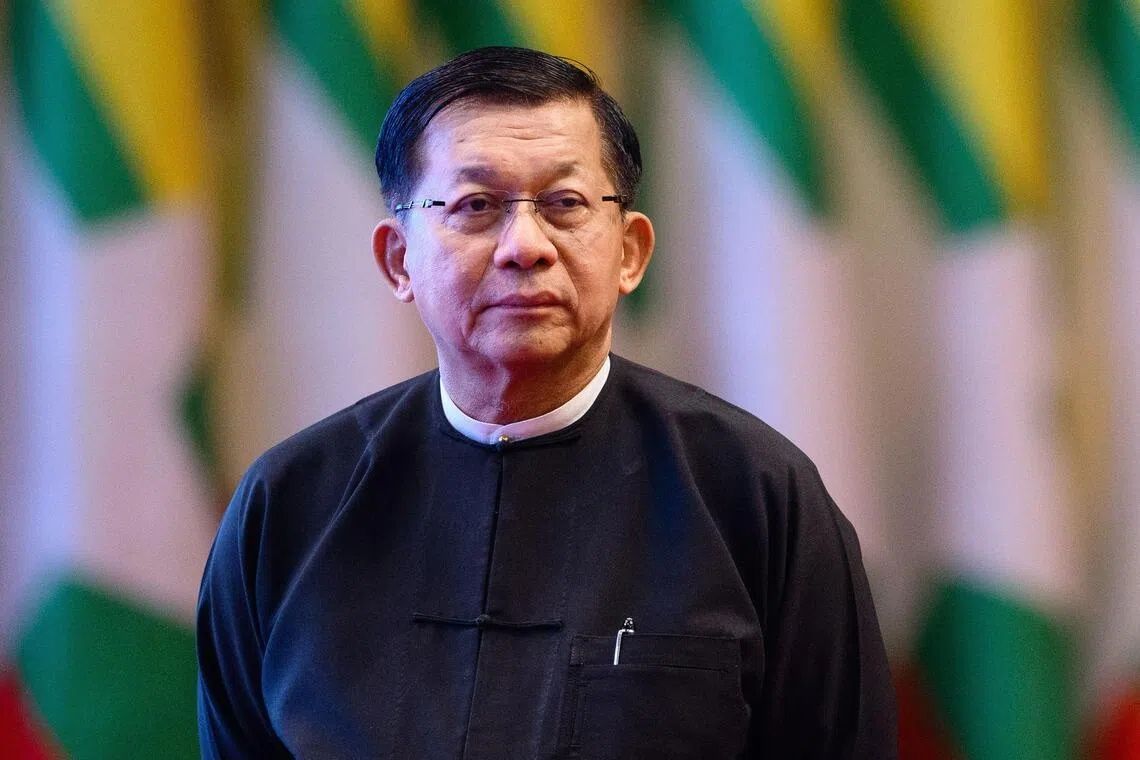
Myanmar's former military strongman Min Aung Hlaing is poised to arrive in Thailand this week for what marks his inaugural official visit since donning civilian credentials, underscoring his carefully orchestrated campaign to resurrect Myanmar's standing within the Southeast Asian community. The journey represents a symbolic shift for a leader who seized absolute power through a 2021 military coup that precipitated one of the region's most destabilising conflicts, an armed struggle that has fractured the nation and left an estimated 100,000 dead across all warring parties.
Min Aung Hlaing's transformation from uniformed commander to titular civilian president hinges on April elections that international democracy monitors universally condemned as a facade designed to obscure the continuity of military rule beneath a veneer of electoral legitimacy. The choreography of these polls—carefully structured to prevent genuine competition and orchestrated to guarantee predetermined outcomes—fooled neither Western capitals nor experienced observers of Myanmar's political machinations. Yet despite this transparent charade, the former general has leveraged his new civilian status as a diplomatic tool, embarking on a calculated sequence of state visits to India, China, and Laos intended to signal Myanmar's readiness for renewed international engagement.
Thailand's strategic embrace of Myanmar's leadership reflects Bangkok's pragmatic assessment of regional stability concerns that transcend questions of democratic principle or human rights accountability. As the geographical buffer between Myanmar's internal chaos and Thailand's own territory, Bangkok confronts tangible security challenges that demand some form of functional relationship with Naypyidaw's power structure. The sprawling Myanmar-Thailand border has become a permeable membrane through which conflict bleeds outward: armed clashes routinely spill across international lines, displacing populations and forcing Thailand to shelter millions of Myanmar refugees in camps along the frontier.
Beyond the refugee crisis, Thailand's leadership has identified more sinister cross-border threats demanding urgent cooperative action. Myanmar's borderland territories, particularly those beyond effective central government control, have metamorphosed into havens for sophisticated transnational criminal enterprises. Cyberscam networks have proliferated in these ungoverned spaces, targeting victims across Southeast Asia and extracting hundreds of millions of dollars through fraudulent schemes. Simultaneously, narcotics trafficking organisations exploit the porous frontier and weak enforcement capacity to move synthetic drugs destined for markets throughout the region. These concrete security interests explain why Thailand's Foreign Minister Sihasak Phuangketkeow has signalled that cybercrime and drug trafficking will feature prominently in official discussions during Min Aung Hlaing's visit.
Thailand's diplomatic overture toward Min Aung Hlaing must be understood within the broader context of Asean's fractured response to Myanmar's 2021 coup. The ten-member regional bloc has maintained formal exclusion of Myanmar's military-installed leadership from senior ministerial summits and high-level proceedings, yet this collective stance masks significant internal division and diverging national interests. Thailand's manoeuvring represents an effort to establish bilateral channels that might succeed where multilateral pressure has failed, potentially creating space for incremental normalisation that could eventually soften Asean's unified stance. The fact that Myanmar's foreign minister participated in an informal Asean meeting last month suggests that even formal Asean mechanisms may be gradually eroding.
Analysts observing Myanmar's diplomatic strategy note an inherent contradiction embedded within Min Aung Hlaing's approach to regional rehabilitation. The leadership has simultaneously pursued membership restoration while categorically rejecting Asean's so-called five-point consensus—a framework emphasising dialogue with all stakeholders, including armed resistance movements, as the necessary path toward genuine conflict resolution. This paradox reflects what regional experts describe as a fundamentally zero-sum worldview in which the regime interprets compromise with opposition forces as existential weakness rather than prudent statesmanship. Min Aung Hlaing appears intent on leveraging Asean membership as a legitimising credential while evading any pressure to implement the bloc's stated conflict-resolution principles, a sleight of hand that independent analysts find emblematic of the regime's broader tactical approach.
The sidelined democracy icon Aung San Suu Kyi, who remains confined under house arrest following her removal from office, received a notable concession in recent days when Myanmar authorities permitted her to meet a representative of the International Committee of the Red Cross—her first publicised encounter with a foreign official since the coup. While this modest permission might be dismissed as theatrical gesture, it signals that Min Aung Hlaing's handlers are attuned to international perceptions and willing to perform minor humanitarian courtesies ahead of high-profile diplomatic engagements. The timing of this Red Cross meeting immediately preceding the Thailand visit suggests calculated orchestration designed to soften the optics surrounding Min Aung Hlaing's rehabilitation tour.
Min Aung Hlaing's Bangkok itinerary reflects Thailand's commitment to ceremonial affirmation of improved bilateral relations. The schedule includes formal reception at Government House with full military honours, bilateral discussions with Thai Prime Minister Anutin Charnvirakul, participation in a business forum, and a state dinner. Most substantively, the two governments plan to formalise labour cooperation through a memorandum of understanding, signalling expanded bilateral institutional frameworks that would typically accompany normalised diplomatic relations. Each element of this carefully choreographed visit communicates that Thailand has effectively lifted Myanmar from pariah status, at least within the bilateral framework.
However, Min Aung Hlaing's rehabilitation efforts encounter significant resistance from human rights advocates and accountability mechanisms operating outside the regional framework. The former general remains subject to international sanctions imposed by multiple Western nations and faces an active International Criminal Court warrant for crimes against humanity—allegations grounded in the military's well-documented campaign of mass atrocities during earlier decades of rule. Justice For Myanmar and other civil society organisations have issued sharp public rebukes of Thailand's diplomatic hospitality, arguing that extending ceremonial legitimacy to an ICC-indicted leader effectively shields him from accountability and delivers precisely the rehabilitative service that Min Aung Hlaing actively seeks.
This tension between regional pragmatism and global accountability standards reflects a broader contradiction embedded within Asean's approach to Myanmar. The bloc's commitment to non-interference and consensus-based decision-making has historically subordinated human rights concerns to stability considerations and state sovereignty principles. Yet Myanmar's case tests these foundations severely: the scale of civilian casualties, the documented character of military atrocities, and the ongoing nature of the conflict create mounting pressure to reconcile Asean's traditional posture with the demands of accountability. Thailand's decision to roll out formal honours for Min Aung Hlaing effectively prioritises bilateral security interests over these larger questions of principle, betting that functional cooperation on border security issues outweighs the moral hazard of dignifying a leader facing international prosecution.
The success or failure of Min Aung Hlaing's current diplomatic offensive will likely hinge on whether regional powers can translate bilateral improvements into multilateral movement within Asean structures. Should Thailand's engagement catalyse broader movement toward Myanmar's reintegration into senior Asean forums, the message would effectively communicate that enough time has passed and sufficient cosmetic changes have occurred to justify overlaying the coup with diplomatic normality. Conversely, if Thailand's courtship produces only marginal bilateral dividends while Asean maintains collective exclusion, the initiative may expose the limits of individual member-state efforts to engineer consensus on questions where the bloc fundamentally fractures. For Myanmar's long-suffering population, meanwhile, such diplomatic manoeuvring carries little practical significance without parallel movement toward genuine power-sharing, ceasefire negotiations, and accountability for wartime conduct—none of which Min Aung Hlaing's current trajectory suggests he considers negotiable.

