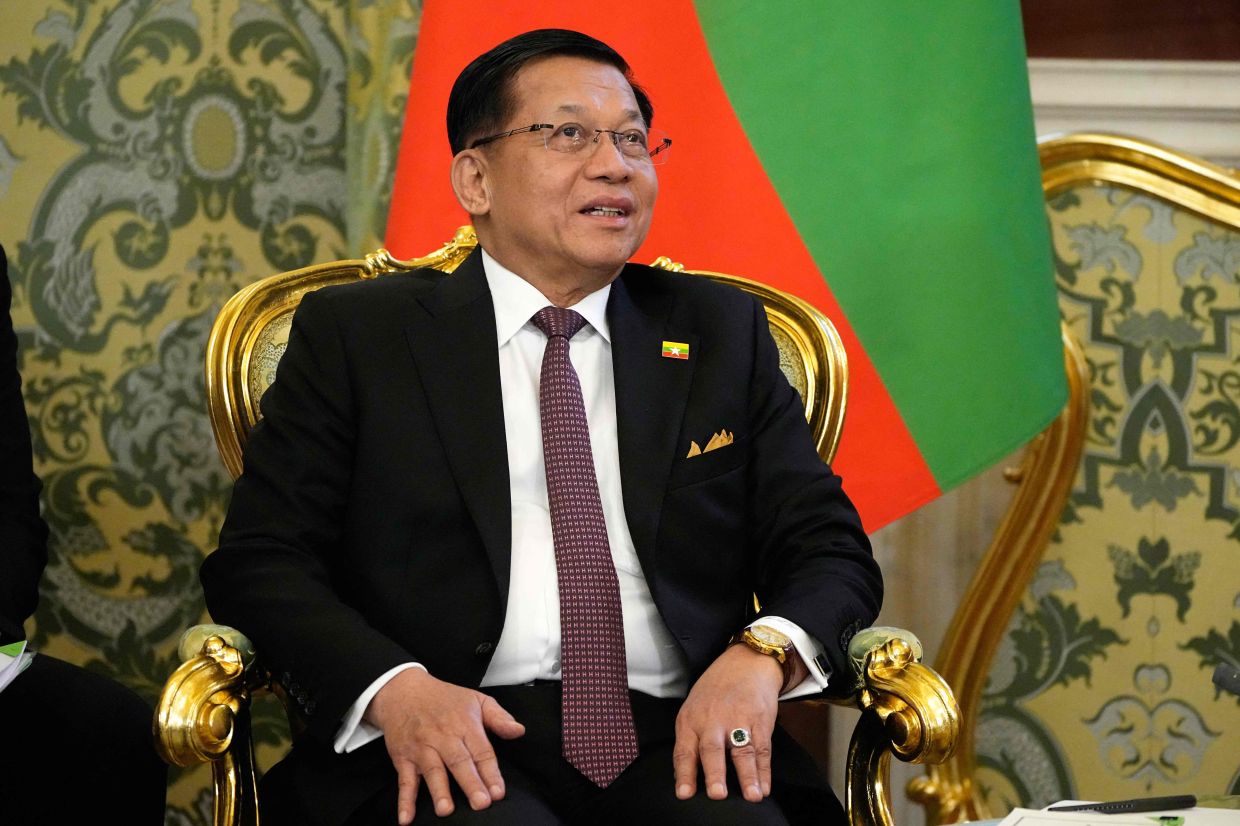
Myanmar's military-backed leader Min Aung Hlaing will undertake an official visit to Cambodia in early September, according to confirmation from the Cambodian Senate. The trip forms part of what observers describe as a carefully orchestrated campaign to consolidate international acceptance of his position, following similar journeys to Russia, China, India, and Thailand. Officials in Phnom Penh have already begun preparations, with Kuy Sophal, Minister of the Royal Palace, and Chin Ketna, permanent deputy chairman and secretary-general of the National Committee for Organising National and International Festivals, inspecting potential venues to host the Myanmar delegation.
The Cambodian Senate has framed the visit as an opportunity to deepen cooperation between the two neighbouring nations. Chea Thyrith, spokesperson for the Senate president, emphasised that the engagement reflects a commitment to strengthening bilateral friendship and pursuing mutually beneficial collaboration. This diplomatic language reflects Cambodia's positioning as a neutral facilitator within the region, though the timing and nature of the visit carry broader implications for Myanmar's international standing and Asean's internal dynamics.
However, Min Aung Hlaing's diplomatic offensive has generated substantial controversy among human rights organisations and pro-democracy advocates. These groups view his international tour as a calculated strategy to rehabilitate his image and secure recognition as Myanmar's legitimate civilian leader—a claim that remains deeply contested given the circumstances of his rise to power. The Myanmar military orchestrated a coup in February 2021 that removed democratically elected leader Aung San Suu Kyi from office, subsequently detaining her on charges widely regarded as politically motivated. Since then, thousands of pro-democracy activists, journalists, and ordinary citizens have reportedly been imprisoned.
The pathway to Min Aung Hlaing's current position underscores the legitimacy crisis at the heart of Myanmar's political turmoil. In April 2024, he was elected president through a process that drew widespread international criticism as a facade lacking genuine democratic substance. The election occurred within Myanmar's military-controlled parliament, bypassing any genuine popular mandate or transparent electoral process. This contested elevation has prompted sustained international criticism and has been a primary factor in Asean's decision to exclude Myanmar from its summit meetings, reflecting the regional bloc's inability to reconcile member states' interests with Myanmar's political trajectory.
Since his election, Min Aung Hlaing has embarked on a deliberate tour of strategic partners, having already visited India, China, Laos, Thailand, and Russia. Each visit serves a dual purpose: signalling to domestic audiences that the military government maintains international standing despite isolation from certain forums, and attempting to cultivate relationships with major powers that might offset diplomatic pressure from the West and democratic nations. The Cambodia visit should be understood within this broader context of diplomatic choreography rather than as an isolated bilateral engagement.
Cambodia's role in hosting this visit reflects its historical positioning within Asean dynamics. During its 2022 chairmanship of the regional organisation, Cambodia had attempted to mediate Myanmar's political crisis and facilitate dialogue between the military government and opposition forces. This diplomatic engagement, though ultimately limited in concrete outcomes, established Cambodia as a country willing to maintain engagement with Myanmar's current leadership while nominally supporting Asean consensus positions. The upcoming visit suggests a continuation of this approach, balancing Cambodia's bilateral interests with its obligations within the regional framework.
Kin Phea, president of the International Relations Institute of Cambodia, has offered nuanced analysis of the visit's significance. He characterises it as potentially serving both governments' interests—for Min Aung Hlaing, it represents another opportunity to demonstrate international acceptance; for Cambodia, it allows the country to position itself as a diplomatic bridge and showcase its own experience in managing post-conflict reconciliation and nation-building. However, Phea cautioned that Cambodia's willingness to host the Myanmar leader should not be misinterpreted as endorsing the military government or granting it the international legitimacy it seeks.
Phea specifically highlighted a critical distinction that often becomes obscured in discussions of Myanmar's diplomatic rehabilitation. While individual countries may receive visits from Myanmar's leadership and pursue bilateral cooperation, the question of Myanmar's standing within Asean remains governed by the five-point consensus—a collective agreement among member states regarding conditions Myanmar must satisfy for full participation in the organisation's highest-level forums. This consensus, reached in April 2021, stipulates requirements including cessation of violence, dialogue among Myanmar's stakeholders, and humanitarian assistance access. No single country, regardless of its willingness to engage with Min Aung Hlaing, can unilaterally alter Asean's position on Myanmar's participation.
The distinction between bilateral diplomatic engagement and multilateral institutional standing carries significant implications for Southeast Asia's broader political architecture. Cambodia's bilateral relationship with Myanmar does not constitute a pathway for Myanmar to circumvent the collective Asean response to its political crisis. This separation reflects the regional organisation's struggle to maintain coherence while accommodating members with different diplomatic priorities and strategic interests. For Malaysia and other Asean partners, the Cambodia visit serves as a reminder that while individual member states may pursue their own bilateral relationships, the region's formal mechanisms for addressing Myanmar's governance crisis remain structured around collective consensus rather than individual accommodations.
Looking forward, the sustainability of Min Aung Hlaing's international rehabilitation strategy remains uncertain. While visits to willing partners like Cambodia and Russia reinforce narratives of international engagement, they do not address the fundamental governance concerns that prompted Myanmar's isolation from Asean's highest-level forums. The military government faces mounting international pressure regarding human rights, democratic governance, and the treatment of detained opposition figures. Cambodia's diplomatic courtesy should thus be understood not as capitulation to the Myanmar leadership's legitimacy claims, but as a calculated engagement strategy that preserves bilateral relations while maintaining formal observance of Asean's collective positions on Myanmar's political transition.

