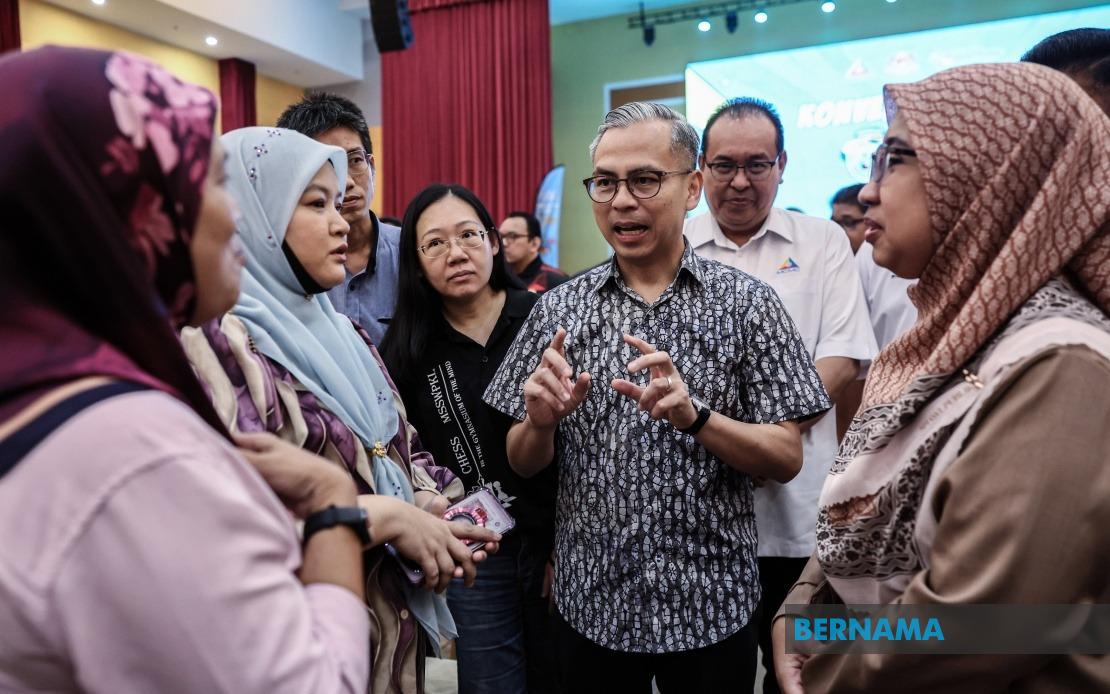
The government has moved to dispel any confusion surrounding the MyKhas allocation scheme, reaffirming that the fund serves as a targeted resource for addressing constituent needs rather than functioning as a personal perk for elected representatives. Speaking at a press conference in Kuala Lumpur on Thursday, PKR Information Chief and Communications Minister Datuk Seri Fahmi Fadzil underscored that the mechanism operates under the direct administration of the Prime Minister's office, with disbursements determined by that office alone rather than by individual MPs seeking to leverage it for their own benefit.
The clarification comes as part of a broader push by the federal government to establish clearer governance standards around resource allocation. Fahmi emphasized that Prime Minister Datuk Seri Anwar Ibrahim has consistently maintained that all government disbursements exist fundamentally to serve the public interest, rejecting any notion that elected officials possess exclusive rights over such provisions. This positioning reflects an attempt to refocus discourse around public funds away from patronage-based models toward need-based distribution frameworks.
According to Fahmi, the MyKhas arrangement has been formally incorporated into both the Malaysia Plan and Budget documents as a special provision explicitly falling within the Prime Minister's remit. This institutional embedding signals an intent to embed the fund within Malaysia's core budgetary architecture rather than treating it as an ad-hoc or discretionary element. The formalization appears designed to establish a permanent framework guiding how such resources flow to constituencies while maintaining centralised oversight.
The Communications Minister's own practice serves as an illustrative example of the intended application. Fahmi noted that even he, despite his elevated ministerial standing, cannot access MyKhas for personal or constituency use. This self-imposed restraint underscores the government's message that the fund transcends traditional hierarchical expectations within Malaysian politics, where access to such mechanisms has historically been tied to individual political standing. By positioning himself as bound by identical restrictions as other MPs, Fahmi signals equal application of governance rules across the political hierarchy.
The fund's designated purpose focuses squarely on resident and voter welfare within parliamentary constituencies. Rather than serving as discretionary spending vehicles for MPs to strengthen their political positions, MyKhas channels resources toward tangible improvements in constituency living standards. These improvements span diverse areas including educational infrastructure, religious facilities such as mosques, and essential civic amenities including drainage systems and maintenance works. This breadth of application reflects an attempt to address multiple dimensions of constituent welfare simultaneously.
For constituencies governed by opposition parties, the government has established an alternative pathway ensuring that political control does not determine access to resources. Citizens in these areas can submit applications through the Implementation Coordination Unit housed within the Prime Minister's Department. This mechanism ostensibly guarantees that opposition-held constituencies maintain equal standing in resource allocation processes, though practical implementation of such measures often reveals complications when centralised approval structures encounter political opposition at departmental levels.
Prime Minister Anwar reinforced these principles in a statement released the previous day, emphasizing that parliamentary allocations represent national resources rather than political property. His articulation of this position coincides with a broader governance agenda emphasizing transparency and equity in resource distribution. By consistently repeating this message through multiple government spokespersons, the administration signals that this framework constitutes core policy rather than a temporary initiative subject to revision.
The timing of this clarification reflects ongoing sensitivity around resource allocation practices in Malaysian politics. Historically, such mechanisms have attracted scrutiny regarding whether they functionally advantage ruling coalition MPs over opposition representatives. By centralising MyKhas administration and emphasizing its non-partisan application, the government appears to address longstanding concerns about potential misuse of public funds for political consolidation. Whether these institutional changes produce substantive shifts in practical distribution patterns remains to be observed through actual implementation data.
The establishment of clear parameters around MyKhas availability carries implications for how Malaysian constituencies experience development and service delivery. Decoupling resources from individual MP discretion potentially reduces patronage dynamics while standardizing access criteria. However, the success of this reorientation depends heavily on consistent application by the Prime Minister's office and subordinate implementation bodies, which operate with varying degrees of political influence and bureaucratic capacity across Malaysia's diverse regions.
For Southeast Asian observers, Malaysia's effort to formalize and centralize resource allocation mechanisms offers a case study in institutional reform around parliamentary governance. As regional democracies grapple with balancing decentralized representation with standardized service delivery, Malaysia's approach of administrative centralization with transparency objectives presents one model, though whether it satisfies both democratic and efficiency objectives remains contingent on implementation fidelity and political commitment to non-partisan application across an extended timeline.

