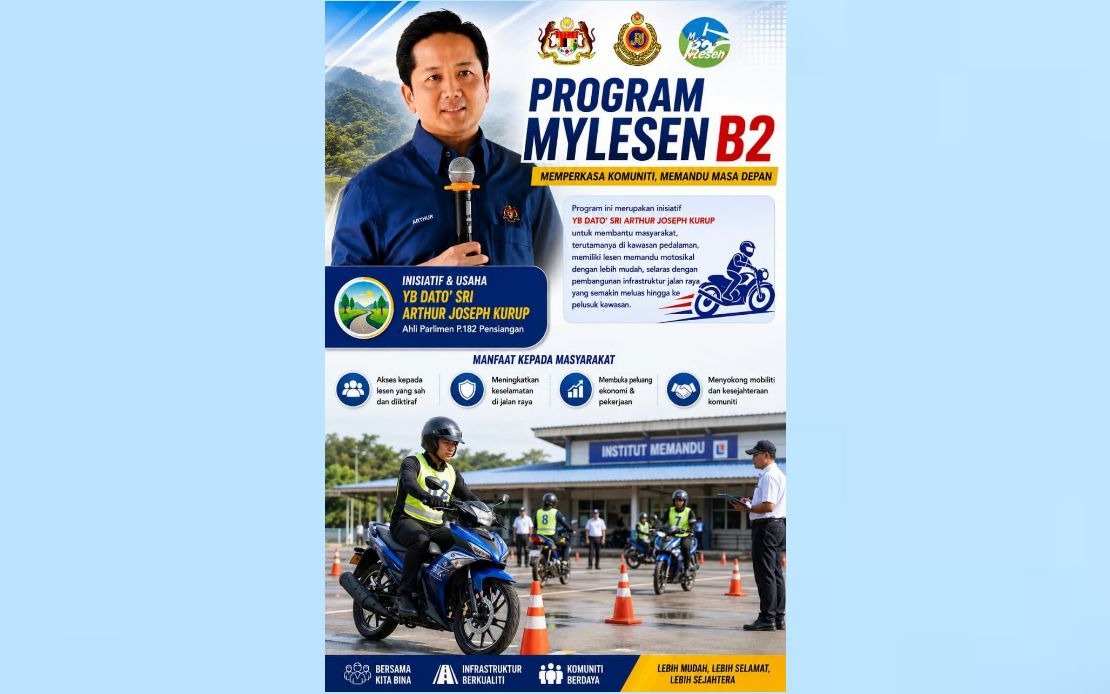
The MyLesen B2 scheme has made a return to Pensiangan in Sabah, bringing accessible motorcycle licensing services directly to rural communities that have historically faced barriers in obtaining valid riding credentials. The initiative represents a targeted effort to address the practical challenges faced by residents in remote constituencies who would otherwise need to undertake lengthy journeys to urban driving schools or licensing centres to complete their qualification requirements.
Pensiangan Member of Parliament Datuk Seri Arthur Joseph Kurup, who also serves as the Natural Resources and Environmental Sustainability Minister, unveiled the relaunch of the programme during a Facebook announcement on July 3. The project specifically targets residents who have never previously held a driving licence, particularly young people in the district who depend on motorcycles as their primary mode of transport yet lack the formal credentials to ride legally.
The accessibility provided by the programme addresses a significant logistical burden for rural Sabahans. Rather than requiring participants to travel substantial distances to cities or towns where licensed driving schools operate, the MyLesen B2 initiative brings the entire process to their doorstep, eliminating transport costs and time commitments that frequently discourage eligible riders from regularising their status. This localized approach acknowledges the unique infrastructure challenges that distinguish rural Malaysia's transportation landscape from more urbanised regions.
Despite the convenience factor, the programme maintains full compliance with established training and assessment protocols. Participants remain obligated to complete mandatory coursework and pass prescribed examinations before receiving their motorcycle licences, ensuring that the ease of access does not compromise safety standards or licence validity. This dual commitment to accessibility and quality reflects a recognition that expanding legal riding credentials must not come at the expense of road safety outcomes.
Educational components embedded within the MyLesen B2 framework specifically emphasize road traffic regulations and safe riding practices. Participants gain substantive knowledge of traffic laws applicable to motorcycle operators, fundamentally improving their awareness of responsibilities as licensed road users. This educational grounding proves particularly valuable in rural communities where formal road safety instruction may not have been previously available, potentially reducing accident rates among newly licensed riders.
Eligibility for the programme extends to residents between 16 and 63 years old, with priority consideration for first-time licence applicants who have never previously held any category of driving credential. This broad age range recognizes that licence acquisition represents a practical need across multiple demographic cohorts rather than a concern confined to teenagers or young adults, while the emphasis on first-time applicants ensures resources focus on those currently operating without legal authorization.
The economic dimensions of licence possession extend well beyond merely formalizing existing riding patterns. Valid motorcycle licences unlock employment opportunities that would otherwise remain inaccessible to unlicensed individuals, particularly in rural labour markets where formal transport credentials represent prerequisites for certain job categories. Young men and women in Pensiangan gain pathways toward economic participation and income generation that motorcycle licensing facilitates, effectively expanding their horizons beyond current local employment possibilities.
The permanent validity of obtained licences, contingent upon compliance with ongoing regulatory requirements, transforms the MyLesen B2 participation into a long-term asset rather than a temporary expedient. Unlike short-term employment schemes or time-limited assistance programmes, motorcycle licences remain operational throughout recipients' lives, providing enduring value that compounds over extended periods. This permanence distinguishes the initiative from many government interventions and reinforces its strategic value for rural development.
Registration facilities have been established at two local service centres—the Pensiangan Parliamentary Service Centre and the Sook State Assemblyman's Service Centre—ensuring that administrative access matches the programme's commitment to geographic convenience. These multipurpose government offices serve as existing infrastructure nodes where residents already conduct various official transactions, minimizing additional institutional touchpoints required for programme participation. The dual registration locations further reduce barriers for inhabitants of dispersed settlements.
For Sabah's rural constituencies, the MyLesen B2 return addresses a concrete governance gap where regulatory compliance intersected with geographic inconvenience. The programme's relaunch signals official recognition that road safety and legal licence acquisition represent achievable targets even in constituencies where population density and infrastructure development remain limited. This initiative exemplifies how targeted social policy can align accessibility with regulatory integrity, offering practical solutions to developmental challenges that affect rural Malaysia's estimated 4 million inhabitants who depend significantly on two-wheeled vehicles for transportation and livelihood.

