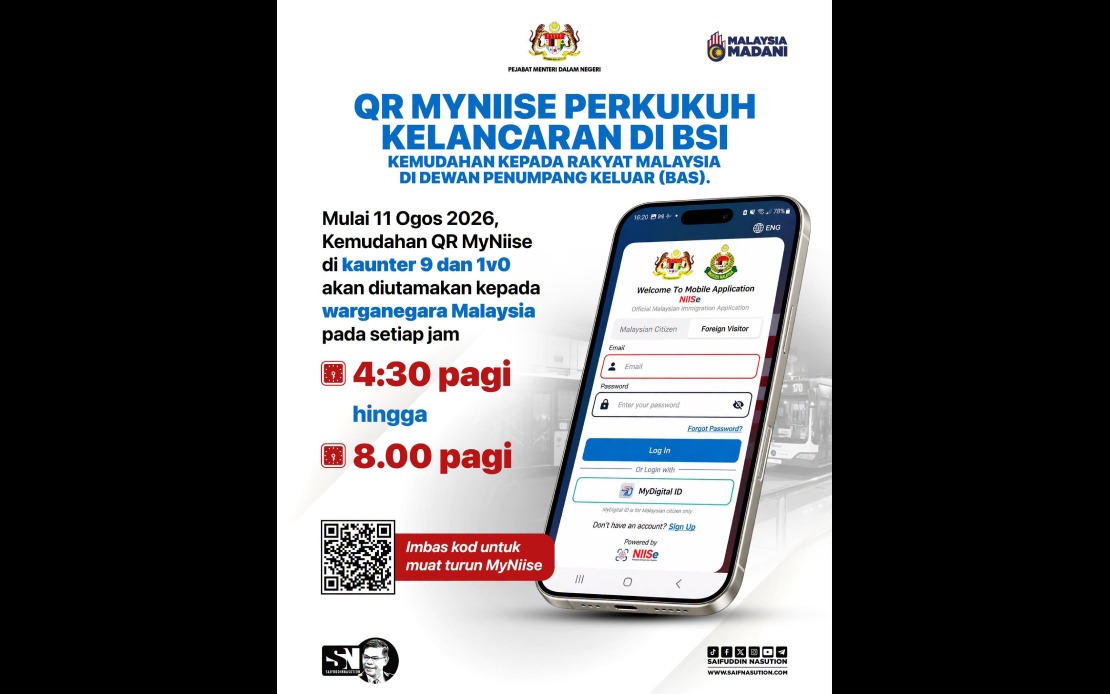
Malaysia's Home Minister Datuk Seri Saifuddin Nasution Ismail has rolled out a new priority immigration clearance facility for travellers using the National Integrated Immigration System QR code at Bangunan Sultan Iskandar, effective from August 11. The initiative addresses a persistent pain point for thousands of daily cross-border commuters, particularly during the congested early morning hours when workers rush to reach Singapore before office hours.
The dedicated MyNIISe QR lanes operate from counters 9 and 10 in the Bus Departure Hall, functioning between 4.30 am and 8 am to capture the peak outflow of Malaysian workers heading across the Causeway. This carefully timed window reflects the reality of cross-border commuting patterns, where a significant portion of travellers depart in the pre-dawn darkness to secure spots on crowded bus services and arrive at their workplaces punctually.
The announcement underscores a recognition by Malaysia's immigration authorities that the traditional manual immigration process, while necessary for security and documentation verification, creates bottlenecks that unnecessarily delay commuters. For many Malaysians working in Singapore's financial services, petrochemical, and manufacturing sectors, saving even ten or fifteen minutes during immigration clearance translates into reduced stress and more reliable arrival times. This efficiency gain carries particular weight given Singapore's strict punctuality expectations in the workplace.
MyNIISe represents a significant technological modernisation of Malaysia's immigration framework. The system consolidates entry and exit data through a unified digital platform accessible via smartphone applications, eliminating the need for traditional manual form-filling and paper document verification at the counter. Users can download the application from the Apple App Store, Google Play Store, or Huawei App Gallery, making it accessible to smartphone users across different ecosystems and reflecting Malaysia's efforts to serve its diverse tech-using population.
The priority immigration scheme also serves a broader policy objective of easing physical congestion at the BSI crossing. The Johor Bahru-Singapore corridor remains one of Southeast Asia's most heavily trafficked land borders, with daily commuter volumes exceeding 300,000 during normal times. When conventional immigration processing slows to a crawl during peak hours, the resulting queues spill backward into the departure hall, creating safety concerns and operational inefficiencies. By expediting processing for MyNIISe users, the government effectively creates a two-tiered system that incentivises digital adoption while reducing strain on physical infrastructure and counter staff.
For daily commuters, the practical advantage becomes apparent through simple mathematics. A typical morning queue at BSI during peak hours can extend to thirty minutes or more, particularly when counter staffing cannot match incoming passenger volumes. The MyNIISe QR system reduces per-person processing time from approximately three to five minutes down to potentially under one minute, since the system pre-validates biographical data and travel history before the traveller reaches the counter. This acceleration effect compounds when applied across hundreds of users during the prime departure window.
The initiative also reflects growing regional trends toward digitisation of border management across Southeast Asia. Singapore has long operated sophisticated automated clearance systems like its Electronic Travel Pass, while Thailand, Vietnam, and Indonesia have progressively upgraded their immigration infrastructure. Malaysia's MyNIISe represents a competitive catch-up effort, positioning the country as digitally progressive while improving the quality of service for its citizens and resident workers. The availability across multiple app stores indicates deliberate inclusivity, avoiding the vendor lock-in that might exclude users of less mainstream smartphone platforms.
From a labour market perspective, reducing commute friction benefits not only individual workers but the broader Malaysian economy. Thousands of skilled and semi-skilled workers employed in Singapore contribute remittances to Malaysian households and maintain economic links to their home country. By reducing daily commute inefficiencies, the government subtly enhances the attractiveness of cross-border work arrangements, potentially strengthening labour market dynamics in Johor and other border regions where Singapore employment provides important income sources.
The timing of this announcement, with a specific implementation date and clearly defined operational hours, suggests this represents a concrete policy delivery rather than aspirational infrastructure planning. Saifuddin Nasution's public declaration via Facebook creates accountability, signalling that the government expects measurable improvement in border clearance times. This public commitment-making approach helps establish credibility with the commuting public, who have experienced numerous infrastructure promises that materialised slowly or incompletely.
Looking forward, the MyNIISe QR priority scheme may serve as a blueprint for other Malaysian border crossings facing similar congestion challenges. The land borders at Bukit Kayu Hitam (Kedah-Perlis), Padang Besar (Perlis), and even maritime entry points like Port Klang could potentially benefit from similar expedited processing tracks. If successful at BSI, the model demonstrates how relatively simple technological solutions combined with operational reorganisation can yield substantial improvements in cross-border mobility without requiring massive infrastructure investment.
The scheme also carries implicit messaging about government capacity and modernisation. By deploying a digital-first solution to a persistent logistical problem, authorities signal responsiveness to citizen concerns and willingness to leverage technology for practical benefit. This contrasts with sectors where Malaysian government services have struggled to keep pace with technological change, making the MyNIISe implementation particularly visible as evidence of successful digital governance.

