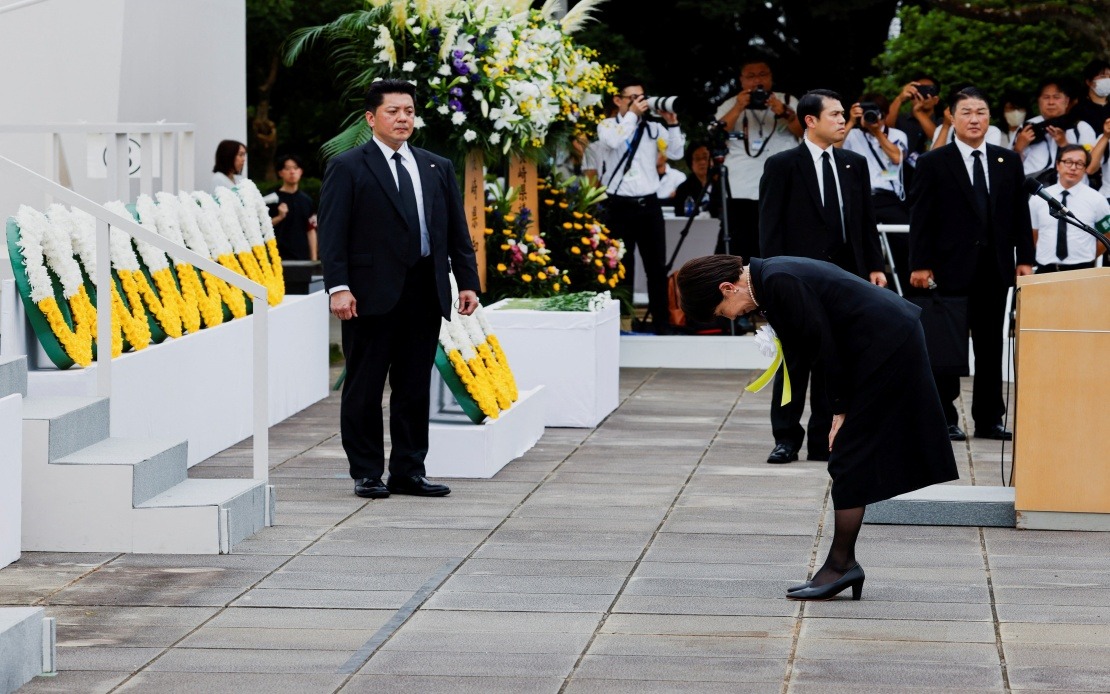
Japan's southwestern city of Nagasaki gathered to mark 81 years since the atomic bombing that devastated the community on August 9, 1945, an event now shadowed by contemporary debates over nuclear deterrence and weapons proliferation. The commemoration took place against a backdrop of heightened geopolitical tensions worldwide, intensifying calls from peace advocates and officials to prevent the spread of nuclear capabilities and pursue comprehensive disarmament initiatives.
The memorial ceremony proceeded with traditional solemnity, centring on a moment of silence scheduled for 11.02 a.m., the exact moment when the "Fat Man" plutonium device was detonated by a United States bomber over the city. Nagasaki remains the only location to experience a nuclear weapon detonation in warfare, a distinction that has shaped decades of Japanese peace activism and international nuclear policy discussions. Mayor Shiro Suzuki was positioned to deliver remarks emphasising the incompatibility between nuclear weapons and human survival, reinforcing Nagasaki's role as a moral voice in disarmament advocacy.
Prime Minister Sanae Takaichi's participation in the ceremony carried particular significance given ongoing domestic political tensions surrounding Japan's three nonnuclear principles, which have anchored Tokyo's nuclear policy since the postwar period. These principles—prohibiting the production, possession, or allowance of nuclear weapons on Japanese soil—have faced unprecedented scrutiny in recent years as some policymakers and security analysts question whether they remain viable amid China's military expansion and North Korea's advancing nuclear arsenal. Takaichi's attendance at the Nagasaki ceremony follows her recent reaffirmation at Hiroshima that the government remains committed to these principles, signalling an effort to balance security concerns with peace advocacy.
The United Nations Secretary-General Antonio Guterres contributed to the proceedings through a formal statement, underscoring the international dimension of Nagasaki's symbolic importance. The UN's participation reflects the city's status as a focal point for global disarmament efforts and its influence on international treaties and agreements. This diplomatic presence highlights how Nagasaki has transcended its historical tragedy to become a platform where Japan shapes international nuclear policy discourse.
The historical impact of the bombing remains staggering in scale. Approximately 74,000 people perished in Nagasaki by the close of 1945, with countless others suffering lifelong health complications from radiation exposure. The bombing came merely three days after Hiroshima was similarly attacked, concentrating Japan's nuclear devastation within a single week and fundamentally altering the trajectory of warfare and international relations. Japan's surrender eight days later, on August 15, 1945, ended World War II but initiated an era defined by nuclear anxiety and the imperative to prevent such weapons from being used again.
Contemporary significance attaches to this year's commemoration particularly because of the failed Nuclear Non-Proliferation Treaty review conference held in May. The monthlong gathering in New York concluded without reaching consensus on substantive measures, marking the third consecutive failure of this crucial five-yearly meeting. This breakdown underscores the deepening divisions within the international community regarding nuclear weapons, with established nuclear powers resisting constraints on their arsenals while non-nuclear states demand genuine disarmament progress. For Japan, which sits at the intersection of nuclear vulnerability and alliance with a nuclear-armed power, this stalemate compounds the dilemmas facing policymakers.
The institutional memory of nuclear weapons' devastation increasingly rests on the shoulders of an aging population of survivors, or hibakusha, whose average age now exceeds 86 years. These individuals represent a living archive of nuclear warfare's human costs, and their efforts to transmit testimony to younger generations have become more urgent as time passes. Their advocacy work, alongside official commemorations like Nagasaki's anniversary, serves to anchor abstract policy debates in visceral human experience and moral authority that younger politicians and international negotiators cannot easily dismiss.
For Southeast Asian observers, Nagasaki's commemoration carries particular relevance given the region's location within strategic competition between nuclear-armed powers and ongoing concerns about weapons proliferation. Japan's navigation of its nonnuclear stance while deepening security cooperation with the United States illustrates the complex equilibrium that regional countries must maintain. The failure of international disarmament mechanisms, as evidenced by the NPT review conference breakdown, suggests that frameworks upon which regional security and non-proliferation depend are increasingly fragile.
The debate surrounding Japan's three principles reflects deeper anxieties about whether traditional disarmament and deterrence frameworks remain adequate for the current threat environment. As China advances its nuclear capabilities and as North Korea demonstrates persistent weapons development, Japan faces pressure to reconsider policies formulated in a different strategic context. Yet abandoning the principles risks undermining Japan's moral authority on nuclear issues and could accelerate proliferation across the region, setting precedents that might influence South Korea's own nuclear policy debates.
Nagasaki's role in maintaining global memory of nuclear weapons' consequences cannot be overstated. The city has evolved into a repository of historical witness and a focal point for disarmament advocacy that extends far beyond Japan's borders. Each annual commemoration serves as a checkpoint for measuring progress toward a world without nuclear weapons, and this year's ceremony, conducted amid palpable policy uncertainty in Tokyo and negotiating failure at the UN, demonstrated the continued relevance of this historical reckoning to contemporary security challenges and moral imperatives.

