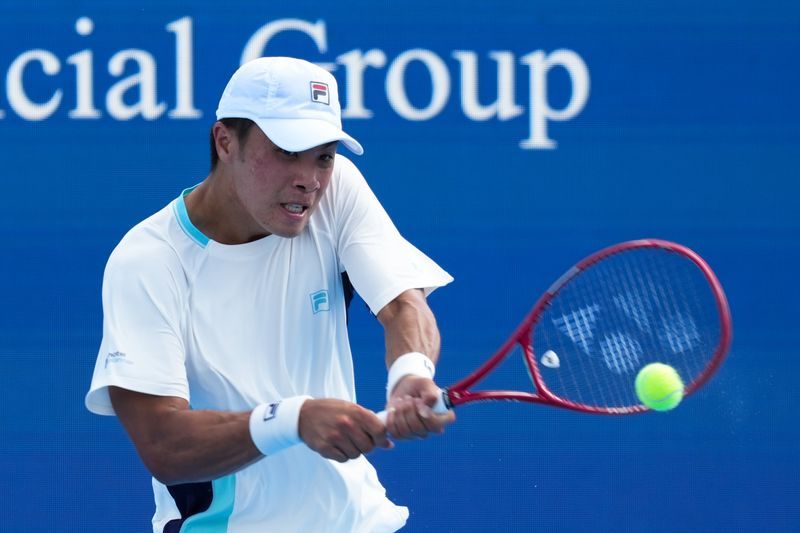
Brandon Nakashima has extended his career-best run on the North American hard court circuit by rallying past sixth-seeded compatriot Taylor Fritz at the Cincinnati Open on Friday, advancing to the tournament's semi-finals with a 7-6(9) 4-6 6-3 victory. The 25-year-old's comeback, achieved despite trailing a break in the final set, underscores his surging form during a crucial period of the professional calendar as the sport approaches the U.S. Open later this month.
Nakashima's achievement represents a significant milestone in his career trajectory. By reaching the semi-finals in Cincinnati, he has now secured spots in the last four of back-to-back Masters 1000 events, having made similar progress at last week's Canadian Open in Montreal. This consecutive run at elite-level tournaments demonstrates a level of consistency that has previously eluded the American and marks a notable shift in his competitive standing among tennis's upper echelon.
The match itself proved a tightly contested affair, particularly in its early stages. Both players displayed commanding serving prowess throughout the opening set, forcing the contest into a tiebreak that epitomised the quality and tension of their encounter. After exchanging leads and several critical points, Nakashima ultimately prevailed in the breaker, converting his fifth set point when Fritz sent a return into the net—a moment that would prove pivotal in determining the match's trajectory.
Fritz responded with considerable intensity in the second set, employing aggressive returning tactics that disrupted Nakashima's service rhythm. The sixth seed capitalised on these opportunities to secure an early break and subsequently closed out the set with an ace, forcing a decisive third set and suggesting momentum had shifted decisively in his favour. At that juncture, Fritz appeared positioned to exploit his opponent's inconsistency and emerge victorious.
The final set, however, revealed the mental fortitude that increasingly characterises Nakashima's play. Fritz initially capitalised on his rival's unforced errors to establish a 3-2 advantage and appeared to control proceedings. Yet the American demonstrated remarkable resilience, recovering from a seemingly disadvantageous 30-0 position to convert his second break point of the match and restore parity at 3-3. This reversal marked a turning point, as Nakashima's confidence visibly grew while Fritz's precision diminished.
From that juncture, Nakashima closed out the match emphatically, winning the final three games as his opponent's errors accumulated and the momentum definitively swung toward the 27th-seeded American. The manner of his victory—mounting a genuine comeback against a top-10 opponent rather than merely surviving an extended contest—demonstrates the psychological dimensions of his recent improvement. This represents Nakashima's fourth top-10 victory during the 2024 season, a remarkable tally that reflects his elevation in standing among elite competitors.
Context matters significantly for understanding Nakashima's emergence. Prior to this Cincinnati campaign, his head-to-head record against Fritz stood at just 1-4, meaning Friday's victory constitutes a notable statement of intent. Overcoming an opponent with a previous psychological advantage, combined with the championship-level execution required in clutch moments, suggests Nakashima has developed the tactical intelligence and emotional regulation necessary to compete consistently at the highest levels.
The broader timing of this form carries considerable significance for the American's immediate prospects. The U.S. Open begins imminently, and the confidence derived from consecutive Masters 1000 semi-final appearances typically translates into improved seeding, easier early-round matchups, and the psychological momentum essential for deep Grand Slam runs. American tennis has produced limited recent Grand Slam champions, making each promising development among rising American competitors worthy of sustained attention.
Looking ahead, Nakashima faces either Italian 10th seed Lorenzo Musetti or fellow American Frances Tiafoe in the Cincinnati semi-finals. Both represent formidable opponents competing at the Masters 1000 level, yet Nakashima's trajectory suggests he enters such matches with justified confidence. The manner in which he dissected Fritz's game—particularly his ability to elevate performance during critical junctures—provides a blueprint for success against comparable opponents possessing technical strengths and competitive experience.
Nakashima's resurgence carries implications for American tennis beyond individual achievement. The country's depth at the senior professional level has fluctuated considerably, with inconsistent representation at Grand Slam semi-finals and finals. Nakashima's consistent performance against elite opposition, combined with simultaneously impressive results from Tiafoe and other younger Americans, suggests potential revitalisation of American competitiveness in men's professional tennis. This matters particularly as global markets increasingly monetise tennis through streaming platforms and digital engagement, where American-based success stories attract substantial viewership and commercial interest from sponsors and broadcasters.
For Malaysian and Southeast Asian tennis enthusiasts, Nakashima's progress represents a compelling storyline to follow during the U.S. Open fortnight. The American's rise exemplifies broader trends in men's professional tennis, where consistency, mental strength, and tactical sophistication increasingly differentiate elite competitors from talented but inconsistent players. His semi-final appearance in Cincinnati has cemented expectations that he will contend seriously in the year's final Grand Slam tournament.

