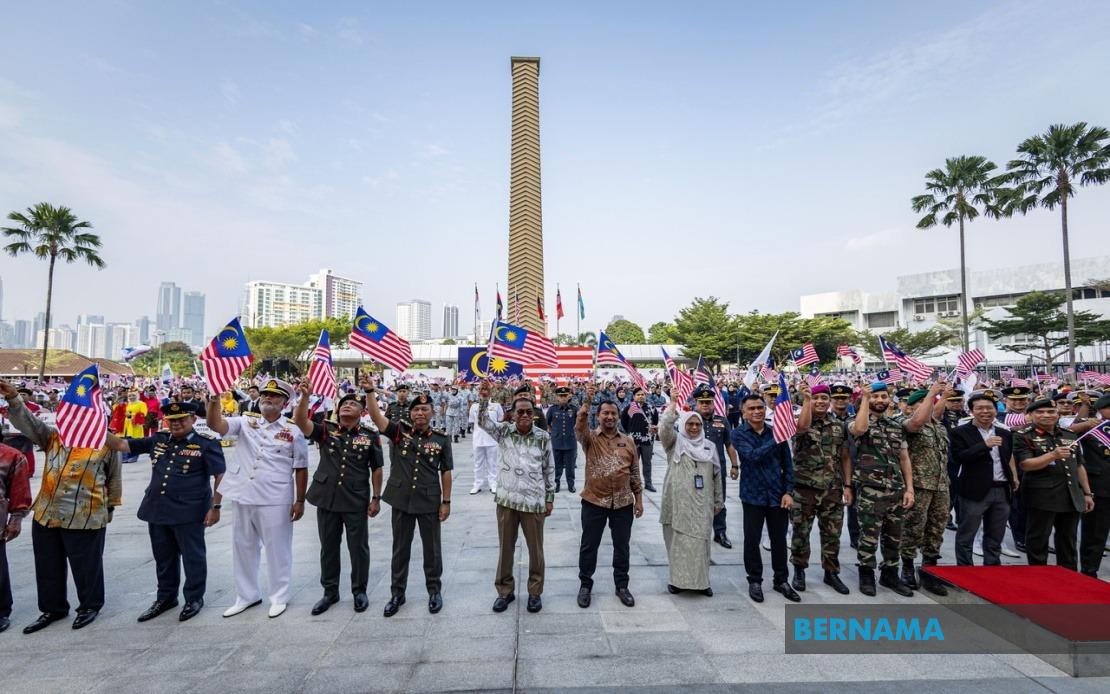
Datuk Seri Mohamed Khaled Nordin, Malaysia's Defence Minister, has issued a forthright appeal to the nation to shield its patriotic observances from becoming vessels for political agitation and factional discontent. Speaking at the launch of the Defence Ministry's National Month and Fly the Jalur Gemilang campaign, he stressed that the upcoming National Day and Malaysia Day celebrations must transcend the emotional turbulence that frequently accompanies divisive national issues, instead channelling collective sentiment toward reinforcing the bonds that hold the country together.
The minister's remarks come against a backdrop of growing calls within segments of civil society to boycott or scale back National Day festivities in protest against various government policies and international matters. Mohamed Khaled specifically addressed the Rohingya refugee crisis, which has emerged as a flashpoint for activist movements seeking to use the National Day period as a platform for highlighting humanitarian concerns. His position reflects a broader tension within Malaysia's political discourse between those who view national celebrations as occasions for critical engagement and those who see them primarily as moments for reaffirming state legitimacy and territorial pride.
Central to Mohamed Khaled's argument is a conceptual distinction between patriotism and protest. He contended that channelling grievances through boycott campaigns misappropriates the symbolic and emotional weight of National Day, transforming an occasion meant for introspection about shared identity into a tool for advancing narrow agendas. The minister framed this not as an appeal to suppress dissent but rather as a call to preserve the sanctity of national moments from what he characterised as the corrosive effects of partisan sentiment and external manipulation.
In articulating his vision of how Malaysians should approach the coming celebrations, Mohamed Khaled invoked the foundational principles upon which the nation was established. Malaysia, he underscored, exists as an independent and sovereign state explicitly constructed upon principles of mutual respect among its diverse racial and religious communities. These architectural features of the Malaysian state—its commitment to pluralism and interethnic harmony—form the basis of the country's stability and international standing. From this perspective, any fracturing of national unity during patriotic observances represents not merely a symbolic breach but a potential weakening of the very foundations that protect the nation's peace and territorial integrity.
The minister's call for Malaysians to unfurl the Jalur Gemilang with renewed pride and gratitude contains an implicit assertion about what national symbols represent. For Mohamed Khaled, the flag embodies the collective achievements and sacrifices of previous generations, and hoisting it with dignity becomes an act of honouring not contemporary political disputes but the broader arc of Malaysia's journey toward independence and development. This approach seeks to elevate the flag beyond its role as a nationalist emblem and position it instead as a unifying object that transcends partisan divisions.
An additional dimension to the Defence Minister's message involves acknowledgement of those who bear the costs of national security and sovereignty. His call for prayers and gratitude directed toward security personnel serving at Malaysia's borders carries particular weight given the contemporary security challenges facing Southeast Asia, from maritime disputes to transnational terrorism. By linking patriotic expression to recognition of those who defend the nation, Mohamed Khaled attempts to reframe National Day participation as encompassing a duty of solidarity with Malaysia's defenders—a framing that complicates simplified narratives about boycotts as mere expressions of political dissatisfaction.
For Malaysian readers and regional observers, Mohamed Khaled's intervention illuminates deeper tensions within Southeast Asian democracies concerning the relationship between freedom of expression and national cohesion. Malaysia, like several of its neighbours, has sought to balance space for legitimate criticism with efforts to maintain social stability through appeals to shared national identity. The contention over how National Day should be observed reflects this ongoing negotiation—whether the occasion should function primarily as an opportunity for celebrating achievements and reaffirming bonds, or whether it can simultaneously serve as a platform for highlighting unmet aspirations and policy shortcomings.
The specific invocation of the Rohingya issue reveals how international humanitarian crises intersect with domestic political expression in Malaysia. The refugee presence and government policies toward displaced populations have become focal points for activism, particularly among younger Malaysians and civil society organisations. Mohamed Khaled's dismissal of boycott calls framed around such concerns suggests official preference for confining substantive policy debates to separate forums rather than interweaving them with patriotic observances. However, this position may underestimate the extent to which groups marginalised from conventional policymaking channels view national celebrations as rare moments when their concerns can gain public attention.
The minister's appeal also speaks to broader anxieties within Malaysia's establishment about maintaining social cohesion amid rapid economic and demographic changes. With Malaysia's ethnic and religious diversity continuing to evolve, and with younger generations increasingly asserting distinct political identities, traditional invocations of unity face greater scrutiny. Mohamed Khaled's framing attempts to address this by positioning patriotism not as acquiescence to any particular government agenda but as commitment to the nation-state itself—a distinction that may resonate differently across Malaysia's increasingly segmented political landscape.
Looking ahead, the effectiveness of such calls for unity will likely depend on whether ordinary Malaysians perceive genuine inclusivity in how national celebrations are conducted and whether their concerns receive substantive engagement outside these occasions. Should National Day observances occur amid perceived government indifference to significant public grievances, appeals to set aside sentiment may ring hollow, particularly among constituencies feeling excluded from decision-making processes. Conversely, if authorities demonstrate responsiveness to community concerns while maintaining the integrative function of national celebrations, the balance Mohamed Khaled advocates might be achieved.
The Defence Minister's position ultimately reflects a classical approach to managing diversity within nation-states: preserving occasions of collective identification while channelling particular disagreements into separate deliberative spaces. Whether this framework proves adequate for managing Malaysia's increasingly complex political contestation remains an open question as the nation approaches its coming National Day celebrations.

