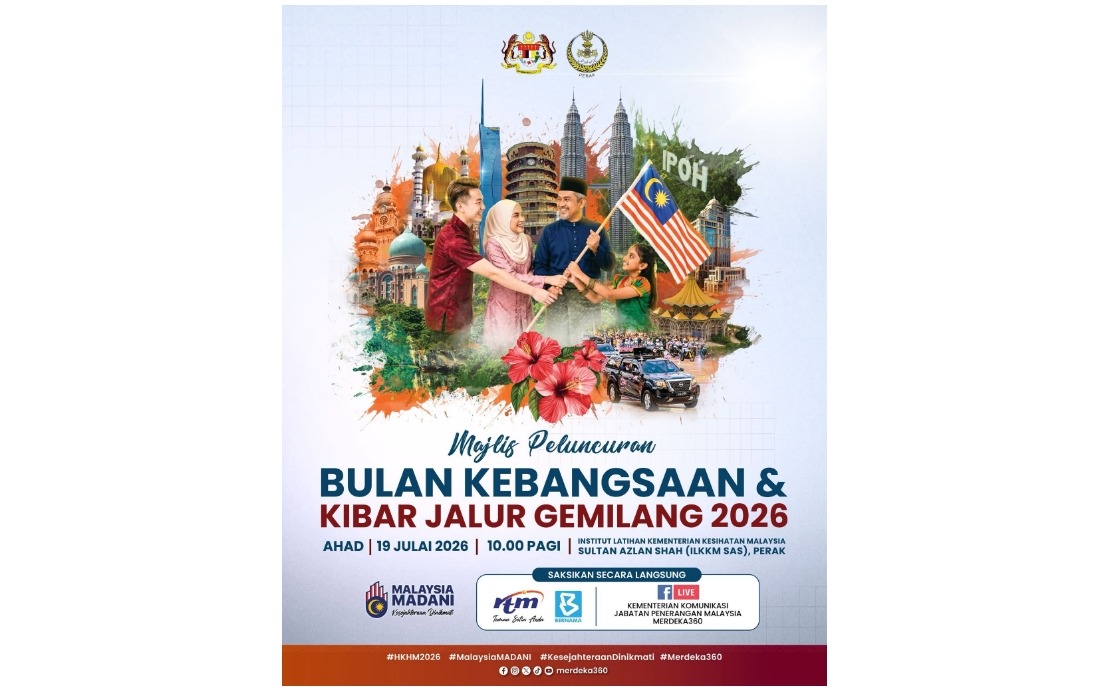
The official launch of Malaysia's National Month 2026 campaign and the Fly the Jalur Gemilang initiative will take place on July 19 at Institut Latihan Kementerian Kesihatan Malaysia Sultan Azlan Shah in Perak, signalling the beginning of the year's national celebrations. Beginning at 10 am, the ceremony will reach audiences nationwide through live broadcasts on Radio Televisyen Malaysia, BERNAMA TV, and simultaneous streaming across the Merdeka360, Ministry of Communications and Department of Information Malaysia social media channels, ensuring accessibility for all Malaysians regardless of location.
The launch represents a coordinated national effort to foster patriotic sentiment among citizens in the lead-up to the country's major national commemorations. The government has selected the theme "Malaysia MADANI: Kesejahteraan Dinikmati" to underscore its vision for the 2026 National Day and Malaysia Day festivities, with the Malaysia MADANI logo retained as the official visual identity throughout the year. This thematic choice deliberately connects the celebrations to the broader Malaysia MADANI framework, which has become the centrepiece of the current administration's policy agenda.
The chosen theme carries substantial symbolic weight, extending beyond conventional patriotic messaging to articulate the government's developmental philosophy. By emphasising "prosperity enjoyed" — the English translation of "Kesejahteraan Dinikmati" — Malaysian policymakers are signalling that economic growth and national advancement must translate into tangible benefits reaching all segments of society. The underlying philosophy grounded in values of justice, humanity and public welfare reflects a deliberate positioning of national development as inclusive rather than concentrated, addressing longstanding concerns about wealth distribution and equitable access to opportunity across Malaysia's diverse population.
The launch ceremony will distribute official logos, patriotic musical compositions and comprehensive promotional materials through the Merdeka360.my digital platform, enabling state governments, local authorities, schools, corporations and community organisations to access standardised resources for their own National Month observances. This decentralised approach allows grassroots participation while maintaining consistency in messaging and visual presentation across the federation, a particularly important consideration in Malaysia's federal system where state-level autonomy must be balanced against national cohesion.
Communications Minister Datuk Seri Fahmi Fadzil has already outlined the scale and location of the principal national celebrations. The 2026 National Day festivities on August 31 will unfold at Dataran Putrajaya, intentionally calibrated to balance ceremonial significance with budgetary restraint during what remains a challenging economic environment for many households. This measured approach represents a conscious pivot from increasingly lavish national celebrations in previous years, reflecting both fiscal prudence and a recognition that patriotic expression need not depend on extravagant expenditure.
Malaysia Day 2026 on September 16 will shift the celebratory spotlight to Sarawak, a strategic decision that reinforces the constitutional partnership between Peninsular Malaysia and the East Malaysian states. This rotation of venue recognises Sarawak's unique historical position in the Malaysian federation and reinforces national unity by demonstrating that major state commemorations acknowledge regional contributions and identities. The choice also carries political significance in a federation where East Malaysian concerns about marginalisation periodically surface in national discourse.
To sustain enthusiasm throughout the National Month period, the government has choreographed seven complementary programmes and patriotic activities across the country. Kembara Bahasa HKHM will promote the national language as a unifying element, while Quran Hour caters to the Muslim majority's religious observance. Ambang Merdeka and Merdeka Countdown will build temporal momentum toward the main celebrations, RIUH Merdeka promises cultural entertainment and engagement, and the National Statesmen Commemoration Ceremony will honour historical figures whose contributions shaped independent Malaysia. This multifaceted programming strategy acknowledges that national identity is neither monolithic nor static, but rather a composite of linguistic, religious, cultural and historical elements requiring periodic reinforcement and celebration.
For Malaysian audiences, these celebrations carry particular resonance given ongoing conversations about national unity and social cohesion. In an increasingly polarised political environment where partisan divisions sometimes override national sentiment, coordinated campaigns to emphasise shared patriotic identity serve an important function. The emphasis on prosperity being enjoyed comprehensively by all Malaysians addresses anxieties about economic inequality and social fragmentation, positioning National Month as an opportunity to reaffirm collective commitment to inclusive development.
Regionally, Malaysia's National Month celebrations attract interest from other Southeast Asian nations navigating similar challenges of maintaining national identity amid globalisation and internal diversity. The Malaysia MADANI framework has become an export of sorts, with elements of the philosophy discussed in regional forums and bilateral discussions. How Malaysia articulates and executes its vision for inclusive development through such national campaigns influences regional perspectives on governance, prosperity and the appropriate relationship between state and citizenry.
The digital-first approach to distributing campaign materials through Merdeka360.my reflects evolving communication strategies in Malaysia's government apparatus. Rather than relying primarily on traditional media or top-down distribution, the platform democratises access to promotional resources, enabling stakeholders at every level to participate in nation-building activities using standardised, professionally designed materials. This approach particularly resonates with younger Malaysians who increasingly consume patriotic content through digital platforms rather than conventional broadcasting.
As the National Month campaign unfolds from its July 19 launch through August and September celebrations, its success will partly depend on how effectively participating organisations translate the Malaysia MADANI framework into visible, tangible expressions of patriotism that resonate with ordinary Malaysians. The coordination between federal agencies, state governments and community groups will test Malaysia's capacity for cohesive national messaging while respecting local autonomy and cultural particularity. In a federation as diverse and complex as Malaysia, such delicate balance-seeking remains perpetually necessary and perpetually challenging.

