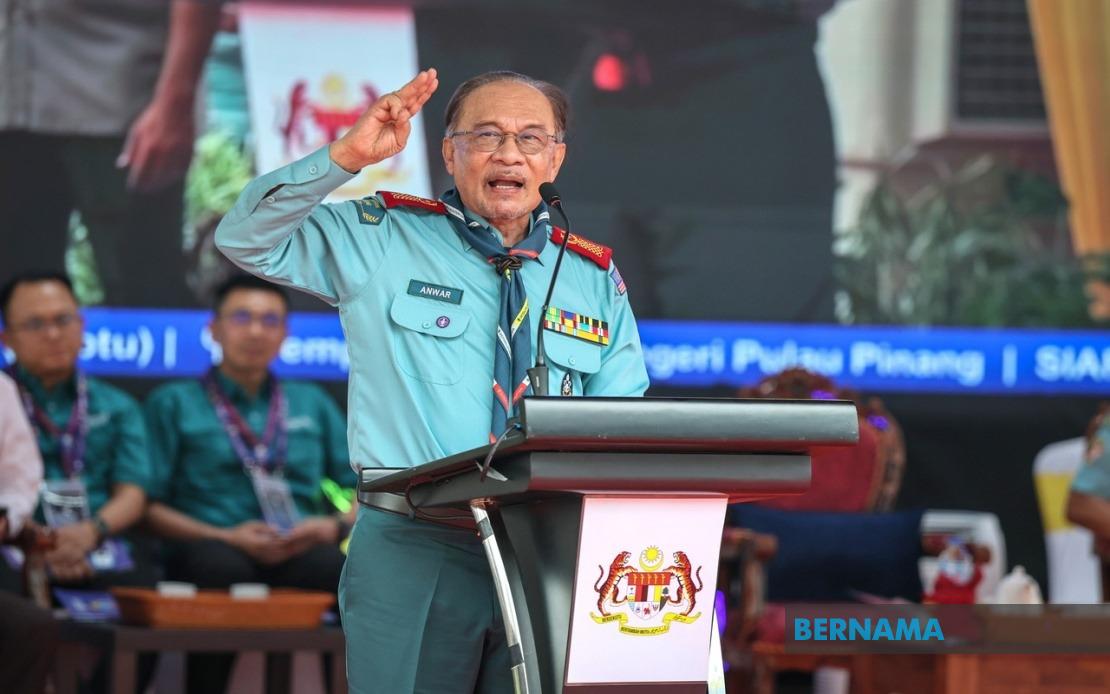
Prime Minister Datuk Seri Anwar Ibrahim has articulated a vision of national progress that extends well beyond conventional measures of economic and technological achievement, arguing instead that Malaysia's long-term success depends fundamentally on cultivating a generation of young people who combine intellectual rigour with moral discipline and social responsibility. Addressing the opening ceremony of the 15th Malaysian Scouts Jamboree at Penang State Stadium, Anwar framed the development of human character as equally critical to the accumulation of material wealth or technological capability, challenging a purely GDP-focused narrative that has long dominated development discourse in the region.
The Prime Minister's remarks underscore a growing concern among policymakers across Southeast Asia about the adequacy of traditional education systems in preparing young people not merely as workers or consumers, but as citizens capable of navigating complex social challenges. Anwar contended that institutions of learning—whether schools, polytechnics, or universities—serve a purpose that transcends the transmission of technical knowledge, functioning instead as incubators for individuals who can balance personal ambition with broader obligations to family, community and nation. This framing signals a deliberate reorientation of the national education narrative toward what might be termed "civic humanism," positioning moral development and values formation as inseparable from skills acquisition.
The context for Anwar's intervention becomes clearer when examined against Malaysia's contemporary demographic and social landscape. The country faces the dual challenge of managing rapid technological disruption while maintaining social cohesion across its multiethnic fabric. Young Malaysians, increasingly exposed to borderless digital environments and global cultural influences, risk becoming untethered from the traditional moorings that have historically anchored national identity and intergenerational continuity. Anwar's emphasis on instilling "spirit, education, discipline and love" represents an attempt to articulate a framework through which technological progress and cultural preservation might be harmonized rather than treated as opposing forces.
The Prime Minister specifically highlighted the tension between technological advancement and cultural rootedness as a defining challenge for the emerging generation. He warned that the rapid evolution of information technology and artificial intelligence, while presenting unprecedented opportunities, poses a risk of cultural erosion if not accompanied by deliberate efforts to reinforce local values and heritage. This observation carries particular resonance in Malaysia, where rapid urbanization and digital adoption have already visibly strained traditional social structures and intergenerational transmission of cultural knowledge. Anwar's implicit argument is that adapting to technological change need not mean abandoning the foundational values that constitute Malaysian identity.
The selection of the Malaysian Scouts Jamboree as the platform for these remarks reflects a strategic appreciation for the symbolic role such organizations play in youth formation. The jamboree, which convenes over 5,450 scouts from Malaysia and ten other nations including South Korea, Indonesia, Singapore and Sri Lanka, embodies precisely the kind of structured environment designed to instil discipline, service orientation and cross-cultural understanding. By delivering his message within this context, Anwar anchored his philosophical position to a concrete institutional practice, suggesting that the scouting movement's emphasis on character development and civic engagement offers a proven model for the kind of youth formation Malaysia requires.
The jamboree's return to Penang carries historical significance that amplifies Anwar's message. The event had not been held in the state for six decades, since Teluk Bahang hosted the inaugural gathering in 1966. This 60-year interval spans Malaysia's transformation from a newly independent nation consolidating its identity to a middle-income country grappling with questions of social cohesion and cultural continuity in an increasingly globalized environment. The symbolic resonance of bringing the jamboree home to Penang, particularly as Malaysia approaches its 2026 National Day celebrations, suggests an intentional effort to reconnect contemporary youth with the nation's foundational values during a period of significant political and social recalibration.
Anwar's emphasis on fostering unity in diversity assumes particular importance given his positioning of the younger generation as custodians of Malaysia's future leadership. The Prime Minister's implicit message is that the heterogeneity of the Malaysian population—a defining feature of the nation since independence—requires not merely constitutional accommodation or political management, but active cultivation of values that transcend ethnic and religious boundaries. Young people must internalize not simply the legal framework of national unity but the deeper cultural and philosophical commitments that make such unity meaningful. This framing positions values education not as an optional enrichment but as foundational infrastructure for national stability.
The call for sustained nurturing of patriotic sentiment ahead of Malaysia's approaching 2026 National Day represents a forward-looking dimension of Anwar's intervention. By explicitly linking youth development to preparedness for future challenges, the Prime Minister acknowledges that the nation faces tests whose precise nature remains unknowable, requiring adaptability rooted in stable core values rather than rigid adherence to predetermined responses. This formulation suggests confidence that a generation properly grounded in character and values will possess the resilience and wisdom necessary to navigate unforeseen obstacles while maintaining essential continuities.
From a Southeast Asian perspective, Anwar's discourse reflects broader regional anxieties about the adequacy of development models that prioritize economic growth and technological modernization without attending to social fabric and cultural continuity. Malaysia's experience as a multiethnic, multireligious society offers particular insights relevant to neighbouring nations confronting similar tensions between modernization and cultural preservation. The Prime Minister's articulation of a development philosophy that treats moral formation as indispensable rather than supplementary positions Malaysia as a contributor to regional thinking about sustainable and inclusive progress.
The presence at the jamboree of Chief Minister Chow Kon Yeow and Chief Scout Datuk Prof Dr Mohd Zin Bidin reflected the multisectoral alignment required to operationalize Anwar's vision. Youth development cannot be entrusted solely to formal educational institutions but requires coordination across government, civil society, cultural organizations and community structures. The composition of attendees at the jamboree opening suggested recognition that this agenda transcends partisan political boundaries, appealing instead to broader consensus about national values.
The international participation in MYJAM15, bringing scouts from eleven countries to Penang, creates opportunities for Malaysian youth to develop cross-cultural competence while reinforcing awareness of their own cultural identity through encounter with others. This experiential learning complements Anwar's philosophical argument that authentic cultural rootedness enhances rather than impedes engagement with the wider world. Young Malaysians who understand and appreciate their own traditions acquire frameworks for understanding and respecting traditions different from their own, creating interpersonal foundations for regional cooperation and understanding.
Looking forward, the implementation of Anwar's vision will require sustained commitment beyond rhetorical affirmation. Translating the principle that moral development and discipline constitute essential components of national progress into concrete institutional reforms, curriculum redesign, and resource allocation represents a substantial undertaking. The success of this endeavor will significantly influence not only Malaysia's internal social cohesion but also its capacity to exercise regional leadership in articulating development models that integrate material progress with values preservation and civic responsibility.

